

Original articles & blog content. Written, illustrated and published, on auto-pilot.
Our Content Engine learns your business, writes articles in your voice with custom images, and publishes them to your WordPress site on a schedule you set. Your blog stays active and Google keeps noticing, without you writing a word. Try the whole system with 3 free articles: no card, no commitment.
Try it free: 3 articles, written for your business
Enter your web address and email. We analyse your site, find the topics your customers search for, and write your first articles free.
Your blog pipeline at a glance
Runway, cadence, credits, what's scheduled, everything in one place. No spreadsheets, no calendars, no chasing freelancers.
Buy credits as you go, or subscribe for full autopilot
Either way, you get the same volume discounts and the same article quality. The choice is whether you want a monthly rhythm we manage for you, or to top up as the mood takes you.
Buy credits when you want them
Top up your balance whenever, spend the credits however. No monthly commitment, no auto-renewal, no surprises.
- Buy in bulk, get a deeper discount. Same tier ladder as subscriptions.
- Credits never expire. Spend them next week or next year.
- Buy 1 to 100 credits at a time. From £5 down to £1.75 each.
- Switch on Auto mode any time, your credits power it just the same.
Pick a monthly volume, we do the rest
Choose how many articles you want each month. We top up your credits at every renewal and Auto mode publishes them to your site on the cadence you chose, without you lifting a finger.
- Full hands-off Auto mode runs on your subscription credits.
- Higher volumes get bigger discounts, same ladder as pay-as-you-go.
- Adjust your monthly quantity any time, Stripe prorates fairly.
- Unspent credits roll over. No "use it or lose it" each month.
6 Reasons You Need Fresh Content, Now More Than Ever!
Google has changed. AI search has changed everything else. A dead blog doesn't just stagnate any more, it actively costs you visibility. Here's why posting regularly on your website is no longer optional!
Google rewards sites that publish
Search engines have always favoured sites that show signs of life. Sites publishing original content monthly consistently out-rank otherwise-identical sites that don't. Stop publishing and you slide down the rankings, even if your old posts were great.
AI search can't quote a blank page
ChatGPT, Perplexity, Google's AI Overviews, all of them cite recent, well-structured articles. Every week without new content is another week you're invisible to the fastest-growing slice of search traffic.
Topical authority compounds
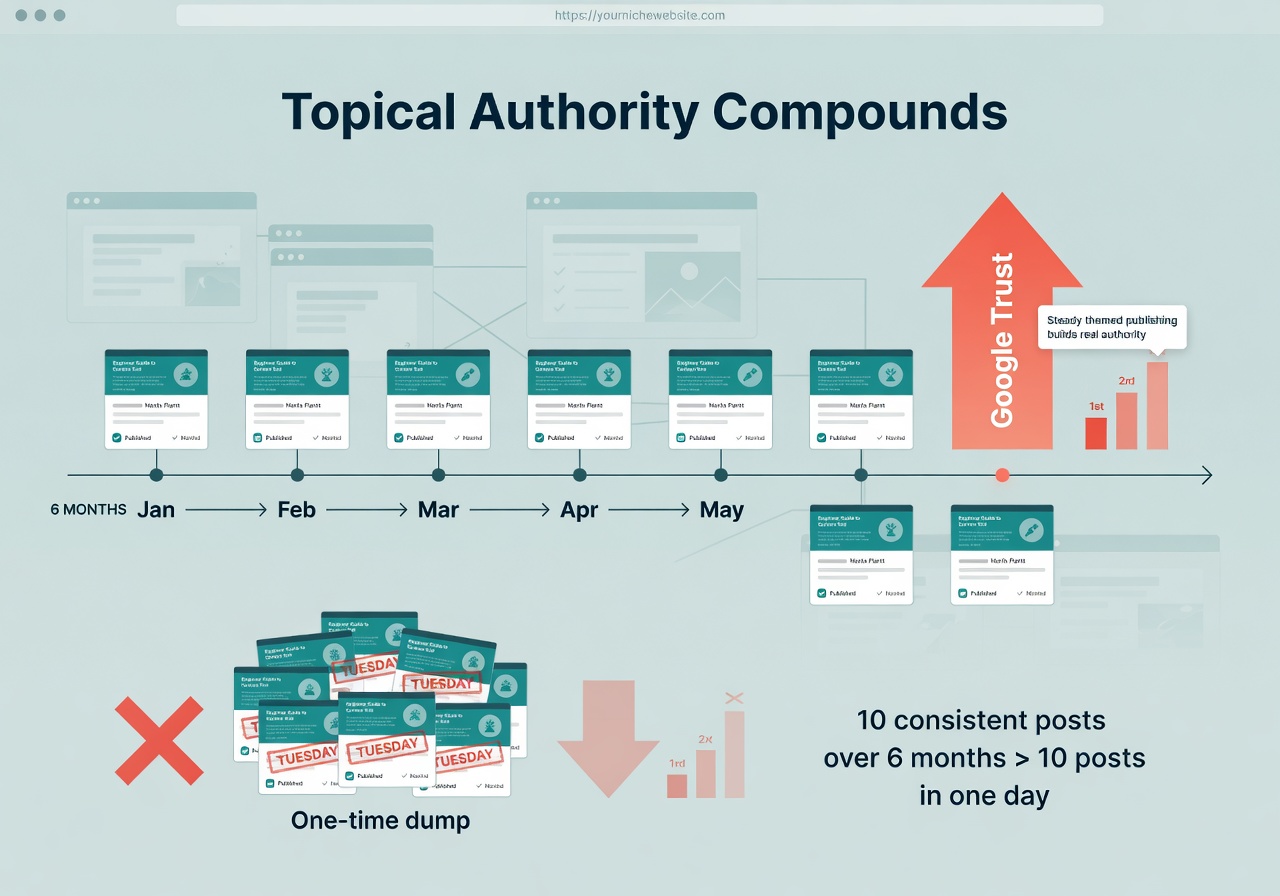
Google trusts sites that consistently cover a niche. Ten posts on related topics over six months outperform ten posts dumped on one Tuesday. Steady, themed publishing is how you build real authority.
Long-tail traffic adds up fast
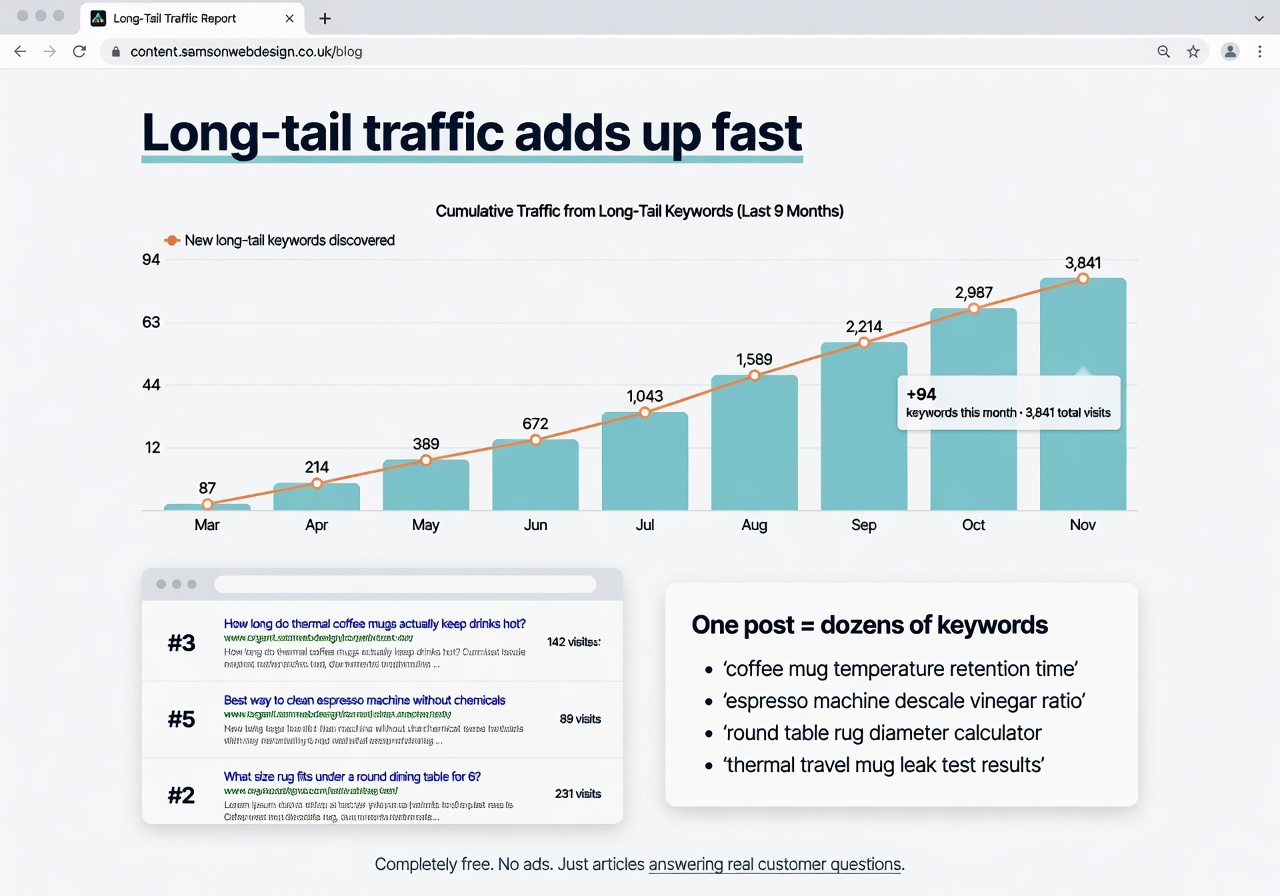
Every article ranks for keywords you'd never think to target, the specific questions your customers type into Google. One post can pull in dozens of search terms over time, completely free.
A dead blog kills trust instantly
Visitors see "last post: 2022" and assume you're out of business. Up-to-date content signals an active, growing operation. It's a five-second trust check before they even read what you wrote.
Posts are assets, not expenses
Ads stop the second you stop paying. Articles keep earning traffic for years. A consistent weekly rhythm builds a compounding library that pays you back long after the post was published.

Search engines have always favoured sites that show signs of life. Sites publishing original content monthly consistently out-rank otherwise-identical sites that don't. Stop publishing and you slide down the rankings, even if your old posts were great.

ChatGPT, Perplexity, Google's AI Overviews, all of them cite recent, well-structured articles. Every week without new content is another week you're invisible to the fastest-growing slice of search traffic.
Google trusts sites that consistently cover a niche. Ten posts on related topics over six months outperform ten posts dumped on one Tuesday. Steady, themed publishing is how you build real authority.
Every article ranks for keywords you'd never think to target, the specific questions your customers type into Google. One post can pull in dozens of search terms over time, completely free.

Visitors see "last post: 2022" and assume you're out of business. Up-to-date content signals an active, growing operation. It's a five-second trust check before they even read what you wrote.

Ads stop the second you stop paying. Articles keep earning traffic for years. A consistent weekly rhythm builds a compounding library that pays you back long after the post was published.
Try it without paying a penny
3 fully-written articles, in your voice, on us. See if it's worth it before you spend anything. No card, no commitment, no obligation.
Real articles written and published by Content Engine
A live sample of articles the Content Engine has written and pushed to customer sites. Click any of them to read the full article and judge the quality before you sign up.
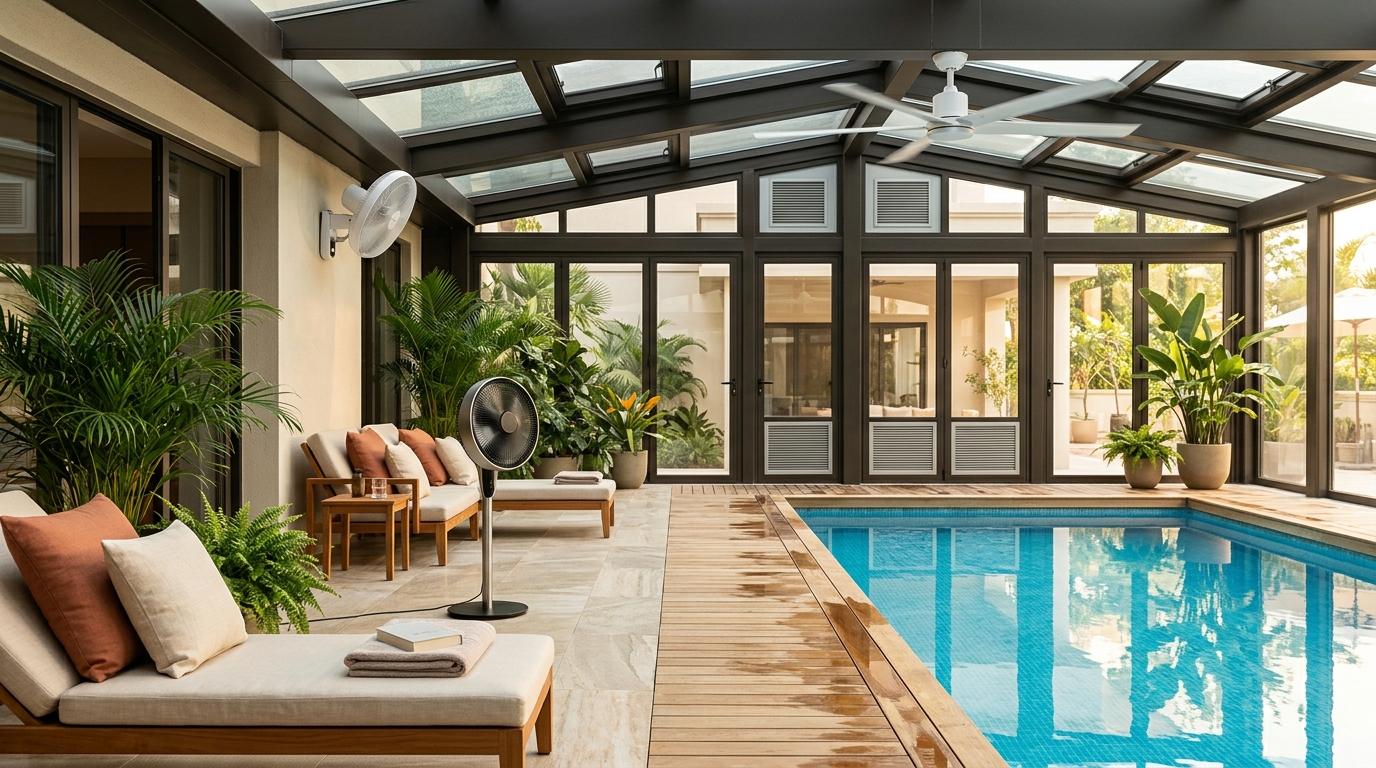
Poolside Comfort Tech: Fans, Ventilation, and Climate Control Inside Your Pool Enclosure
A pool enclosure transforms your outdoor space into a year-round retreat. But anyone who has spent time inside a glazed aluminium structure on a warm afternoon knows the challenge: heat builds up fast, humidity can climb, and without the right airflow, comfort suffers. Getting the climate right inside an enclosure is not just about luxury. It is about protecting the structure, preserving water quality, and making sure you actually want to use the space.
The good news is that there is now a wide range of ventilation solutions and air circulation technology that are well suited to enclosed pool environments. Some are built into the enclosure design itself. Others are standalone additions you can retrofit. Here is how to think about it.
Why Air Circulation Matters More Than Cooling
In a standard living room, a fan simply keeps you cool. Inside a pool enclosure, the job is more demanding. Evaporating pool water constantly adds moisture to the air. Without sufficient circulation, that humidity settles on glazing panels, aluminium frames, and any furniture or equipment stored inside. Over time, persistent condensation accelerates corrosion and creates conditions for mould.
This means the priority is not just temperature reduction. It is moving and renewing the air continuously. A well-ventilated enclosure should be exchanging its internal air regularly, drawing warm humid air out and pulling fresher, drier air in. Cooling is a secondary benefit that follows naturally from good ventilation design.
Built-In Ventilation: The Foundation
The most effective approach starts at the design stage. Arch Enclosures structures include integrated ventilation panels and operable roof sections that allow passive airflow when the weather permits. On milder days, simply opening the right combination of panels can create a natural chimney effect, where warm air rises and escapes through the roof while cooler air enters at lower levels.
For domestic enclosures, this passive system is often sufficient across spring and autumn. During peak summer, or in particularly humid climates, you will want to supplement it with active circulation. This is where fans and mechanical ventilation come in.
Choosing the Right Fan for an Enclosed Pool Space
Not every fan is suited to a poolside environment. The key criteria are different here compared to choosing a bedroom fan or home office model. You need to think about:
- Moisture resistance: Fans rated for damp or humid environments are essential. Look for IP-rated models where possible, or at minimum fans from manufacturers who specify humidity tolerance.
- Consistent airflow at low noise: Pool spaces are social and relaxing. A fan running at a roar defeats the purpose. Models like the Dreo Smart Tower Fan Pilot Max S, which Forbes Vetted named a top overall pick for 2026, deliver 12 fan speeds and run notably quietly, making them a strong candidate for enclosure use.
- Oscillation range: A wide oscillation arc distributes air across the full width of the space rather than creating one cold tunnel and leaving the rest stagnant.
- Smart controls: Timer functions, app connectivity, and auto modes let you schedule the fan to run during peak heat hours without manual intervention. For a pool enclosure you may not visit every day, this is genuinely useful.
Tower fans work particularly well in enclosures because their vertical form factor moves air across a tall column, which helps counteract the tendency for warm air to stratify at roof level. The Dyson Pure Cool TP07, reviewed by CNET as a comfortable and steady performer, adds HEPA air purification to the mix, which can help manage any airborne pool chemical particles in a sealed environment.
Mechanical Ventilation: When You Need More Than a Fan
For larger or more permanently glazed enclosures, passive ventilation and portable fans may not be sufficient on their own. A mechanical heat recovery ventilation (MHRV) system is the next step up. These units extract humid internal air while recovering most of the heat from it before exhausting it outside, then supply fresh filtered air back in. The result is controlled humidity, good air quality, and minimal heat loss.
MHRV systems are well established in pool hall design for commercial leisure centres, and scaled-down domestic versions are increasingly accessible. They are typically wall-mounted, relatively unobtrusive, and can be integrated into an enclosure during installation or retrofitted later. If you are swimming daily and the enclosure is closed for much of the year, the investment pays back in lower corrosion maintenance and a consistently more comfortable environment.
Managing Temperature as Well as Humidity
Once airflow is sorted, temperature control is the next consideration. For most UK enclosure owners, the goal is not aggressive cooling but moderation: preventing the space from becoming uncomfortably hot in July and keeping it usable into October without excessive heating bills.
A few practical approaches that work well alongside good ventilation include:
- Thermal glazing panels: Specified at the build stage, these reduce solar heat gain without compromising light transmission significantly.
- Retractable shade: Internal or external blinds on south-facing panels can cut peak afternoon temperatures noticeably.
- Pool covers: Keeping the pool surface covered when not in use reduces evaporation and therefore reduces the humidity load on your ventilation system, which in turn reduces the amount of work your fans need to do.
- Supplementary heating: Infrared panel heaters or small electric radiators can extend the comfortable season into winter without the complexity of ducted systems.
A Practical Checklist for Getting It Right
If you are planning a new enclosure or upgrading an existing one, here is a sensible order of priorities:
- Confirm that the enclosure design includes adequate passive ventilation openings at both low and high levels.
- Add at least one good quality tower fan or ceiling-mounted circulation fan for active airflow during peak use periods.
- Consider an MHRV unit if the enclosure will be heavily used or closed for extended periods.
- Use a pool cover consistently to manage the humidity source at its origin.
- Review glazing and shading options if solar heat gain is a problem in your specific orientation.
Getting the climate inside an enclosure right is not a single product decision. It is a layered system where each element supports the others. The enclosure structure provides the foundation, ventilation manages the humidity, fans distribute the air, and shading handles peak solar gain. Put those pieces together and you have a space that is genuinely comfortable to swim in through twelve months of the year, not just the three or four when the weather cooperates.
If you would like advice on ventilation specifications for a specific Arch Enclosures structure, our team can walk you through the options as part of the design consultation process.
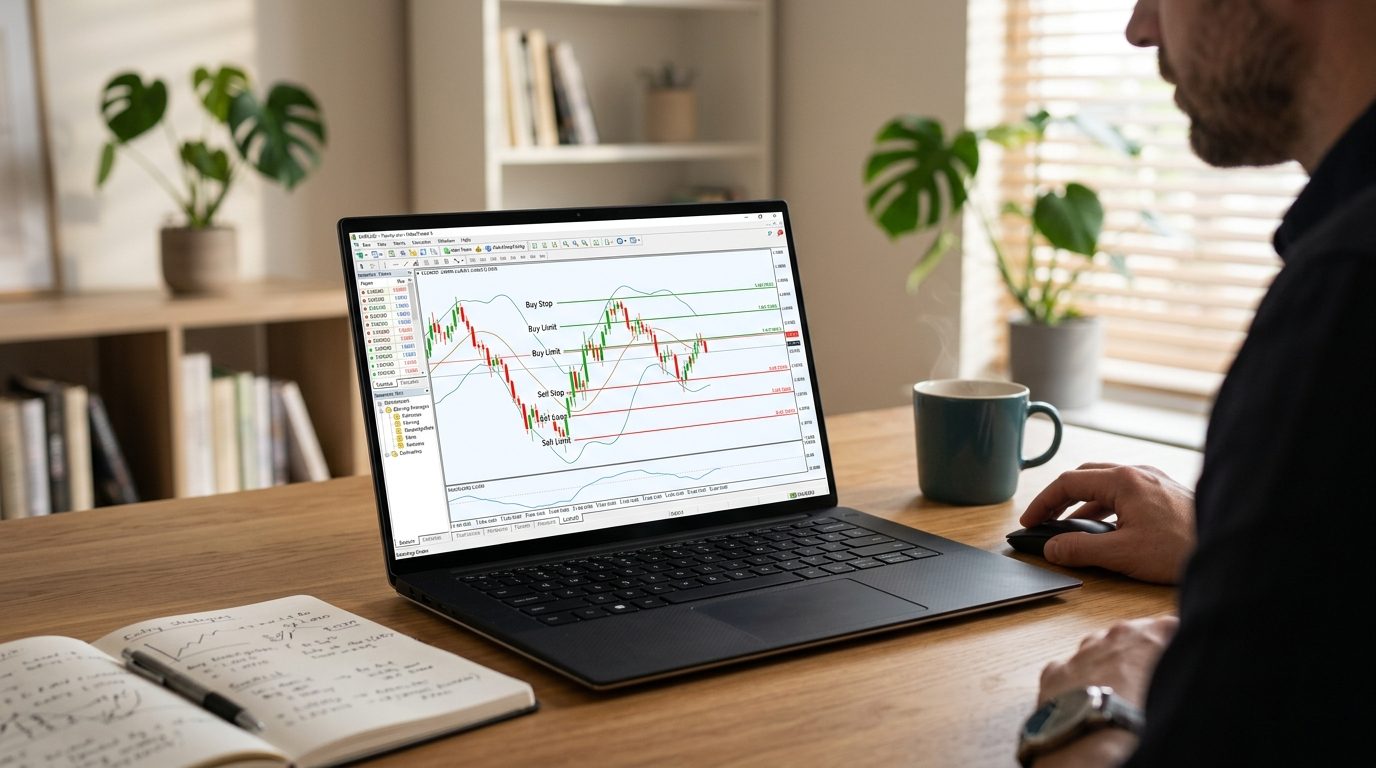
Pending Orders Mastery: Buy Stop, Buy Limit, Sell Stop, Sell Limit Logic for Automated MT4/MT5 Setups
Most traders lose money not because their analysis is wrong, but because their execution is sloppy. They hesitate at the entry, chase price, or sit glued to a screen waiting for a setup that may never materialise during their session. Pending orders solve all three problems at once.
In MT4 and MT5, a pending order is a standing instruction to your broker: execute this trade when price reaches a specific level. You set the logic in advance, walk away, and the platform handles the rest. Understanding which order type to use in which situation is what separates traders who consistently get filled at good prices from those who perpetually enter late.
The Four Core Pending Order Types
MT4 offers four pending order types. MT5 extends this to six (adding Buy Stop Limit and Sell Stop Limit), but the four core types are the foundation of almost every automated setup you will build. Each one has a precise definition that controls when and how it fires.
- Buy Limit: an instruction to buy at a specified price that is equal to or lower than the current Ask price. You expect price to drop to your level before reversing upward.
- Buy Stop: an instruction to buy at a specified price that is equal to or higher than the current Ask price. You expect price to break above your level and continue higher.
- Sell Limit: an instruction to sell at a specified price that is equal to or higher than the current Bid price. You expect price to rally to your level before reversing downward.
- Sell Stop: an instruction to sell at a specified price that is equal to or lower than the current Bid price. You expect price to break below your level and continue lower.
The distinction between Limit and Stop orders comes down to one question: are you fading price movement to get a better entry, or are you joining price movement as it breaks through a level? Limit orders fade. Stop orders follow breakouts.
Buy Limit and Sell Limit: Entering at Value
Limit orders are the natural tool for pullback traders and anyone who works from identified support and resistance zones. If EUR/USD is trading at 1.0850 and you have identified a demand zone at 1.0800, you place a Buy Limit at 1.0800. Price has to come down to you. Your fill will always be at 1.0800 or better, never worse.
In a market structure context, Buy Limits belong at:
- Swing lows that have been confirmed as higher lows in an uptrend
- Previous areas of consolidation that broke to the upside (now acting as support)
- Fibonacci retracement levels aligning with a structural pivot
- Order blocks on the M15 or H1 that sit inside a higher-timeframe bullish trend
Sell Limits work identically but in reverse. If GBP/USD is at 1.2600 and a supply zone sits at 1.2680, you set a Sell Limit at 1.2680. You are selling into strength, at a level where you believe institutional selling will overwhelm retail buying pressure.
The advantage here is stark: you get a better average entry price than a trader who waits for confirmation and enters at market. The trade-off is that price may not return to your level at all, and the order expires unfilled. Set an expiry time on every limit order to avoid stale orders cluttering your terminal days later.
Buy Stop and Sell Stop: Trading Breakouts with Precision
Stop orders flip the logic entirely. You are not waiting for price to come back to you. You are saying: if price reaches this level, that itself is confirmation, so get me in immediately.
A Buy Stop above a swing high is the cleanest breakout entry tool available. Suppose the S&P 500 (US500) has been consolidating between 5,100 and 5,150 for three sessions. You identify 5,152 as the breakout level, just beyond the cluster of swing highs. A Buy Stop at 5,152 fires the moment Ask price tags that level, entering you into the breakout move without requiring you to watch the screen at the precise moment price accelerates.
Sell Stops work the same way on the downside. A key support at 1.0750 on EUR/USD that you expect to break becomes a natural Sell Stop placement. When Bid price reaches 1.0750, the order executes and you are short into the continuation move.
The practical risk with stop orders is slippage during fast-moving markets. In thin liquidity or around high-impact news, price can gap through your level, and you get filled several pips beyond where you intended. For this reason, some traders avoid stop orders around major news events and prefer to be flat or already positioned beforehand.
Building a Full Trade Plan with Pending Orders
The real power of pending orders appears when you combine them with your stop loss and take profit levels at the point of order placement. In MT4 and MT5, you set all three values simultaneously: the entry level, the stop loss, and the take profit. Once the pending order triggers and becomes a live trade, the stop and target are already active.
A clean workflow for a market structure reversal setup looks like this:
- Identify the higher-timeframe trend direction and the last significant swing point.
- Mark the pullback zone where you want to re-enter in trend direction (this becomes your limit order level).
- Define your invalidation level (stop loss) below the swing low for longs, above the swing high for shorts.
- Set a take profit at the next structural target, typically the prior swing high for longs.
- Place the Buy Limit or Sell Limit with all three fields populated.
- Set an expiry, usually 24 to 48 hours, or aligned with a specific session end.
Now you can close MT4, step away from the terminal, and the setup either triggers cleanly or it doesn't. There is no temptation to move the entry because price got close, no second-guessing the stop placement under live pressure.
Common Mistakes That Kill Pending Order Setups
Even traders who understand the mechanics trip over execution errors that negate the whole advantage of pre-planned orders.
- Placing limits too close to current price: a limit entry needs breathing room. If your Buy Limit is only 5 pips below current price on a pair with a 20-pip average hourly range, it will trigger almost immediately and offer no improvement over a market order.
- No expiry on limit orders: a Buy Limit placed during a ranging phase that never gets swept can sit dormant, then fire days later during a completely different market context.
- Using a Buy Stop to buy into a liquidity void: if there is no real structural reason for the level, a stop entry into empty space just chases price at the worst possible moment.
- Forgetting to account for the spread: MT5 fills Buy Limit orders at Ask, and Sell Limit orders at Bid. On pairs with wide spreads, your effective entry is worse than the price you typed. Factor the spread into every pending order you place.
MT5 Additions Worth Knowing
If you trade on MT5, two additional order types are available: Buy Stop Limit and Sell Stop Limit. These are hybrid orders. A Buy Stop Limit triggers a Buy Limit order when price reaches the stop level, rather than executing immediately. This gives you a breakout trigger combined with a controlled fill price, useful when you want confirmation that a level has been breached but still want to buy a small pullback into the new breakout level rather than chasing the spike.
These are more advanced and less commonly used, but for traders running algorithmic strategies through Expert Advisors on MT5, they offer precise control over entry sequencing that simple stop or limit orders cannot match.
Putting It Together
Pending orders are not just a convenience feature. They enforce discipline by requiring you to define your trade plan completely before price gets anywhere near your level. By the time the market arrives at your order, the emotional content of the moment is removed. The order fires or it doesn't. You either get the trade you planned or you wait for the next setup.
That shift from reactive to pre-planned execution is one of the most consistent improvements active traders can make, and MT4/MT5 makes it straightforward. Get the four core order types into muscle memory, build them into every structural setup you identify, and let the platform do the work.
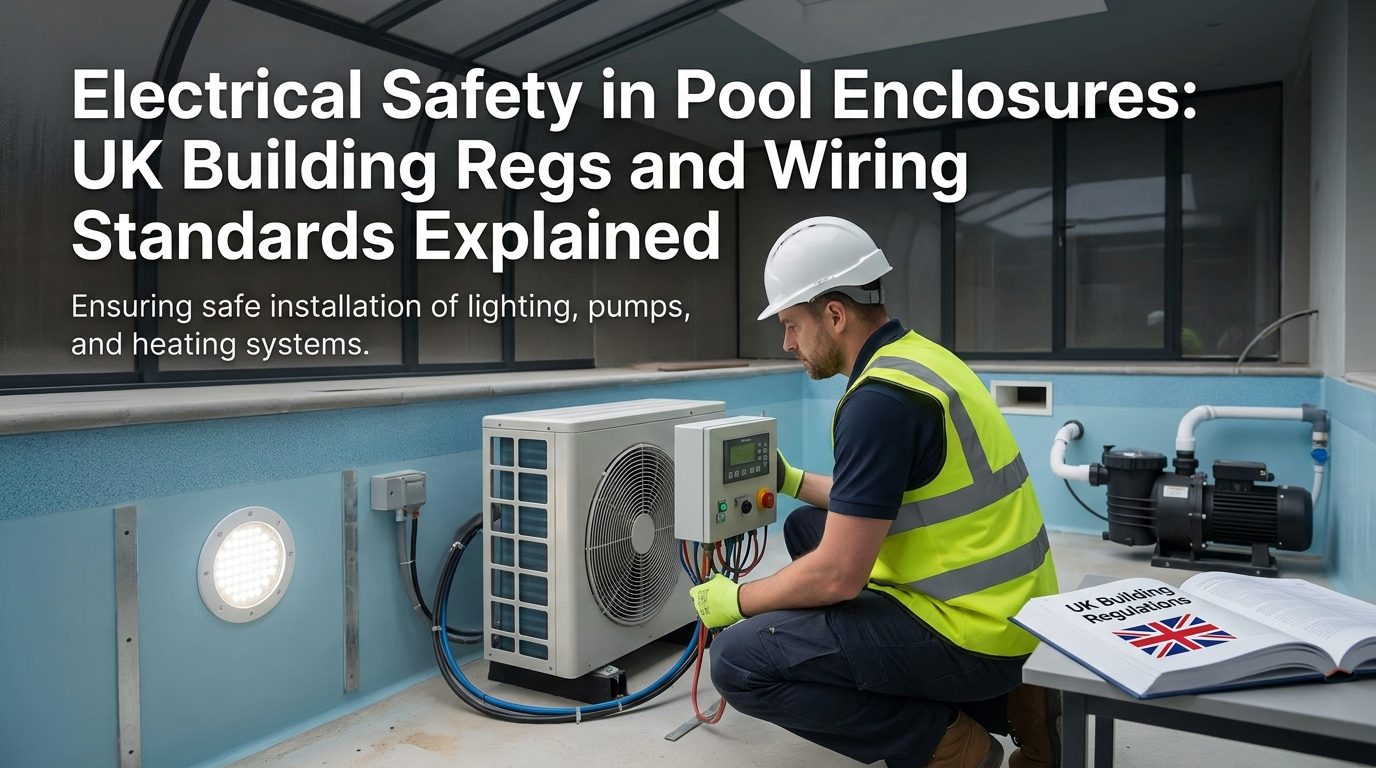
Electrical Safety in Pool Enclosures: UK Building Regs and Wiring Standards Explained
A standard outdoor pool is already a demanding electrical environment. Add an aluminium enclosure over it and you concentrate humidity, trap condensation, and bring conductive metalwork into continuous proximity with every circuit serving the water. That combination changes the risk profile considerably, and it changes the compliance obligations that go with it.
Most installation errors in pool environments are not the result of ignorance about electricity in general. They come from treating a pool enclosure like a damp outbuilding rather than recognising it as a distinct category with its own dedicated section of the wiring regulations. Understanding that distinction is where safe, certifiable work begins.
Why Pool Enclosures Create a Distinct Electrical Hazard Category
Water reduces human body resistance from around 100,000 ohms when dry skin contacts a source, down to as little as 1,000 ohms when the skin is wet. At mains voltage, that difference is the difference between a mild tingle and a fatal shock. Poolside, where people are barefoot, wet, and often gripping metal ladders or handrails, the conditions for maximum conductivity are almost always present.
An enclosure makes this worse in one specific way: it keeps surfaces wet. Condensation forms on glazed panels, on the aluminium frame, on junction box lids, and on cable runs that would dry out quickly in open air. A component rated for occasional splashing behaves very differently when it sits in near-constant high humidity for months at a stretch.
The common shock sources in pool facilities include underwater lighting, circulation motors, junction boxes, hydrotherapy equipment, exterior pool lights, timer controls, heaters, and electrically operated covers. Each of these is routinely present inside a domestic enclosure. A fault in any one of them, without proper protection, creates a hazard that can affect every surface in the structure simultaneously.
That last point is the one specific to enclosures rather than open pools. An aluminium frame is a continuous conductive structure. If a fault current finds its way into one section of that frame through a poorly terminated luminaire cable or a pump casing with degraded insulation, it can travel the full length of the structure. Anyone touching the frame while standing in or near the water completes a circuit. Without systematic bonding and earthing, the entire enclosure becomes a potential shock source rather than a protective shell.
This combination of factors is precisely why BS 7671:2018+A4:2026 dedicates Section 702 specifically to swimming pools, paddling pools, and fountain basins. The general installation rules in other parts of the standard are not sufficient on their own. Section 702 exists because the physics of this environment demands a separate set of requirements, and no amount of good general practice substitutes for following them explicitly.
BS 7671 Section 702: The Zones That Govern Every Circuit Decision
Section 702 structures the entire pool environment into three zones, each defined by its distance from the water. The zone classification is not a rough guide: it determines which equipment is permitted, which IP ratings are mandatory, and where sockets and switches can legally be placed. Every circuit decision inside an enclosure should start with identifying which zone the relevant part of the installation occupies.
Zone 0, Zone 1, and Zone 2: What They Mean in Practice
Zone 0 is the water itself. Any electrical equipment installed here, typically underwater lighting, must operate on SELV circuits at a maximum of 12 V AC or 30 V DC. The transformers supplying those circuits must sit outside Zone 1 entirely. Zone 0 requires IPX8 ingress protection, meaning the equipment must withstand continuous immersion. There is no flexibility on this.
Zone 1 extends 2 metres horizontally from the pool edge and 2.5 metres vertically above the water surface. Inside a standard domestic enclosure, this zone covers most of the usable floor area around the pool. SELV circuits remain the preferred supply here. Certain fixed equipment specifically designed and rated for Zone 1 use, such as dedicated pool pump units and water heaters, is permitted, but general-purpose electrical equipment is not. The IP rating requirement here is IPX5, meaning protection against low-pressure water jets from any direction.
Zone 2 extends a further 1.5 metres beyond the outer boundary of Zone 1. In a modest-sized enclosure, this may be a relatively narrow strip near the end walls or at the access points. Standard fixed equipment is permitted here provided it carries at least IPX4 protection against water splashing from any direction. The reduced IP requirement reflects the lower likelihood of direct water contact, but it is still a mandatory minimum, not a suggestion.
Sockets, Switches, and the 3.5 Metre Rule
No socket outlet may be installed within Zone 1. Any socket placed in Zone 2 must be protected by a 30 mA RCD. The practical convention used by most NICEIC-registered contractors working on compliant enclosure installations is to position all general-purpose sockets at least 3.5 metres from the pool edge where the layout allows, keeping them clear of Zone 1 with a meaningful margin rather than sitting exactly on the boundary.
This matters more inside an enclosure than it does in an open pool setting, because the enclosed footprint is often compact. In a telescopic enclosure covering a 6-metre pool, for example, a socket positioned 2.1 metres from the edge technically falls in Zone 2, but any movement of the pool structure or temporary equipment placed near the water could bring it into effective Zone 1 territory. Designing to the 3.5-metre rule from the outset avoids any ambiguity.
The April 2026 Amendment and Existing Installations
The BS 7671:2018+A4:2026 amendment, which came into force in April 2026, updated the broader wiring regulations framework. One of its practical consequences for pool enclosure owners is that any significant alteration to an existing installation triggers a requirement to review Section 702 compliance across the affected circuits. Adding an enclosure to a previously open outdoor pool almost certainly qualifies as a significant alteration.
This is relevant to homeowners who installed a pool several years ago under earlier versions of the regulations and are now adding an enclosure for year-round use. The enclosure changes the environment around the electrical installation materially: humidity increases, ventilation patterns change, and the frame introduces new conductive metalwork that must be bonded. An electrician signing off the enclosure installation cannot simply confirm the new structure is earthed and leave the existing pool circuits untouched. The interaction between the two must be assessed and documented. You can find further context on enclosure compliance requirements for UK homeowners planning this type of project.
Section 702 applies to permanent and semi-permanent paddling pools with electrically powered pumps, heaters, or lighting just as it does to built-in pools. Inflatable paddling pools with no electrical equipment at all are exempt, but the moment a pump or lighting system enters the picture, the full framework applies. There is no simplified version for smaller bodies of water.
Earthing, Bonding, and SELV: The Three Pillars of Safe Pool Wiring
Getting the zone classifications right tells you what equipment you can use and where you can put it. Earthing, bonding, and SELV supply are the three mechanisms that make the installation safe when something goes wrong. Each addresses a different failure mode, and none of them can substitute for the others.
Protective Equipotential Bonding
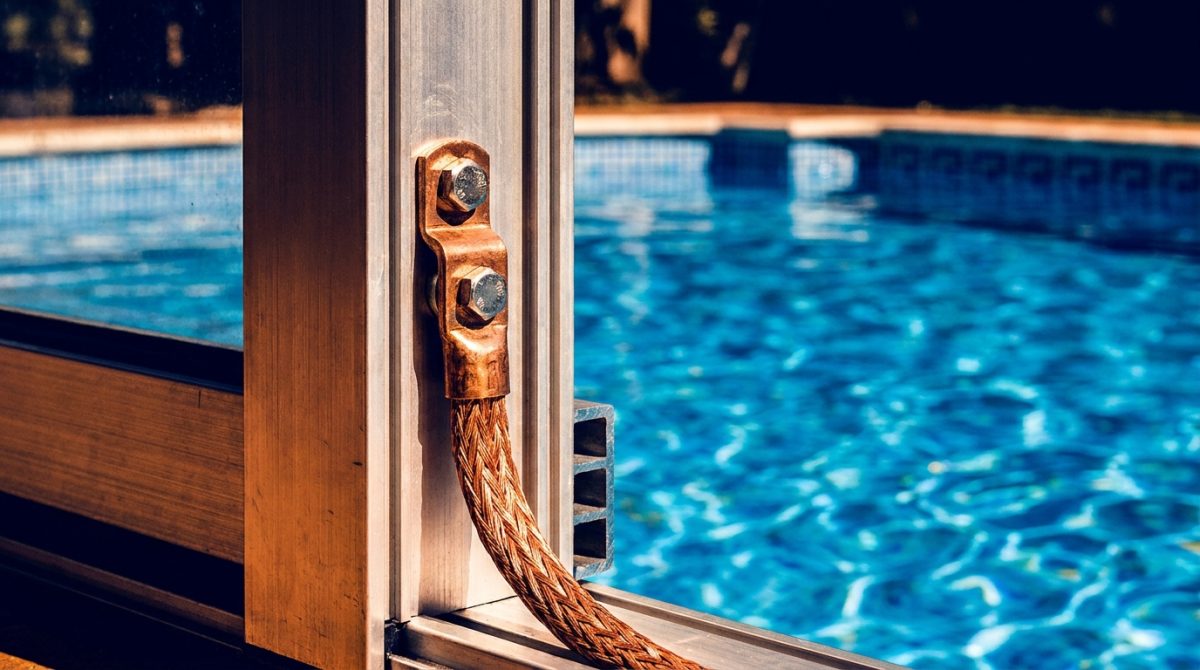
Equipotential bonding eliminates the voltage difference between simultaneously accessible metal surfaces. In a pool enclosure, that means connecting pool ladders, handrails, the aluminium frame, water supply and heating pipes, pump casings, and any other accessible metalwork to the main earthing terminal using copper conductors of at least 4 mm squared cross-section. The objective is straightforward: if a fault energises one metal surface, every other metal surface the swimmer could touch at the same time is at the same potential. No current flows through the body because there is no voltage difference to drive it.
This is not the same as simply earthing individual pieces of equipment, though that is also required. Bonding specifically addresses the simultaneous contact scenario, which is the one that kills people in pool environments. A swimmer holding a metal ladder while touching the pool wall, or a child climbing out of the water while resting a hand on the enclosure frame, both depend on equipotential bonding for their protection.
Arch Enclosures manufactures its aluminium frame sections with pre-drilled bonding lugs at regular intervals, which allows an electrician to make clean, secure connections without drilling through the structural profiles. Drilling through anodised aluminium to create a bonding point is not just inconvenient. It removes the corrosion-resistant surface at exactly the point where a dissimilar metal conductor is attached, accelerating local degradation over time. Factory-specified lugs avoid that problem entirely and make the bonding network easier to inspect and test during maintenance visits.
SELV Supply and Safety Isolating Transformers
SELV, Separated Extra-Low Voltage, is mandatory in Zone 0 and strongly preferred throughout Zone 1. A SELV circuit is supplied by a safety isolating transformer that provides galvanic separation from the mains supply. The secondary winding is not connected to earth, and the circuit voltage is capped at 12 V AC. Even if the insulation on a Zone 0 luminaire fails completely, the maximum voltage available to drive current through a swimmer's body is 12 V. That is not zero risk, but it is an entirely different order of magnitude from mains exposure.
The safety isolating transformer must be positioned outside Zone 1. For most domestic enclosures, this means siting it in a dedicated plant room, in a weatherproof enclosure mounted to the outer wall of the structure, or in a utility room with a cable run into the pool area. The transformer itself must carry a rating for continuous damp conditions. A transformer specified for a dry indoor environment will not perform reliably in the elevated humidity inside an enclosure, and a failed transformer in the plant room can leave pool lighting circuits either dead or, worse, falling back on an improvised supply that lacks the required separation.
RCD Protection and Device Type Selection
30 mA RCD protection is required for every circuit serving the pool area, regardless of zone. This is non-negotiable in BS 7671 Section 702 terms. What is worth careful thought, however, is the type of RCD selected when variable-speed pump drives or electronic heating controls are on the circuit.
Type AC RCDs detect sinusoidal AC fault currents. Many modern variable-speed pump motors and electronic thermostat controllers produce smooth DC components in their fault currents, which Type AC devices may not detect reliably. Type A RCDs respond to both AC and pulsating DC fault currents. NICEIC-registered contractors working on compliant pool enclosure installations routinely specify Type A as the default where any electronic control equipment is present on the circuit, rather than using Type AC and then adding the electronic equipment later.
After commissioning, a continuity test across the entire bonded network must be carried out and documented in the Electrical Installation Certificate. The acceptable result is a resistance of no more than 0.05 ohms between any two bonded points. If that figure is not achieved, the bonding connection at one or more points is inadequate, and the certificate cannot be issued. For homeowners considering the full scope of pool ownership responsibilities, the water safety habits that come with enclosure ownership extend well beyond the initial installation and into how the space is used and maintained day to day.
Lighting, Heating, and Pump Circuits Inside an Enclosure: Specification Choices That Matter
Getting the zone classification right on paper is one thing. Translating it into actual component selections and cable routes is where most mistakes occur, and where the cost of getting it wrong becomes very visible during an inspection.
Underwater and enclosure lighting
Underwater LED lighting running on 12 V SELV is the standard specification for Zone 0, and for good reason. At that voltage, even a fault condition cannot drive a lethal current through a swimmer. The detail that often gets missed, however, is the niche and conduit penetrating the pool wall. Both must be sealed with a purpose-made waterproof fitting rated IPX8, because water will track back along the cable by capillary action if the entry point is not properly sealed, carrying moisture directly into the transformer housing and causing early failure or a fault.
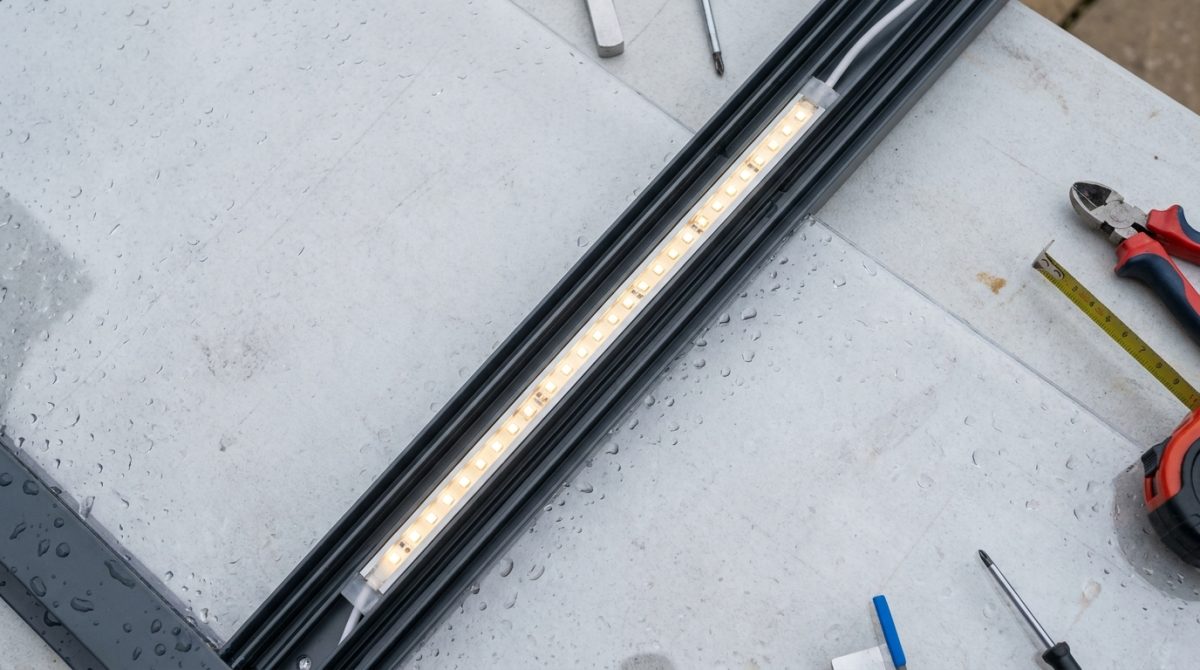
Above-water lighting mounted on the aluminium frame inside Zone 1 requires a minimum of IPX5 to handle the water jets that can occur during normal pool use. Many architects and pool designers now specify IP65-rated recessed LED strip fittings that sit flush within the glazing bar profiles of the enclosure frame. This approach eliminates exposed pendant fittings entirely, which is significant because pendant fittings collect condensation at the canopy junction, corrode at the terminal block, and are consistently the first point of failure in a pool enclosure lighting system.
Heating circuits and their boundaries
Pool heating circuits are a frequent source of specification errors because the zone boundary for the heat source is not always obvious on site. Whether you are running a heat pump, an electric immersion element, or control wiring for a gas boiler, all connections and control wiring must be treated as Zone 1 equipment unless you can demonstrate that the physical installation point lies outside Zone 1's boundaries.
A heat pump unit sitting on a patio slab adjacent to the enclosure, but beyond 2 metres from the water edge, falls entirely outside Section 702 scope. That is worth knowing because it gives designers and installers genuine flexibility when positioning equipment. The key is documenting the measurement clearly on the as-installed drawings, so that a future inspector can verify the classification without having to re-examine the physical layout from scratch.
Variable-speed pump drives and RCD compatibility
Variable-speed pump drives are now common in well-specified enclosure installations because they cut energy consumption by up to 70 percent compared with a single-speed motor running at full load. That is a significant operational saving over a swimming season. The complication is that the switching electronics inside these drives generate harmonic currents, and those harmonics can cause nuisance tripping on standard Type AC or Type A RCDs, which are not designed to handle the waveform distortion involved.
The fix is straightforward: specify a Type F RCD, or an RCD with a short time-delay, on the circuit feeding the pump drive. This retains full protection against genuine fault currents while tolerating the harmonic load without spurious trips. It is a one-line change on the design specification that prevents a significant amount of frustration during commissioning and ongoing use. You can find further detail on pool electrical hazard sources that make variable-speed drive compatibility worth planning carefully from the outset.
Motorised enclosure panels
Motorised roof and wall panels, one of the features that makes a retractable enclosure genuinely useful through changing weather, typically use 24 V DC actuators or motors. At that voltage they sit comfortably below the SELV threshold of 50 V AC or 120 V DC, which means the wiring within Zone 1 is treated as straightforward low-voltage work rather than a high-risk installation. The one requirement that still applies is that the motor housing itself must carry the correct IP rating for wherever it is physically mounted, because the enclosure environment remains damp regardless of the operating voltage.
Cable selection throughout the enclosure
All cable runs inside an enclosure should use double-insulated armoured cable, or be run in IP-rated conduit rated for the zone they pass through. Surface-clipped single-core cables inside standard grey PVC conduit are not suitable here. The damp, condensation-laden environment inside an enclosure will degrade standard PVC conduit fittings over time, and an inspection under BS 7671 Section 702 will flag this as a non-compliance. Armoured cable also offers mechanical protection against accidental damage during cleaning, furniture movement, and the general use that an enclosed pool space sees year-round.
Commissioning, Certification, and Ongoing Maintenance You Cannot Skip
A correctly designed and installed pool electrical system that has no paperwork to prove it is a liability. The documentation produced at commissioning is not a bureaucratic formality; it is what protects the homeowner legally, financially, and physically for the life of the installation.
Part P notification and certification
Any new pool electrical installation, or any significant alteration to an existing one, is notifiable under Part P of the Building Regulations in England. That means the work must either be carried out by a registered competent person who self-certifies through their scheme (such as NICEIC or NAPIT), or submitted to the local authority building control department for third-party inspection before and after completion. There is no grey area here, and no informal route that satisfies the regulation.
On completion the installer must issue an Electrical Installation Certificate. Keep this document permanently alongside your pool enclosure file, not filed away with general paperwork from the build. Insurers handling a water damage or fire claim will ask for it, and conveyancers will request it during any property sale. Its absence creates delays and, in some cases, forces a full re-inspection at the owner's expense. For a broader view of how electrical compliance fits into pool enclosure compliance more generally, the regulatory picture extends well beyond wiring alone.
Inspection frequency in a damp environment
An Electrical Installation Condition Report should be carried out every year for a domestic pool enclosure. This is more frequent than the standard five-year cycle recommended for dry domestic premises, and the reason is straightforward: the damp environment accelerates insulation degradation, causes terminal corrosion, and weakens the mechanical components inside RCD mechanisms at a rate that makes a five-year gap genuinely risky.
The PWTAG Code of Practice, while primarily aimed at commercial pool operators, recommends integrating electrical inspection into a structured technical operation plan. Domestic owners with larger or more complex enclosures benefit from adopting the same discipline, treating annual electrical checks as a scheduled event rather than something triggered only by a problem.
Seasonal checks before reopening
If your enclosure is closed over winter, the electrical systems need a structured check before reopening, not just a visual sweep. That check should include:
- Testing all RCDs using both the built-in test button and a calibrated RCD tester, to confirm trip times remain within the 40 ms limit at rated fault current
- Visually inspecting all bonding connections for green oxide corrosion, which indicates the connection is degrading and needs cleaning or replacement
- Confirming that IP-rated enclosures on junction boxes and cable entry points have not been left open after previous maintenance visits, which is one of the most common causes of insulation failure found during annual EICRs
These checks take an hour with the right equipment and the right person. Skipping them because the pool looks fine and nothing tripped last season is the reasoning behind most of the electrical failures that occur in pool environments. The failure mode is gradual, invisible, and then sudden. An annual check is the only reliable way to catch the gradual part before it becomes the sudden part.
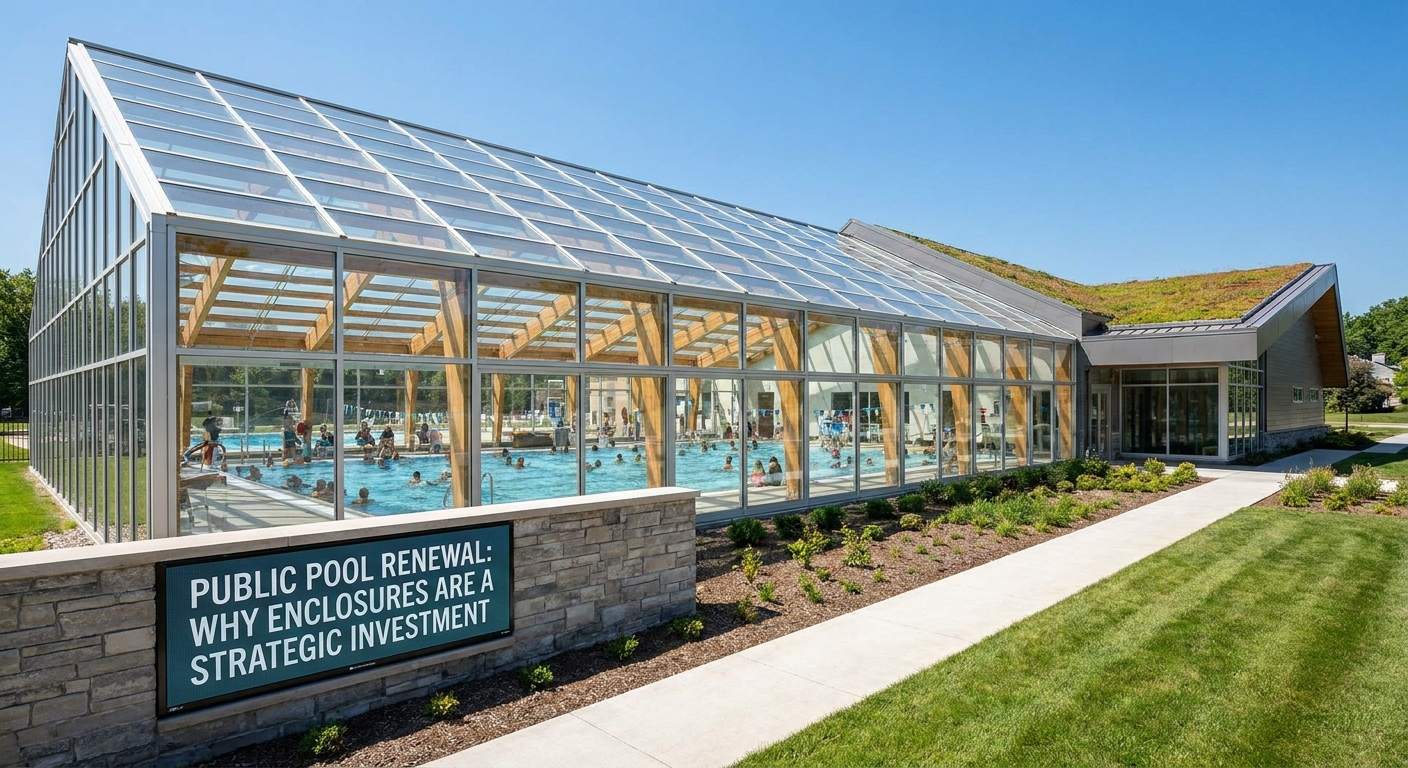
Public Pool Renewal: Why Enclosures Are a Strategic Investment
Vancouver's Kitsilano Outdoor Pool sits on some of the most valuable recreational land in Canada, and the city is now staring at renewal concepts costing anywhere from tens of millions to $300 million depending on which option council chooses. That figure is not an anomaly. It is the predictable destination for any outdoor public pool left to age without a coherent protection and extension strategy, then handed to engineers with a blank sheet of paper and a mandate to fix everything at once.
The same reckoning is arriving at leisure centres and municipal baths across the UK, just at different speeds and with fewer zeros on the invoices. The underlying problem is identical: ageing outdoor pool infrastructure that was built for a different era, maintained on shrinking budgets, and now facing a binary choice that nobody wants to make.
The Renewal Crisis Facing Public Outdoor Pools
The Kitsilano Pool situation is a useful reference point precisely because the numbers are so stark. Three preliminary renewal concepts have been outlined, with costs ranging up to $300 million at the top end. That upper figure would fund a comprehensive redevelopment including a new facility, upgraded amenities, and significant site works. Even the lower-cost options run into many tens of millions. For a pool that provides seasonal outdoor swimming, those figures represent an enormous capital commitment relative to the revenue the asset can realistically generate.
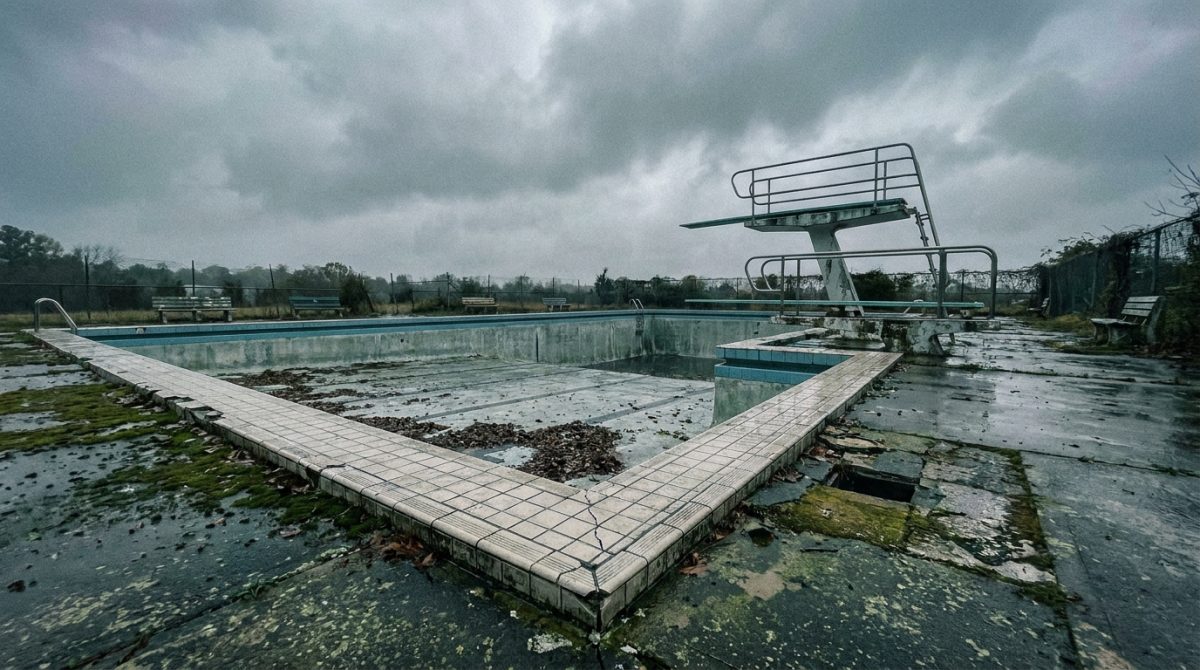
The dilemma facing Vancouver is structurally identical to what councils and leisure trusts across the UK confront with their own outdoor stock. Three options tend to emerge from every feasibility process: full rebuild to modern standards, partial renovation targeting the most critical defects, or closure with the site repurposed or left vacant. All three options carry political and financial risk. Full rebuilds are expensive and slow. Partial renovation often produces a facility that still closes seasonally and still ages. Closure is locally unpopular and permanently removes a community asset.
Seasonal operation is the root cause of the financial mismatch. A UK outdoor public pool typically opens in late May and closes in early September. That is roughly 14 to 16 weeks of revenue-generating operation. Against that window, a nine-figure capital programme is arithmetically impossible to justify through admissions, memberships, and lane hire alone. The pool would need to run for generations simply to approach cost recovery on the construction investment, by which point the next renewal cycle begins.
The Leavenworth City pool feasibility study in Washington State is instructive because it approached the problem without a predetermined answer. Planners identified only two genuinely viable mid-range options rather than a full replacement build. One of those was covering the existing outdoor pool with a seasonal enclosure, either an air-supported structure or a retractable system such as the DynaDome. The study's reasoning was straightforward: the existing pool shell and site infrastructure have residual value. Protecting and extending that value costs significantly less than demolishing and rebuilding from scratch.
Public sector budget pressure is now forcing precisely this kind of rigorous thinking across the UK. Every pound of capital spend on leisure infrastructure is being scrutinised against measurable returns: cost per visit, revenue per square metre, energy consumption per swimmer, and payback period. Councils and leisure operators cannot afford renewal projects that deliver the same seasonal, weather-dependent asset they already have. That pressure creates the conditions in which a pool enclosure stops being a luxury add-on and starts being a credible, defensible infrastructure decision that changes what the asset can do and what it can earn.
What a Pool Enclosure Actually Does to an Ageing Asset
It is worth being precise about the mechanisms here, because the value of an enclosure is often described in vague terms about protection and comfort when the reality is more specific and more financially quantifiable. An aluminium and polycarbonate enclosure does several distinct things to an existing pool that each carry a measurable cost or lifespan implication.
The most fundamental is physical protection of the pool fabric itself. Outdoor pools in the UK and across northern climates suffer progressive damage from freeze-thaw cycling. Water penetrates micro-cracks in coping stones, grout lines, and pool shell finishes, freezes, expands, and widens those cracks over successive winters. UV radiation degrades polysulfide and polyurethane sealants, degrades liner materials, and accelerates the embrittlement of plastic fittings and pipework. An enclosure intercepts both mechanisms. The pool fabric inside an enclosed structure experiences a far narrower temperature range across the year and is shielded from direct UV exposure, which directly extends the interval before coping replacement, liner replacement, and pipework remediation become necessary. Each of those items carries a five-figure cost on a public pool.
Chemical consumption is a significant and often underappreciated operating cost for any public pool. Pool covers can reduce chemical needs by up to 60% by limiting evaporation and the UV breakdown of chlorine. On a public facility running through a 50-week season, the cumulative saving on chlorine, pH adjustment chemicals, and algaecides runs to a meaningful sum annually. That reduction also matters for water quality consistency, which has direct implications for Health and Safety Executive compliance and the labour cost of testing and adjustment.
Debris exclusion is a third mechanism that is easy to overlook but materially affects plant longevity. Leaves, insects, airborne particulates, and organic material entering an open outdoor pool increase the filtration load, raise bacterial challenge, and accelerate the fouling of filter media. More frequent backwashing consumes water and energy. Pump and filter service intervals shorten. An enclosure reduces all of this because the pool environment is no longer directly exposed to the outdoor debris load. Filters run cleaner, pump seals last longer, and heat exchangers stay cleaner for longer before descaling is required.
The energy figures from the Peter Kirk Pool feasibility study in Kirkland, Washington put numbers on the broader thermal picture. That study found that retractable roof enclosure structures can save up to 27% on energy costs compared to a traditional enclosed swimming pool building. The reasons are intuitive: retractable systems can open to allow natural ventilation, reducing mechanical ventilation load, while the enclosure structure itself reduces wind-driven heat loss from the water surface when closed. For a public facility paying commercial energy tariffs, a 27% reduction in pool energy costs translates to tens of thousands of pounds per year depending on pool size.
The cumulative effect of all these mechanisms is that the pool's mechanical and structural components are being asked to do less work under more stable and controlled conditions. Heating plant cycles less aggressively. Pumps run against a cleaner system. The pool shell is not repeatedly stressed by thermal expansion and contraction across a wide seasonal range. Each of those factors extends the replacement cycle for expensive capital plant. A circulation pump that might need replacement after eight years of outdoor operation under variable conditions might last twelve or fourteen years in a stable enclosed environment. Multiply that logic across boilers, heat exchangers, filtration vessels, and control systems, and the total deferred capital expenditure represents a significant portion of the enclosure's own cost. The enclosure is not just adding revenue potential; it is actively reducing the rate at which the underlying asset depreciates.
Year-Round Operation Changes the Financial Equation Entirely
The arithmetic of public pool finance only starts to work when you change the denominator. Fixed costs, including staffing, insurance, energy standing charges, maintenance contracts, and debt service, accumulate across all 52 weeks of the year regardless of whether the pool is open. A seasonal outdoor pool spreads those fixed costs across 14 to 16 weeks of revenue. Everything else is subsidy. An enclosure that extends operation to 40 or 52 weeks does not add complexity to the financial model; it fundamentally restructures it.
A typical UK outdoor public pool opens in late May and closes in early September, giving an operational window of roughly 14 to 16 weeks. A well-specified enclosure combined with an appropriate heating strategy can extend that to 40 weeks at a conservative estimate, or to a full 52 weeks for facilities that commit to year-round operation. The difference between 14 weeks and 50 weeks of operation is not a marginal improvement. It is a transformation of what the asset is and what it can generate.
Revenue streams multiply directly with the operational calendar. Admission income, which is the most straightforward metric, scales roughly in proportion to the number of operating weeks, assuming reasonable demand across the extended season. But the more valuable gains come from income types that seasonal operation cannot support at all: annual membership packages that swimmers will only buy if the facility is available through autumn and winter, long-term lane hire agreements with swimming clubs and schools that require year-round certainty, and health and rehabilitation programmes that need consistent access rather than a summer-only slot. Year-round community swimming generates a fundamentally different income profile from a seasonal outdoor facility.
The Leavenworth feasibility study made the case explicitly. The recommendation to cover the existing outdoor pool with a seasonal enclosure was justified primarily on the grounds that it provides year-round swimming, which a simple renovation of the existing outdoor pool could not offer. The study framed year-round access not as an amenity upgrade but as the primary justification for the investment, because without it the financial case for any capital programme collapses back into the familiar seasonal revenue trap.
Market evidence supports the same logic at commercial scale. The commercial end-user segment of the pool enclosure market represents 38.5% of global revenue and is growing at a projected CAGR of 7.8% through 2034, according to market research covering the sector. That growth is driven by operators who have identified year-round enclosed pool operation as a revenue multiplier rather than simply a weather-proofing measure. Hotels, leisure operators, and public aquatic facilities are investing in enclosure infrastructure because extended season operation changes their income model, not because it makes the pool look attractive.
Staffing economics sit alongside the revenue argument and are frequently omitted from feasibility analyses. A pool that operates for 14 weeks per year cannot justify permanent, professionally trained aquatic staff. It recruits seasonal lifeguards, pays for training and induction that delivers only a few weeks of operational return, then loses those staff at the end of the season. A 50-week facility can offer permanent contracts. That changes recruitment quality, reduces the annual cycle of induction costs, simplifies National Pool Lifeguard Qualification compliance, and builds institutional knowledge that improves operational efficiency year on year. The HR costs of seasonal operation are real and largely invisible in high-level feasibility documents.
The combined effect on capital recovery is the key outcome. A public pool generating admission and membership income across 50 weeks rather than 14 is in a structurally different position when it comes to servicing the cost of an enclosure investment. The capital cost of a commercial-grade aluminium enclosure for a public pool is a fraction of the figures being discussed for full rebuilds. At Kitsilano, the gap between an enclosure solution and a $300 million redevelopment concept is of an entirely different order of magnitude. Within a realistic payback window, a pool generating extended-season revenue can recover the enclosure investment and still return a net saving to the operator compared with the annual subsidy required to maintain a seasonal-only operation.
Retractable Versus Fixed: Choosing the Right Enclosure for a Public Site
The first structural decision for any public pool renewal project is whether the enclosure retracts or stays fixed. Both approaches are credible, but they suit different site conditions, planning contexts, and operational priorities, and the wrong choice early in the process is expensive to reverse.
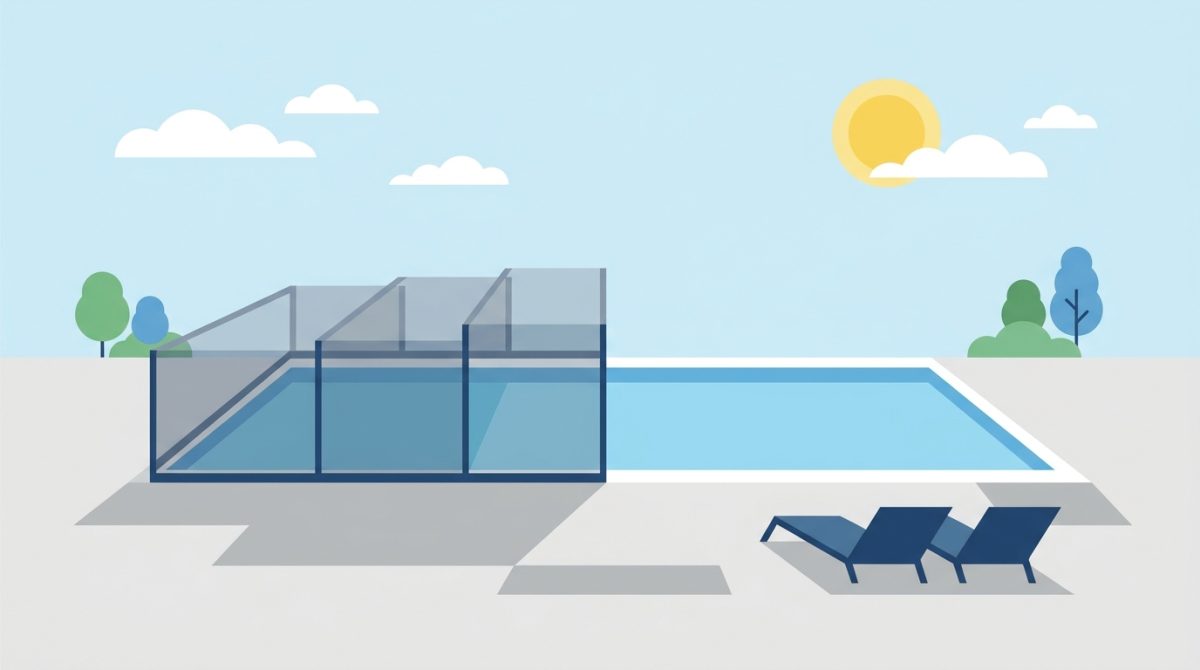
Telescopic pool enclosures use modular sliding track systems so individual sections can retract to expose the pool on warm days. For public facilities, this matters enormously. Swimmers at outdoor lidos often cite the open-air experience as the reason they use that pool rather than an indoor leisure centre. Planning authorities in some areas have made it a condition of consent that the open character of a historic lido be preserved. A fully retractable system satisfies both concerns: the pool operates as an indoor facility in winter and early spring, then opens fully to the sky from May through September.
Market data reinforces why operators are choosing this route. Retractable covers represented the fastest-growing product segment in 2025, carrying a projected CAGR of 8.1% through 2034, the highest growth rate across all pool cover and enclosure product types. That growth is not driven by residential customers alone. Commercial and public aquatic operators are the ones pushing demand, because flexibility over permanent enclosure maps directly onto the mixed seasonal programming that public pools need to run.
Fixed low-profile enclosures serve a different but equally valid purpose. On sites where planning permission for a full pool building would face serious resistance, a low-rise aluminium structure can sometimes be approved under permitted development rules or with considerably less scrutiny than a conventional building application. Fixed enclosures also tend to be lower capital cost, which matters when a municipal authority is working within a constrained renewal budget.
Height is a non-negotiable variable on any public site. The enclosure must clear starting blocks and springboard platforms, provide adequate headroom for competitive diving where applicable, and maintain unobstructed lifeguard sightlines across the entire pool deck. Getting this wrong is not a cosmetic problem; it is a safety and licensing issue that can prevent the facility opening at all.
Arch Enclosures' patented aluminium profile system is engineered to achieve span widths suitable for standard 25-metre and 50-metre competition pools without intermediate support columns interrupting deck circulation. That column-free span is critical for public facilities where wheelchair access routes, spectator areas, and emergency egress all need clear, unobstructed pathways around the pool surround.
Modular construction also resolves one of the practical objections that public sector clients raise early in the procurement conversation. Because the structure is assembled from factory-manufactured sections, installation phases can be scheduled within the existing closed season, typically late September through to March for most UK outdoor pools. There is no need to sacrifice operational weeks during the works, which means the project does not carry a revenue loss as part of its cost justification.
Planning, Procurement, and the Public Sector Approval Process
Public sector clients face a layer of process that private operators do not. Understanding where an enclosure project sits within that process from the outset saves time, cost, and the particular frustration of preparing a planning application only to discover it was not needed, or vice versa.
On the procurement side, local authority and leisure trust contracts require enclosure suppliers to demonstrate structural compliance with BS EN 1090, the European standard covering execution of steel and aluminium load-bearing structures. Alongside that, suppliers must provide wind and snow load calculations specific to the UK site, not generic European values. Building Regulations Part A (structural safety) and Part L (energy efficiency) are both relevant depending on whether the enclosure creates a new enclosed space or simply covers an existing one. Any supplier who cannot produce this documentation at tender stage should not be on the shortlist.
One of the most useful planning characteristics of pool enclosures is that they generally do not trigger the same level of scrutiny as a new pool building. An enclosure installed over existing pool fabric typically does not create a new use class, does not materially alter the site's footprint, and does not constitute a new build in the way that a traditional pool hall would. That distinction matters enormously in terms of the approval timeline and the political difficulty of getting a project through a council planning committee.
Heritage and conservation constraints are a live issue at many of the UK's most loved public pools. Victorian and Edwardian lido sites often sit adjacent to listed buildings or within conservation areas, and any proposal that involves brick, steel, or a structure of significant mass will face strong objections. Low-profile aluminium enclosures with clear polycarbonate panels have a much better record on these sites. The visual transparency of the structure, combined with its relatively low eaves height, has allowed consent to be granted at listed-building-adjacent locations where a more conventional building form would have been refused. For detailed guidance on how the UK regulatory framework applies to enclosure projects, the UK pool regulations guide on this site sets out the key compliance considerations.
Whole-life costing is where the enclosure argument becomes most powerful in a public sector context. A feasibility comparison that puts a 25-year enclosure solution against a new-build option must be constructed on whole-life cost, not just capital outlay. New-build pool buildings carry significant financing costs, longer construction programmes with associated revenue gaps, higher energy loads from mechanical ventilation systems, and ongoing maintenance liabilities for the building fabric. An enclosure installed over a structurally sound existing pool avoids all of those. When the figures are modelled properly over 25 years, the enclosure option routinely costs a fraction of the new-build equivalent.
Procurement teams at leisure trusts and councils are increasingly accepting design-and-build contract structures for enclosure projects. Under a design-and-build arrangement, the manufacturer takes responsibility for both the engineering design and the completed installation, which transfers performance risk away from the client and simplifies the internal approval process considerably. A council does not need to separately appoint a structural engineer, a specialist contractor, and a project manager; the contract consolidates those responsibilities in a single accountable party.
Case Evidence: Where Enclosures Have Delivered Measurable Returns
Abstract arguments about value only carry so far. The case for enclosures at public pools is now backed by a growing body of feasibility evidence and operational data from facilities that have already made the transition, and the numbers are consistent enough to use with confidence in business case documents.
The Leavenworth Feasibility Model
The City of Leavenworth pool feasibility study, a recent and publicly available assessment, provides one of the clearest structured comparisons between the enclosure option and the alternatives. The study examined covering the existing outdoor pool with a seasonal enclosure as its preferred mid-cost scenario, positioned explicitly between a minimal maintenance option that changed nothing and a full reconstruction that would take years and cost several times more. The core reasoning was straightforward: a well-designed retractable enclosure preserves the capital already invested in the existing pool shell and infrastructure, unlocks year-round programming, and does so without the construction timeline or financing burden of starting from scratch. That logic applies with equal or greater force to larger UK public pools where the existing asset base is more substantial.
Commercial Sector Evidence
The hospitality sector has been running enclosed pools longer than most public facilities, and the commercial data is instructive. Hotels and resorts that have enclosed their pool areas consistently report stronger year-round occupancy rates and improved room rate pricing power, because the pool becomes a reliable amenity rather than a seasonal one. The commercial segment now represents 38.5% of global pool enclosure revenue, and it is growing faster than the residential segment, which signals that operators with serious financial accountability are endorsing the investment. Public leisure facilities face a comparable commercial logic: a weather-dependent pool is a liability in the operating budget, while an enclosed pool is an income-generating asset.
UK Leisure Operators and Membership Income
UK leisure operators who have moved outdoor lido pools to enclosed or semi-enclosed operation describe a fundamental shift in their income profile. The structural problem with a weather-dependent outdoor pool is that it cannot support annual membership products, school swimming contracts, or lane booking systems in the same way an indoor pool can. Schools cannot commit to a term of lessons if the pool might be closed by rain in October. Annual members will not pay twelve months of fees for a facility that functions for five. Enclosing the pool removes that barrier entirely. Operators report being able to sell annual memberships and secure multi-term school contracts for the first time, which converts an unpredictable revenue stream into a predictable one. That predictability has knock-on benefits for staffing, programming, and the overall financial resilience of the facility. For further context on how enclosures support multi-use programming across different swimmer groups, the article on multi-use pool design covers this in detail.
Energy and Chemical Savings at Scale
The Peter Kirk Pool assessment and feasibility study, completed in 2025, provides specific energy figures that are worth citing directly in any public sector business case. A well-designed retractable enclosure with natural ventilation capability saves up to 27% on energy costs compared to a fully enclosed traditional pool building. The mechanism is straightforward: when outdoor conditions allow, the enclosure opens and mechanical ventilation is not required. That 27% saving compounds significantly over a 25-year asset life, and at the energy tariffs facing public sector leisure operators in the current market, it represents a very substantial cash figure.
Chemical costs tell a similar story. Research from Pool Operation Management confirms that pool covers can reduce chemical consumption by up to 60% by maintaining water temperature, reducing evaporation-driven chemical loss, and excluding debris that would otherwise demand corrective treatment. For a high-volume public pool processing hundreds of bathers per day, chemical spend is already a major operational line item. A 60% reduction is not marginal. Combined with the filtration savings that come from debris exclusion (less particulate load means less wear on filter media and reduced backwash frequency), the operational cost reductions available to a public pool operator through enclosure are substantial enough to materially affect the break-even analysis on the capital investment.
Arch Enclosures' Track Record
Arch Enclosures has delivered structures for both domestic and commercial clients across the UK, with the modular aluminium system specifically engineered to meet the load, span, and access requirements that larger aquatic facilities demand. The patented profile design allows column-free spans across standard pool widths, satisfies UK structural standards, and can be installed in phases to fit around an existing operational calendar. That combination of engineering capability and procurement-ready compliance documentation is what public sector clients need when they bring an enclosure project to committee for approval.
Making the Business Case to Stakeholders and Funders
Every public sector finance committee asks the same question: what are we actually spending, and what are we getting for it? An enclosure proposal needs to answer that question with four numbered pillars that sit alongside each other on a single page.
- Capital cost versus full renewal. A high-quality aluminium enclosure system represents a fraction of the cost of a full pool rebuild. The Vancouver Kitsilano figures put a full renewal at up to $300 million Canadian. A comparable UK public pool enclosure project typically costs in the low millions, not tens of millions. Presented side by side to a finance committee, the decision stops looking like a spend and starts looking like an avoidance of a far larger one.
- Operational revenue uplift from an extended season. Moving from a 14-week outdoor season to 40 or more weeks of operation multiplies admission income and membership revenue from a fixed asset base. That uplift is forecastable and auditable.
- Annual running cost savings across chemicals and energy. Pool covers of this type reduce chemical consumption by up to 60% and can cut energy costs by more than 25% compared to an unenclosed heated pool. Those savings recur every year of the asset's life.
- Extended asset life reducing the frequency of major capital interventions. An enclosure that adds 20 or more years to a pool's operational life defers the next major capital programme by a generation. That deferral has a net present value that belongs in the business case.
Grant Eligibility Is a Genuine Opportunity
Sport England's swimming infrastructure fund and DCMS levelling-up allocations both recognise year-round community access as a funded outcome. An enclosure project that converts a seasonal outdoor pool into a 12-month community facility fits that criteria far more cleanly than a like-for-like maintenance programme. Simple repairs to ageing infrastructure do not expand access. An enclosure does, which means the project can be framed as a new community outcome rather than a maintenance liability, opening grant routes that straight renewal work cannot access.
It is worth engaging a grants consultant or the relevant Sport England regional contact early in the feasibility process. The framing of the application matters as much as the project itself, and positioning year-round swimming as a public health and social inclusion outcome strengthens the case considerably.
Arch Enclosures at Feasibility Stage
One practical obstacle in public sector procurement is that business cases must be written before budgets are confirmed, and budgets cannot be confirmed before someone has done the technical work. Arch Enclosures addresses this directly by providing specification support, structural calculations, and indicative whole-life cost modelling at feasibility stage. That means public sector clients can build a credible internal case, put realistic numbers to a finance committee, and understand planning risk before committing to a formal procurement process.
This matters because the internal approval process is often where good projects stall. A vague indicative cost range does not give a finance director enough to approve. Detailed structural specifications and a worked whole-life cost model do.
The Strategic Message
The single most important reframe for any stakeholder presentation is this: an enclosure does not just protect water. It protects the entire capital investment already made in the pool tank, the plant room, the changing facilities, the site drainage, and the surrounding infrastructure. A full renewal would demolish and replace all of that. An enclosure preserves it, extends it, and makes it earn its keep for decades longer.
Public pools are community assets that have often taken years of campaigning and fundraising to build. The case for protecting that investment with a well-engineered enclosure is not complicated. It is a straightforward act of stewardship, and it is one that funders, councillors, and communities can all get behind when the numbers are laid out clearly.
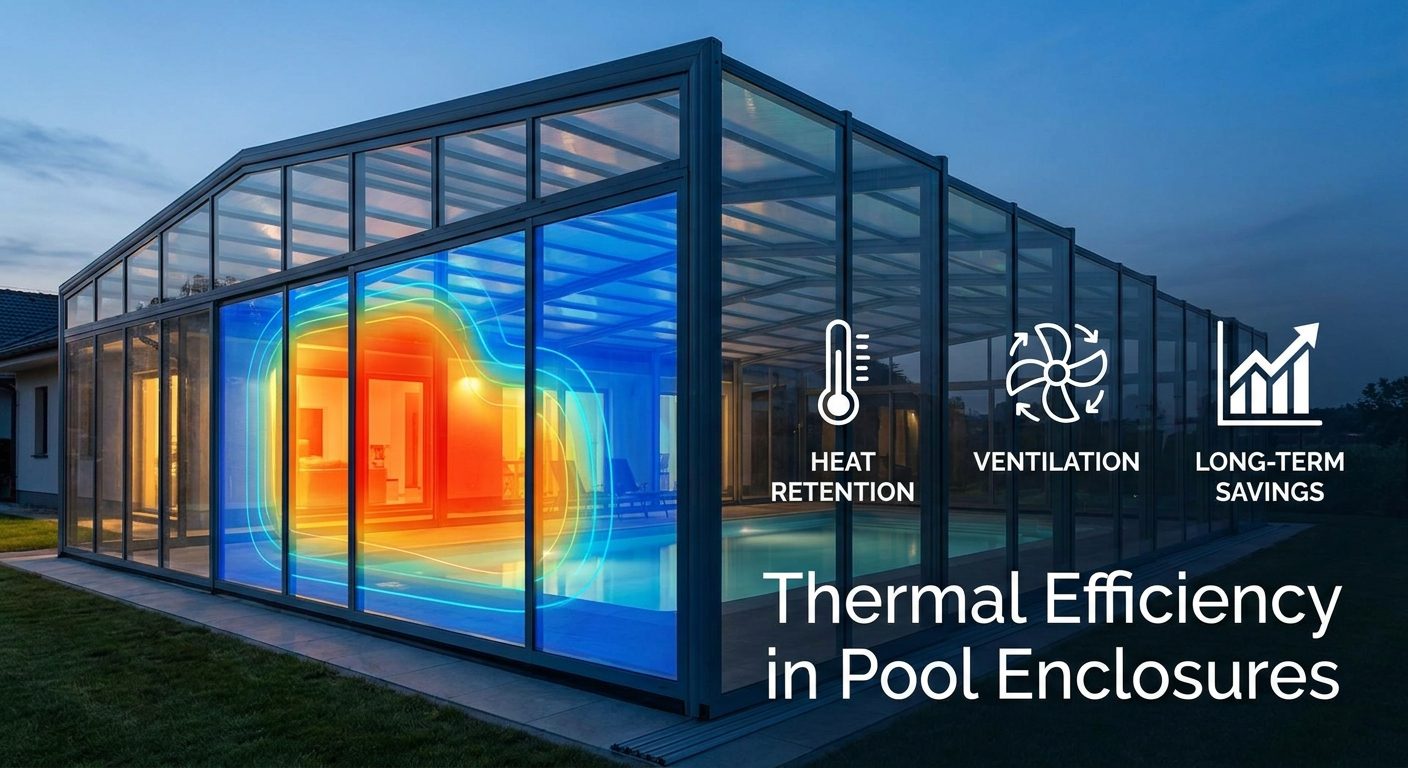
Thermal Efficiency in Pool Enclosures: A Practical Guide to Heat Retention, Ventilation and Long-Term Savings
A pool owner in Cheshire once told us his heating bill was higher in summer than winter. It turned out his exposed outdoor pool, sitting on a hill with no windbreak, was losing heat so fast overnight that his heat pump was running for four to five hours every morning just to get back to 28 degrees Celsius. He was fighting physics with a Direct Debit, and losing. Understanding exactly where that heat goes is the first step to stopping it.
The same problem plays out across thousands of UK pools every season. The good news is that the loss pathways are well understood, and each one can be addressed systematically. But you can only choose the right solution once you know which pathway is costing you the most.
Where Your Pool's Heat Actually Goes
An unenclosed outdoor pool loses heat through five distinct pathways: evaporation, convection, radiation, conduction, and precipitation. They do not all contribute equally. Evaporation accounts for roughly 70 percent of total heat loss in a typical outdoor pool, making it by far the dominant mechanism. Every litre of water that evaporates from the surface carries with it a significant quantity of latent heat, energy that simply disappears into the surrounding air and cannot be recovered.
Convection is the second major pathway. Wind moving across the water surface strips away the thin warm layer of air sitting just above the pool and replaces it with cooler ambient air, accelerating both evaporation and direct heat transfer from the water. On an exposed site, wind can double or triple the evaporative loss rate compared to a sheltered garden. A pool that loses 4 kilowatts per square metre of surface in calm conditions can easily lose 8 to 12 kilowatts in a moderate breeze. This is why two identical pools in different locations can have wildly different running costs.
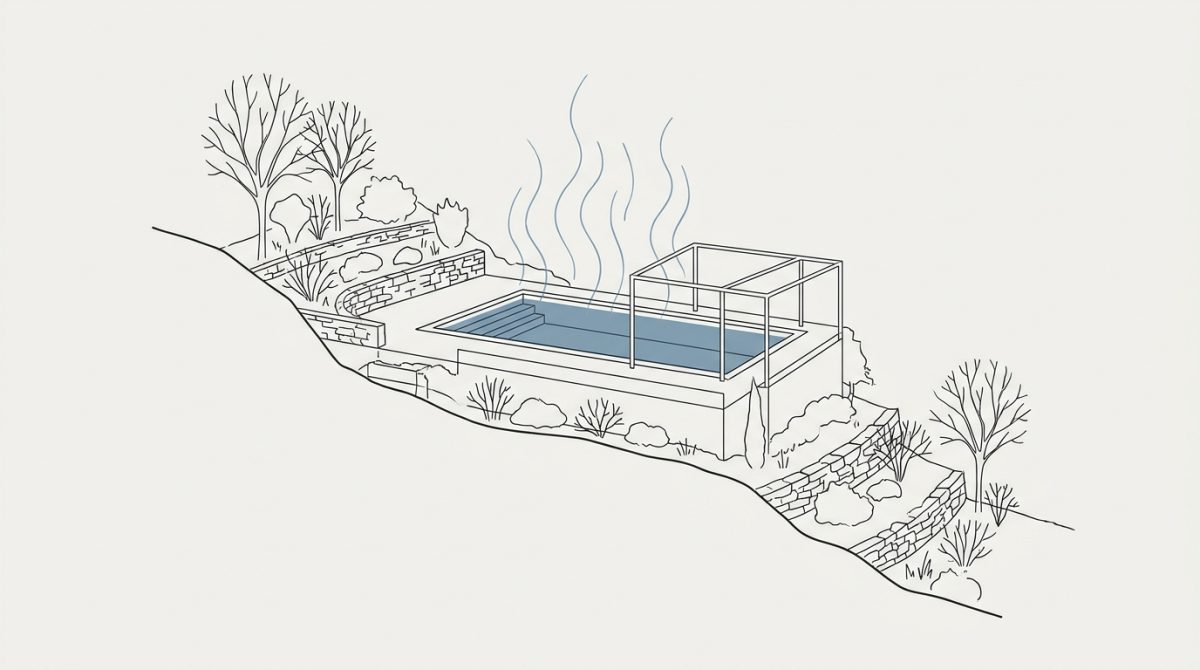
Radiation is the third pathway, and it operates regardless of wind. Every object above absolute zero emits longwave infrared radiation, and a pool heated to 28 degrees Celsius radiates heat continuously toward the sky. On a clear night this effect is especially pronounced because the sky acts as a cold sink, and the pool surface radiates heat toward it with nothing to intercept or reflect that energy back.
Conduction plays a smaller but real role, transferring heat from the water to the pool shell and then out through the ground or the walls into the surrounding earth. In above-ground pools the effect is more pronounced because the walls are directly exposed to air. In in-ground pools with uninsulated concrete shells, ground conduction can account for 10 to 15 percent of total losses depending on soil conditions and groundwater temperature.
Precipitation, the final pathway, acts as a cold-water injection. Rain falling directly into a pool at an ambient temperature of 12 degrees Celsius will immediately drag the pool temperature down, and the heating system must compensate to restore the setpoint. This pathway is often underestimated, particularly in the UK where summer rain events are frequent and unpredictable.
A typical UK outdoor pool maintained at 28 degrees Celsius can lose several degrees overnight without any cover or enclosure in place. That might not sound dramatic, but restoring two or three degrees across a pool volume of 60,000 to 80,000 litres requires a substantial energy input every single morning before anyone gets in the water. Over a six-month swimming season, that daily recovery cost accumulates into hundreds of pounds of unnecessary expenditure. Understanding these five loss mechanisms is the foundation for choosing the right enclosure design, because different structures address each pathway to varying degrees and in different combinations. The sections that follow work through exactly how an enclosure modifies each one.
How an Enclosure Changes the Physics of Heat Loss
An enclosure does not simply put a roof over the problem. It changes the fundamental thermodynamic environment in which the pool exists, attacking several loss pathways simultaneously rather than addressing them one at a time.
The most immediate effect is on convective loss. By creating a still-air buffer around and above the water surface, a well-sealed enclosure eliminates wind-driven convective loss almost entirely. The air inside the structure cannot be replaced by cold ambient air because it has nowhere to go. This single change, removing wind from the equation, can cut total heat loss by 30 to 40 percent on its own for pools on exposed sites. For a pool that was previously losing heat at an accelerated rate due to site exposure, the effect is transformative from day one.
The enclosed air space then begins to work as an insulating layer in its own right. As the pool heats the air above it, the temperature differential between the water surface and the surrounding atmosphere drops. Heat loss through both convection and evaporation is driven by that differential, so as the internal air temperature climbs, the rate of heat loss falls. The enclosure is not just blocking the wind; it is allowing the pool to warm its own immediate environment in a self-reinforcing process.
Evaporation continues inside an enclosure, but the physics change significantly. In an open pool, evaporated moisture is carried away by air movement and replaced by dry air, which pulls more moisture from the surface. Inside a closed enclosure, that moisture stays within the structure. As internal humidity rises, the air becomes less able to accept additional water vapour, which slows the evaporation rate. The pool is effectively humidifying its own air until an equilibrium is reached. This is why humidity management becomes an important operational consideration inside any pool enclosure, a topic explored separately in this article.
Radiation loss at night behaves differently inside an enclosure too. Rather than radiating heat to an open sky at effectively minus 20 degrees Celsius (a typical effective sky temperature on a clear UK winter night), the pool surface now radiates toward the enclosure roof and walls, which are far warmer. Those surfaces in turn re-emit some longwave radiation back toward the water. The net radiative loss is substantially reduced compared to an open-sky scenario, particularly on clear, cold nights when radiative losses from an unenclosed pool would be at their worst.
The type of glazing material matters for this radiation pathway in ways that are not immediately obvious. Mathematical modelling research on heat transfer in outdoor pools confirms that transparent covers transmitting direct solar energy to the water are more efficient than opaque covers that absorb solar energy and re-emit it as longwave radiation. The same principle applies to enclosure glazing panels: a transparent glazed roof allows sunlight to pass through and be absorbed directly by the water, while an opaque or heavily tinted panel absorbs that solar energy itself and only partially re-transfers it as heat. Direct transmission is the more efficient mechanism.
The combined effect of all these changes is substantial. Pool enclosures can reduce overall heat loss by 50 to 70 percent depending on design, glazing specification, and site exposure. For a pool costing £3,000 per year to heat without any enclosure, that translates to a potential saving of £1,500 to £2,100 annually, before accounting for any integrated heating system improvements. Over a ten-year period, those savings dwarf the cost of most enclosure installations, which is why the economics of enclosure investment are so compelling when modelled honestly.
Glazing Materials and Their Thermal Trade-Offs
Two primary glazing materials dominate the pool enclosure market: toughened or laminated glass, and twin-wall or multi-wall polycarbonate. Both transmit light and provide weather protection, but they behave very differently in terms of thermal performance, and choosing between them involves genuine trade-offs rather than one material simply being better than the other.
Polycarbonate panels with a multi-wall cellular structure perform well on the insulation metric. The hollow channels running through the panel create multiple air gaps that impede heat conduction, giving multi-wall polycarbonate a lower U-value than single-pane glass. A typical 16mm twin-wall polycarbonate panel achieves a U-value of around 1.9 to 2.5 W/m²K, compared to approximately 5.8 W/m²K for standard 4mm toughened glass. That means polycarbonate conducts significantly less heat outward per unit area per degree of temperature difference, and it generally achieves this at a lower upfront cost than an equivalent glass installation.
Glass has a higher thermal transmittance, which sounds like a disadvantage, but it also delivers superior solar gain transmission. Clear toughened glass transmits around 85 to 90 percent of incident solar radiation directly through to the water, whereas multi-wall polycarbonate, depending on its structure and any tinting, typically transmits 40 to 75 percent. Given that direct solar transmission is the most effective passive heating mechanism for pool water, glass can partially compensate for its weaker insulation performance through higher solar gain on sunny days.
For UK climates, however, the balance tips toward polycarbonate's insulation advantage for a significant part of the year. The UK experiences substantial cloud cover from October through to March, with many regions averaging fewer than two hours of sunshine per day during midwinter. During those months, a pool enclosure is not harvesting much solar gain regardless of glazing type, so the panel that loses less heat overnight and on overcast days delivers better net thermal performance. This is why energy efficiency in pool enclosures is so often framed around polycarbonate's insulation credentials for year-round UK use.
The picture changes for summer months and for southern-facing enclosures in areas with better sunshine totals. Here, glass can deliver genuine passive heating advantages that reduce the load on the primary heating system. The decision is therefore partly a function of geography, orientation, and the owner's primary use pattern for the pool.
Low-emissivity coatings on glass panels narrow the performance gap considerably. A low-e coating works by reflecting longwave infrared radiation back into the enclosure rather than allowing it to pass through the glass outward. This reduces the effective U-value of the panel without meaningfully reducing solar transmission in the visible spectrum. A well-specified low-e glass panel can achieve U-values of 1.0 to 1.2 W/m²K in a double-glazed unit, making it thermally competitive with polycarbonate while preserving the optical clarity and aesthetic quality that glass provides. For high-end residential installations where appearance is a priority, this combination represents the strongest thermal case for glass.
Framing deserves as much attention as glazing, and it is often overlooked in the initial specification process. Aluminium is the standard framing material for pool enclosures because of its strength, corrosion resistance, and the precision with which it can be fabricated. Its thermal conductivity is also very high, roughly 160 W/mK, which means a standard aluminium frame section would act as a continuous cold bridge, conducting heat from the warm interior to the cold exterior along every profile. In a high-performance enclosure structure, this would undermine much of the glazing's thermal benefit.
Modern thermally broken aluminium profiles address this directly. A polyamide barrier, a strip of glass-fibre reinforced nylon, is inserted between the inner and outer faces of the frame profile during manufacture, interrupting the metal-to-metal thermal path. The polyamide has a thermal conductivity of around 0.3 W/mK compared to aluminium's 160 W/mK, reducing the frame's contribution to heat loss by a factor of several hundred. In a well-designed enclosure with extensive glazing area, the cumulative effect of thermally broken profiles versus standard profiles across dozens of linear metres of frame is significant. It is a detail that separates a genuinely thermally efficient structure from one that simply looks the part.
Fixed Versus Retractable Enclosures: The Insulation and Ventilation Balancing Act
When it comes to raw thermal performance, a fixed enclosure holds a clear advantage. Because there are no sliding sections, the structure has no joints in the roof or walls that need to accommodate movement. Every seal is permanent and designed purely for weather exclusion rather than for repeated opening and closing, which means fewer air leakage points and a tighter thermal envelope overall.
Retractable and telescopic designs introduce a different set of trade-offs. Each sliding track joint is a potential path for cold air infiltration, and over time seals on moving sections can compress, degrade or mis-align slightly, widening those gaps. The benefit, of course, is the ability to open sections fully in warm weather, converting the pool from a heated enclosed space into an open-air experience. For many homeowners that lifestyle flexibility is worth the marginal efficiency difference, especially since the enclosure will be fully closed during the colder months when heating costs are highest.
The gap between the two approaches is smaller than it might seem when the retractable system is well engineered. High-quality retractable enclosures built with precision aluminium extrusions and compression seals along every rail can approach the thermal performance of a fixed design when fully closed. The key word is precision: loose tolerances in cheaper systems are where the efficiency difference becomes real and measurable.
Ventilation strategy is also shaped by this choice. A fixed enclosure has no built-in option to simply open up on a warm afternoon, so planned ventilation must be designed into the structure from the start. Ridge vents, louvred panels or mechanical ventilation connections need to be specified during the build rather than added as an afterthought. A retractable system can manage ventilation informally by parting sections, which is convenient but less precise and harder to automate.
For commercial pools, the calculus tends to favour fixed construction. A leisure centre or hotel pool is rarely opened to the elements regardless of the weather, so the lifestyle argument for retractability carries less weight. A fixed enclosure with integrated mechanical ventilation gives the operator consistent thermal performance, predictable running costs and a simpler maintenance schedule across the whole life of the structure. The upfront cost difference often pays back quickly through lower heat loss over years of continuous operation.
Solar Gain: Free Heating You Need to Manage, Not Just Harvest
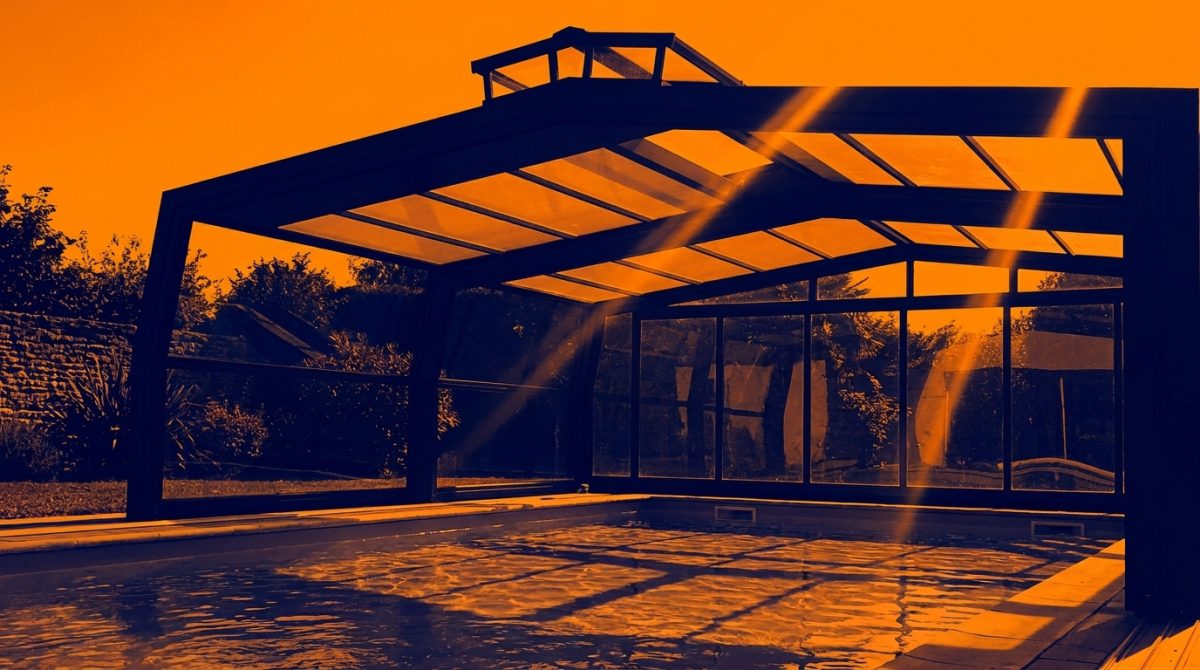
A south or south-west facing enclosure in the UK is not just a pool cover. On a clear spring or autumn day it becomes a passive solar collector, with internal air temperatures potentially climbing 10 to 15 degrees Celsius above ambient before any active heating system switches on. That free energy contribution is one of the strongest arguments for an enclosure, and it is most valuable precisely during the shoulder seasons when heating demand is highest and outdoor temperatures are marginal for swimming.
Summer, however, presents the opposite problem. Without adequate ventilation, an enclosure in high June sunshine can exceed 40 degrees Celsius internally, which is uncomfortable and potentially unsafe for swimmers. The glazed structure that keeps heat in during October becomes a trap for it during July. This is not a design flaw; it is a predictable physical consequence of enclosing a transparent space, and it needs to be managed rather than ignored.
The correct way to think about solar gain is as a resource that changes sign across the calendar year. In cooler months you want to maximise collection and retention. In warmer months you want to limit accumulation and purge excess heat quickly. Orientation, glazing specification and ventilation design need to be considered together from the outset, because each decision affects the others. A south-facing enclosure with no ridge vents and no solar-control glazing will be excellent in winter and miserable in August.
Glazing and Solar Control
Low-iron glass maximises solar transmission because it removes the slight green tint present in standard float glass that absorbs a portion of incoming radiation. In a pool enclosure context, this means more useful heat entering the water and the air during the months you need it most. The trade-off is that the same high transmission becomes a liability in summer when you would prefer to reject some of that energy before it enters the space.
Tinted or solar-control glass sacrifices a portion of winter gain in exchange for a more comfortable summer ceiling temperature. Whether that trade-off makes sense depends on how often the pool is used in midsummer relative to spring and autumn, and on how effective the ventilation system is at purging excess heat. For UK pools used mainly in the cooler shoulder seasons, low-iron glass combined with well-designed ventilation often delivers the better overall result.
Passive Ventilation Through Stack Effect
Ridge ventilation combined with low-level louvres is one of the most effective passive tools for managing solar overheating. Hot air rises naturally and exits through the ridge, drawing cooler replacement air in at low level. This stack-effect airflow can move a substantial volume of air through the enclosure without any mechanical energy input, and pool enclosure specialists including CreoGlass identify it as a key element of both thermal and acoustic comfort management in enclosed pool spaces.
Automated vent actuators take this a step further. Connected to an internal thermostat, they open and close ridge vents in response to actual air temperature rather than relying on the pool owner to remember to act. When the internal temperature drops below the set point the vents close automatically, preserving the heat that has accumulated. When it rises above a comfortable threshold they open, purging the excess passively. This closed-loop approach means the solar gain cycle manages itself across seasons without ongoing manual intervention, which is particularly useful for pools that are not attended daily.
Humidity, Condensation and Why They Matter for Both Comfort and Structure
Even a pool that is well covered when not in use will generate significant evaporation while in use, and an enclosed pool space concentrates that moisture. Internal relative humidity in an unventilated enclosure can exceed 80 percent during and after a swimming session. At those levels the air feels clammy, the glazing mists over, and the conditions for condensation on every cooler surface in the space are firmly established.
Condensation is not just a nuisance. Water sitting repeatedly on aluminium frames, poolside furniture, timber decking or any adjacent building fabric causes corrosion, mould growth and progressive surface degradation. On glazing it leaves mineral deposits and biofilm that reduce clarity over time. The structural integrity of the enclosure itself can be affected if water is consistently finding its way into joints or onto fixings that were not designed for permanent wet contact.
The frame specification matters a great deal here. A standard aluminium profile conducts heat rapidly from the warm interior air to the cold outer face of the frame, dropping the interior surface of the frame below the dew point and turning it into a condensation collector. A thermally broken aluminium profile interrupts that conduction path with a low-conductivity barrier, keeping the interior face of the frame warmer than the dew point even in cold weather. This is not a marginal refinement; in a pool enclosure operating through a UK winter it is a fundamental requirement for keeping the structure dry and maintaining glazing clarity. You can read more about how enclosure ventilation and climate control work together to manage these conditions in practice.
Controlled air exchange addresses the root cause rather than the symptom. Louvred vents cycling fresh, drier air through the space carry moisture-laden air out before it can settle on surfaces. A mechanical heat recovery ventilation unit does the same job more precisely and with less thermal penalty: it exhausts humid air while extracting the heat it carries and transferring that heat to the incoming fresh air. The result is a drier enclosure without the energy waste of simply venting warm air to the outside.
The pool's chemical balance is also affected by humidity management, in a way that is easy to overlook. Heavy evaporation concentrates chlorine, pH adjusters and other dissolved chemicals in the remaining water, pushing the chemistry out of balance faster than normal. Controlling evaporation through good air management reduces the frequency and volume of chemical dosing required, which is both a cost saving and a comfort benefit for swimmers sensitive to high chlorine levels.
For periods of very heavy use or extended poor weather when natural ventilation cannot keep pace, a poolside dehumidifier provides a reliable backup. Units should be sized by the enclosure's volume and the anticipated bather load, with output rated in litres per day. A correctly sized unit running on a humidistat rather than a timer will only operate when conditions actually demand it, keeping its own energy consumption in check while protecting the structure and the water quality during the sessions when humidity loads are at their highest.
Calculating the Heating Economics: Numbers That Justify the Investment
The thermal physics covered earlier in this article are interesting, but the numbers that actually drive decisions are financial. So let's run them properly.
A typical domestic outdoor pool measuring 8 by 4 metres, heated to 28 degrees Celsius in the UK, will consume between 20,000 and 35,000 kWh per year without any enclosure or cover. The wide range reflects site exposure, local climate and the type of heating system in use. A gas boiler on a sheltered southern site sits toward the lower end; an electric resistance heater on an exposed northern site pushes toward the top.
Adding an enclosure reduces that consumption by 50 to 70 percent based on heat loss reduction data. Practically, that brings annual energy use down to roughly 10,000 to 17,500 kWh. At a UK electricity price of approximately 24 pence per kWh in 2025, the saving for a domestic pool heated by an electric heat pump works out to between 2,500 and 5,000 pounds per year. That is a real, recurring saving, not a one-off benefit.
The season extension question is just as important as the raw energy reduction. Without an enclosure, the usable outdoor swimming season in the UK averages 16 to 20 weeks. With an enclosure, that stretches to 40 to 52 weeks depending on the structure type and heating system. Crucially, extending the season does not increase total annual energy cost proportionally, because per-week consumption during the shoulder months of April, May, September and October is considerably lower than in the high-demand winter months. You are gaining weeks of swimming at relatively low marginal cost.
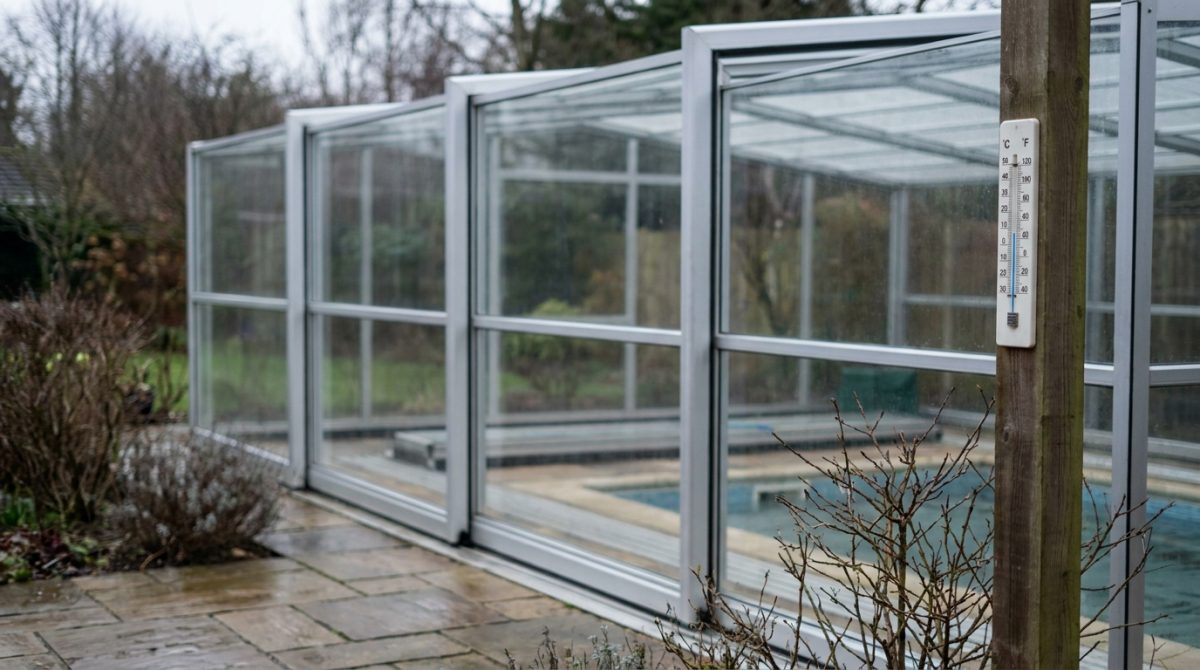
There is a compelling illustration of this principle in the wider energy world. A BBC-reported project repurposed waste heat from a small data centre to warm a public swimming pool. The reason it was viable at all is that the pool's baseline heat demand had been reduced far enough, through insulation and enclosure, that a low-grade heat source could meet it competitively. The same logic applies at domestic scale: once your enclosure has cut peak heat demand substantially, heat sources that would otherwise be too marginal or too slow become genuinely practical options.
The payback arithmetic is straightforward. A pool enclosure at a purchase and installation cost of 20,000 pounds that saves 3,500 pounds per year in energy delivers a simple payback period of under six years. That figure does not include the value of the extended season, avoided chemical costs from reduced evaporation, or the reduced wear on heating equipment running at lower sustained loads. Include those and the real payback is faster still.
For commercial operators, the case is proportionally stronger. A hotel or leisure centre pool with a baseline annual energy spend of 40,000 to 80,000 pounds on heating sees savings in the same 50 to 70 percent range, meaning the enclosure can pay for itself in energy alone within two to four years at commercial scale.
Integrating Heating Systems with Your Enclosure for Maximum Efficiency
An enclosure does not replace a heating system. What it does is change which type of system performs best by cutting peak demand and making low-capacity continuous heating viable in place of high-capacity intermittent heating. That distinction matters when you are specifying equipment.
Air-source heat pumps are the clearest beneficiary of this shift. Outside, exposed to UK ambient temperatures, a heat pump typically achieves a coefficient of performance (COP) of 4 to 5, meaning it delivers four to five units of heat per unit of electricity consumed. Inside a well-managed enclosure, where the surrounding air temperature is consistently 8 to 15 degrees higher than the outdoor ambient, the same unit can achieve a COP of 6 to 7. That improvement alone materially reduces running costs and is a direct consequence of the thermal environment the enclosure creates.
Solar thermal collectors sized for an open pool are almost always oversized for an enclosed one. The reduced baseline demand means a large array collects more heat than the pool can absorb in summer and struggles to justify the capital cost. A better use of that budget is a smaller, higher-quality heat pump paired with solar PV to power it. The Polysolar and Polytropic combination from Clear Pro Pools is a practical example of this approach, using photovoltaic generation specifically matched to a heat pump's consumption profile rather than generating thermal energy directly.
Pool covers used inside an enclosure add a second layer of overnight insulation when the pool is not in use. The enclosure holds the air temperature up; the cover prevents surface evaporation and radiative loss from the water itself. The two work together, and their combined effect on overnight temperature drop is substantially greater than either achieves alone. heating enclosed pool decisions should always account for both layers.
Underfloor heating in the poolside area is primarily a comfort feature, but it contributes marginally to maintaining the internal air temperature of the enclosure. That marginal contribution reduces the load on the primary water heating system over time, particularly during autumn and spring when the thermal gap between inside and outside is at its most responsive to small adjustments.
Any heating integration should be managed by a controller that monitors internal air temperature, water temperature and humidity simultaneously. Treating these as separate systems with separate controls wastes energy. A building management style controller allows the heat pump to reduce output when solar gain is raising water temperature naturally, and the ventilation to respond to humidity without overriding the thermal gains from a cold but sunny morning.
Specifying a Thermally Efficient Enclosure: What to Ask Before You Buy
Marketing language in the pool enclosure market is vague by habit. The phrase "thermally efficient" appears frequently and means almost nothing without supporting data. The questions below will separate suppliers who can back their claims from those who cannot.
Ask for specific U-values, not just descriptions
Request the U-value of the glazing panels as a standalone figure and the overall enclosure U-value including frame losses. A polycarbonate panel might achieve a U-value of 1.5 W/m²K, but if the aluminium frame surrounding it conducts heat freely, the whole-structure figure is considerably worse. Good suppliers can provide both numbers. If a supplier will only describe their product as "thermally broken" or "highly insulated" without attaching a figure, that is a reason for caution.
Verify the thermal break, do not just accept it
Ask whether the aluminium profiles include a polyamide thermal barrier and request supporting evidence. A CE marking or an independent test report from a recognised laboratory is the minimum standard. A verbal assurance from a sales representative is not. Aluminium conducts heat at approximately 160 W/mK; polyamide conducts at roughly 0.3 W/mK. A genuine thermal break makes a measurable difference and a supplier confident in their product will have documentation to prove it.
Check air permeability for retractable designs
Confirm the air permeability rating of the structure in its closed configuration. This matters most for retractable and telescopic designs, where the sliding joints between sections are the primary weakness. A leaky enclosure loses a substantial portion of its thermal advantage in windy conditions, which are exactly the conditions when you most want the enclosure to be performing. Ask for the test standard used and the measured figure, not just a description of the seal quality.
Ensure ventilation has been calculated, not just fitted
Check that the ventilation strategy was designed around your specific pool volume and anticipated bather load. Ridge vents fitted as standard without any calculation are common and often inadequate or, in some cases, excessive for the enclosure size. Either extreme creates problems: too little ventilation causes humidity to build to damaging levels; too much creates draughts that strip heat from both the water surface and the occupants.
Ask for a projected energy saving figure
Any credible supplier should be able to provide a projected annual energy saving based on your pool dimensions, location, orientation and existing heating system. This does not need to be a guarantee, but it should be a reasoned estimate using real heat loss calculations rather than a generic percentage pulled from a brochure. If a supplier cannot or will not provide this figure, treat it as a signal about the quality of technical support you will receive after installation too.
Confirm the alloy specification for chlorine environments
Verify that the aluminium alloy grade used is marine-grade or equivalent, typically in the 6000 or 5000 series, which is suited to chlorine-rich environments. Corrosion in the frame does not just look poor: it compromises the structural integrity of the enclosure and degrades the thermal sealing at joints and fixings. A structure that begins failing at its gaskets and frame connections within eight to ten years is not a thermal enclosure; it is an expensive shelter with diminishing returns.
The Pooltime guide notes that heat transfer modelling supports the case for long-life construction, with superior pool enclosure designs achieving service lives exceeding 30 years. At that timescale, total cost of ownership, not purchase price, is the figure that governs which specification is genuinely the most economical. A structure costing 25,000 pounds that performs reliably for 30 years at low maintenance cost will almost always outperform a 15,000 pound structure requiring significant remedial work or replacement at year 12. Run the maths over the full service life before you sign anything.

Google's May Core Update Is Done Rolling Out, Here's What UK Businesses Need to Do Now
If you've checked Google Search Console recently and noticed your rankings have shifted, you're not imagining it. Google's May 2026 core update finished rolling out after roughly 12 days, and SEO professionals across the industry described it as heavier than the March update. Some sites saw significant drops; others gained ground. Either way, if your organic traffic looks different right now, this update is almost certainly why.
Google handles over 89% of web searches globally, according to Statcounter, so even a modest ranking drop can hit your enquiries and sales in a very real way. The good news is that core updates are not punishments. They are recalibrations of how Google assesses quality, and that means you can respond constructively.
What a Core Update Actually Does
Google runs core updates several times a year to improve how its algorithm ranks content. Unlike a spam penalty, a core update does not target specific rule violations. Instead, it adjusts the weight Google gives to various quality signals across its entire index. Pages that were ranking well might slip if Google now considers other pages more relevant or trustworthy. Pages that were underperforming might rise.
The volatility you see in the days during a rollout is normal. Rankings can bounce around before settling. The May update took around 12 days to fully roll out, so if your rankings felt unstable for two weeks, that is exactly what was happening behind the scenes.
How to Tell If You Were Affected
The first step is to get the data in front of you before you do anything else. Log in to Google Search Console and pull up the Performance report. Compare the last 28 days against the same period before the update started. Look at:
- Total clicks and impressions
- Average position for your key pages
- Which specific pages or queries have dropped most
Google Analytics will tell you whether the traffic drop corresponds to a drop in organic sessions specifically, which confirms the update is the cause rather than a seasonal dip or a technical issue. If you use a rank tracking tool like SE Ranking, Ahrefs, or Semrush, check those too. You want to know which pages fell and from what positions.
Audit Your Content Honestly
Once you know which pages took the biggest hits, you need to look at them with fresh eyes. Google's core updates consistently reward content that is genuinely helpful, accurate, and written with a specific audience in mind. Ask yourself these questions about each affected page:
- Does this page actually answer the question a searcher would have when they land on it?
- Is the information accurate and up to date?
- Does it demonstrate real expertise, or is it thin filler content?
- Would someone trust this page, or does it look unpolished and rushed?
Thin pages, those with under 300 words that say very little, are particularly vulnerable in core updates. If you have lots of them, consider whether they can be improved, combined with related pages, or removed altogether. A smaller site with stronger pages consistently outperforms a larger site full of weak ones.
Check Your E-E-A-T Signals
Google talks a lot about E-E-A-T, which stands for Experience, Expertise, Authoritativeness, and Trustworthiness. For a small UK business, this is not as complicated as it sounds. It basically means: does your website give people good reason to trust you?
Practical things you can do right now include:
- Make sure your About page clearly explains who you are, how long you have been trading, and what you specialise in
- Add author names and brief bios to any blog posts or articles
- Display contact details prominently, including a physical address if you have one
- Make sure your Google Business Profile is complete and up to date
- Gather and display genuine customer reviews, whether on Google, Trustpilot, or directly on your site
These signals matter because Google's quality raters, real humans who assess search quality, use criteria around trust and authority when evaluating sites. The update may have shifted how much weight those signals carry.
Look at Your Technical Foundations
Core updates sometimes expose technical weaknesses that were always there but not previously costing you rankings. While you are in audit mode, it is worth running a quick check on:
- Page speed, particularly on mobile (use Google's PageSpeed Insights for a free report)
- Mobile usability via the Mobile-Friendly Test or Search Console's Core Web Vitals report
- Crawl errors or pages blocked from indexing in Search Console
- Broken internal links that might be leaving important pages undiscovered
None of these will recover a ranking overnight, but fixing them removes friction and sends positive signals over time.
What Not to Do After a Core Update
It is tempting to start making sweeping changes the moment you see a traffic drop. Resist that urge for a few days after the rollout completes. Rankings often continue to settle for a week or two after Google calls an update done. Making lots of changes while things are still volatile makes it very hard to know what actually helped.
Also avoid:
- Deleting pages in a panic without checking whether they have backlinks or internal traffic
- Stuffing keywords into pages hoping to force rankings back up
- Buying links or using any shortcut that might trigger a separate manual action
Core update recovery is a slow process. Google itself has said that even well-executed improvements may not show results until the next core update, which could be months away. That is frustrating, but it is also how this works.
When to Ask for Help
If you have done an honest audit and genuinely cannot identify why your pages dropped, or if the traffic loss is significant enough to affect your business, it is worth speaking to an SEO professional. An experienced agency can look at your site alongside competitor data and give you a clear picture of where the gap is.
For small businesses in particular, organic search is often the most cost-effective long-term source of enquiries. A core update is a good reminder that search visibility is not something you set and forget. It needs regular attention, honest content, and a site that genuinely serves the people visiting it.
If you would like a straight-talking review of how your site is performing after the May update, get in touch with the team at Samson Web Design. We work with UK businesses every day on exactly this kind of thing.
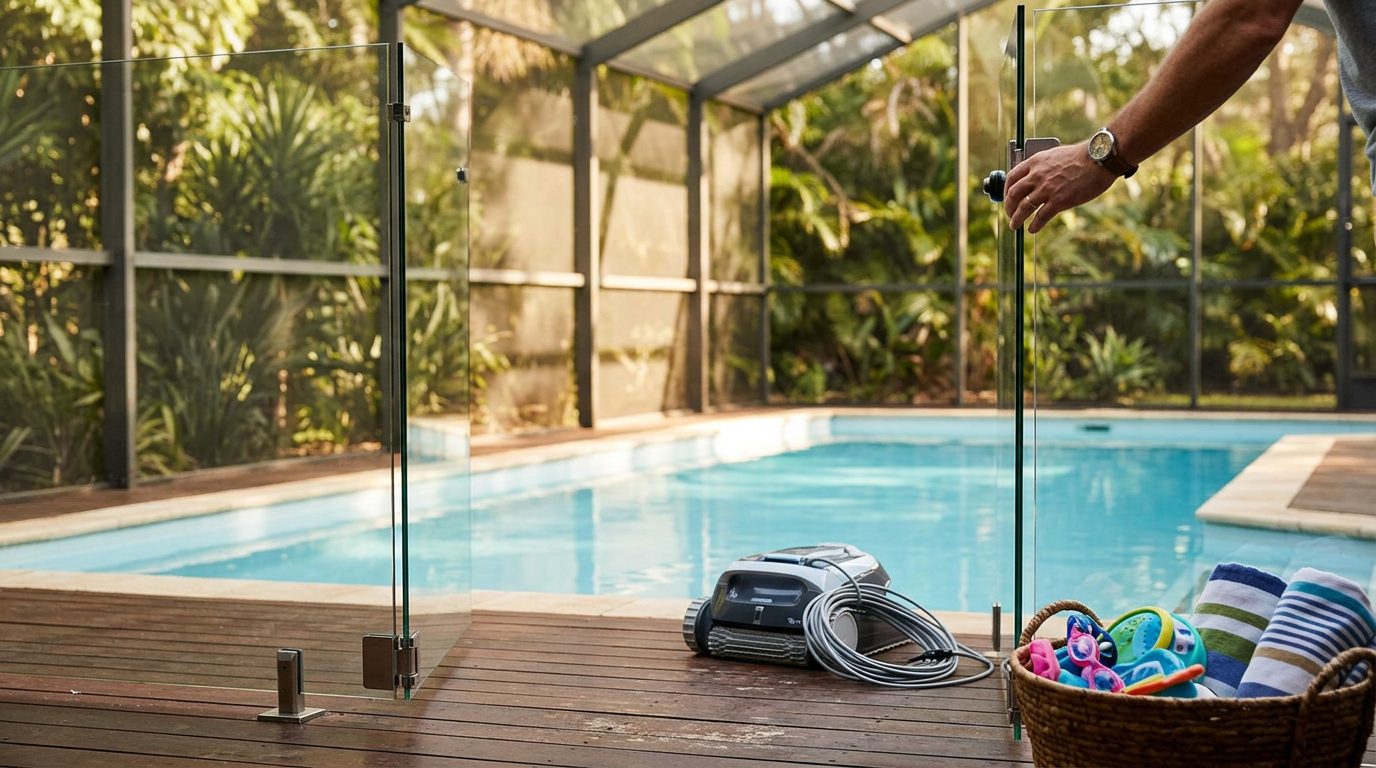
Pool Enclosure Hacks for Busy Parents: Making Year-Round Swimming Actually Manageable
Owning a pool with young children should feel like a treat, not a chore. The reality for most busy parents, though, is that the maintenance list sits quietly in the back of your mind every single week. An aluminium pool enclosure changes that calculation considerably. It cuts down on debris, regulates water temperature, and reduces the chemical load, but it still needs a routine to work at its best.
These are the practical habits and shortcuts that make enclosure ownership genuinely low-effort for households where time is always short.
Build a Five-Minute Morning Check Into the Day
The quickest way to avoid bigger problems is a brief daily scan. While the kettle boils or before the school run begins, get into the habit of a fast visual inspection. It takes almost no time and catches issues early.
- Glance at the water surface and skim off anything that has come in overnight (far less with an enclosure, but still worth doing).
- Check the water level is sitting at the correct midpoint on the skimmer opening.
- Make sure the enclosure doors are properly closed and that no toys or floats are blocking the drainage channels.
That is genuinely all it takes on most mornings. Because an enclosure keeps out leaves, bird droppings, and wind-blown debris, your skimmer basket will need emptying far less often than an open pool. That alone saves a surprising amount of time across the year.
The Weekly Routine That Prevents Most Problems
A structured weekly session is the core of low-effort pool ownership. Aim for around 20 to 30 minutes, ideally on the same day each week so it becomes automatic rather than something you have to remember to schedule.
- Empty the skimmer basket and pump basket.
- Run a robotic or automatic vacuum. A model like the Dolphin E10 can be dropped in and left entirely unattended, which is a genuine time-saver.
- Brush the walls and steps briefly to prevent algae build-up.
- Test chlorine, pH, and alkalinity levels using a straightforward dip-strip kit or a digital tester.
- Adjust chemicals as needed, following the manufacturer's guidance.
Because an enclosure dramatically reduces UV degradation and evaporation, chemical consumption is typically lower for enclosed pools. You will still need to test and balance, but the swings are smaller and less frequent than with an outdoor pool exposed to full sun and rain.
Monthly Tasks Worth Scheduling in Your Calendar
Some jobs are easy to ignore until they become a problem. Block a slot in your calendar once a month for these so they never quietly slip off the list.
- Do a full chemical check including calcium hardness and total dissolved solids, not just the daily chlorine and pH.
- Inspect the enclosure tracks, seals, and rollers for any debris or wear.
- Clean the enclosure glazing panels with a soft cloth and mild soap solution to keep light transmission at its best.
- Check that all safety latches and locks on enclosure doors are functioning correctly.
The glazing check is one that parents especially benefit from. Clean panels let more light in, which makes the space more welcoming and means you can supervise children from outside the enclosure if needed.
Teach the Kids the Three Non-Negotiable Rules
An enclosure adds a significant physical barrier between children and the water, which is one of its most underrated safety benefits for families. That said, rules still matter and children genuinely do remember simple ones when they are rehearsed regularly.
- No entering the pool area alone. The enclosure door stays closed and latched unless an adult is present.
- No running on wet surfaces inside or around the enclosure.
- Toys and floats get put away after every swim, every time.
That last rule is more practical than it might sound. Toys left in the water affect circulation, can block drains, and make chemical testing less accurate. Giving children a specific storage box inside the enclosure turns tidying up into a clear, quick habit rather than a negotiation.
Make the Enclosure Part of Your Family Rhythm
One of the best things about a pool enclosure is that it genuinely extends the swimming season without adding effort. The pool is protected from autumn debris, heated by the greenhouse effect through the cooler months, and ready to use on a rainy Tuesday afternoon just as easily as a sunny Saturday in July.
For busy parents, that means less pressure to get a swim in only during a narrow window of good weather. Scheduling becomes flexible. You can do a quick session before dinner on a Wednesday in October without any extra preparation, because the water is already at a usable temperature and the surface is clean.
Building a loose family swimming schedule, even just deciding on two or three regular slots per week, helps ensure the pool gets used consistently rather than gathering dust between school holidays. A pool that gets regular use is also easier to maintain because the filtration system works more efficiently and chemical levels stay more stable.
Stock a Simple Maintenance Kit Inside the Enclosure
A surprising amount of maintenance time is lost fetching equipment from elsewhere. Keeping a compact kit stored inside or immediately adjacent to the enclosure removes that friction entirely.
- A hand skimmer net for quick surface clearing.
- A testing kit or dip strips.
- A small container of shock treatment and pH adjuster for quick corrections.
- A soft brush for the walls and steps.
- A microfibre cloth for the glazing panels.
When everything is within arm's reach, the five-minute morning check actually takes five minutes. When you have to go to a shed and back, it quietly becomes something you skip.
Year-Round Swimming Without Year-Round Stress
The whole point of an enclosure is that it makes pool ownership less demanding, not more. The structure does a great deal of the work by shielding the water from the elements, stabilising temperature, and keeping the maintenance burden manageable even for households running at full pace.
With a short daily habit, a consistent weekly routine, and a few simple family rules, a pool enclosure genuinely delivers on the promise of year-round swimming without requiring a professional-level time commitment. For busy parents, that is exactly the kind of accessible luxury that makes real sense.
Long-Term Durability of Aluminium Enclosures: Engineered to Withstand Decades of Sun and Weather
A pool enclosure built in 2004 and still running smoothly in 2025 is not a lucky outlier. It is what happens when the right material is chosen from the start. The question worth asking before any purchase is not whether aluminium will last, but why it outlasts everything else it competes against, and what the engineering behind that longevity actually looks like.
Most homeowners comparing enclosure materials focus on upfront cost and appearance. Those are reasonable starting points, but they miss the factor that dominates total cost of ownership: how the material behaves after a decade of rain, frost, poolside chlorine and British summer UV. That is where the differences become stark.
Why Aluminium Outlasts Every Other Enclosure Material
The single most important property aluminium brings to an outdoor enclosure is its behaviour in the presence of oxygen. The moment aluminium is exposed to air, it forms a thin, stable layer of aluminium oxide directly on its surface. This layer is self-repairing: scratch it, and it reforms within seconds. Unlike steel, which corrodes progressively once the surface is broken, aluminium does not rust in any conventional sense. The oxide layer is chemically stable and adheres tightly to the metal beneath it, acting as a permanent barrier rather than a symptom of decay.
Steel enclosures, by contrast, corrode from any breach inward. A single scratch through a galvanised or painted steel section allows moisture to undercut the coating, and from that point the corrosion spreads laterally. Within a few years, what started as a hairline scratch becomes a blistering rust streak. Aluminium simply does not follow that failure path.
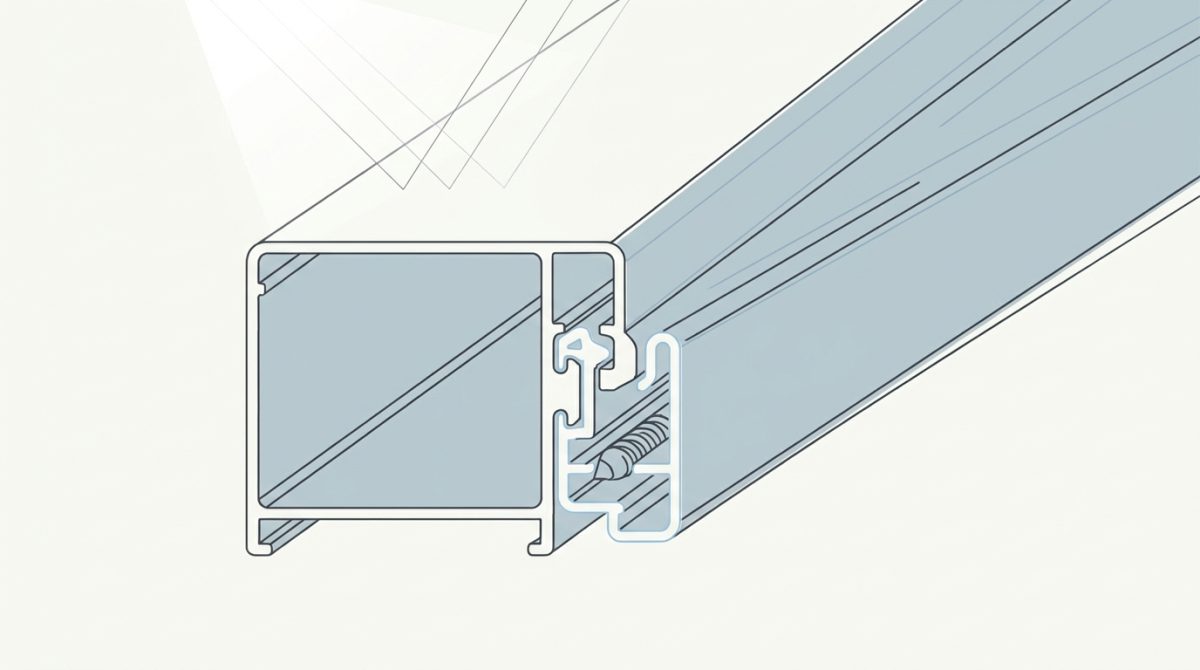
There is also a structural efficiency argument that matters for long spans. Aluminium's weight-to-strength ratio is roughly three times better than steel, which means an enclosure frame can carry the same load-bearing performance with significantly less structural mass. Less mass means lower dead loads on foundations, less stress on fixing points, and fewer visible sections cluttering the sight lines over the pool. For a structure designed to sit in a garden for three decades, carrying its own weight gracefully is not a minor consideration.
Timber enclosures present a different problem. Wood is a natural, hygroscopic material, meaning it absorbs and releases moisture continuously with the weather. In a poolside environment, that cycling is accelerated. Without repainting or retreating every three to five years, timber frames become vulnerable to rot, warping and insect damage. The labour and material cost of that maintenance cycle adds up quickly, and it never actually stops. Even well-maintained timber eventually loses structural integrity at joints, where end grain absorbs water most aggressively.
PVC and polycarbonate framing systems are often marketed as low-cost, low-maintenance alternatives, but their durability record under sustained UV exposure tells a different story. Both materials become brittle over time when subjected to prolonged ultraviolet radiation. In hard frosts, which occur across most of the UK every winter, brittle PVC and polycarbonate sections can crack under impact or thermal stress. A snap-frozen joint that shatters in January is not a theoretical risk; it is a documented failure mode for budget enclosures in northern European climates.
Aluminium behaves almost indifferently to temperature extremes by comparison. It retains full structural integrity across a range from minus 40 to over 200 degrees Celsius. In practical terms, this means that the freeze-thaw cycling of a British winter, where overnight temperatures drop below zero and afternoon temperatures climb back above it repeatedly throughout January and February, produces negligible stress in properly engineered aluminium joints. The expansion and contraction that occurs is predictable, small, and accommodated by standard engineering tolerances. There is no brittleness threshold, no softening point anywhere near ambient conditions, and no moisture absorption to drive internal cracking.
That combination of self-passivating corrosion resistance, structural efficiency, and thermal stability is why quality enclosures built from aluminium regularly reach 25 to 35 years of service life with their frames fundamentally intact.
The Science Behind Powder Coating and Why It Defines Lifespan
Raw aluminium's self-passivating oxide layer is effective, but it is not enough on its own for a poolside environment. The surface needs a finishing process that actively repels moisture, resists UV degradation, and survives decades of thermal cycling without peeling or cracking. Powder coating, when applied correctly, delivers all three. When applied poorly, it accelerates failure faster than no coating at all by trapping moisture under a compromised surface.
The process itself is worth understanding because it explains why powder coating outperforms wet paint so decisively. During powder coating, electrostatically charged pigmented polymer particles are sprayed onto the aluminium profile. The electrostatic charge causes the particles to adhere uniformly, including around edges and into recesses that a liquid paint brush or spray gun would cover unevenly. The coated profile is then cured in an oven at around 200 degrees Celsius. At that temperature, the polymer particles melt, flow together, and form a cross-linked chemical bond with the aluminium surface. The result is not a coating sitting on top of the metal. It is a layer that has partially fused to it.
The finished layer is typically 60 to 80 microns thick. That might sound thin, but a continuous, chemically bonded layer at that thickness forms a complete barrier. Moisture cannot penetrate it. UV radiation is absorbed and scattered by the pigment rather than reaching the aluminium beneath. Salt air, which is the most aggressive common atmospheric corrosive in the UK, hits the coating rather than the metal. As long as the coating remains intact, the aluminium underneath is essentially isolated from its environment.
Independent testing under BS EN ISO 9227, the standard salt spray test for corrosion protection, demonstrates what that isolation means in practice. Quality powder-coated aluminium profiles can withstand over 1,000 hours of continuous simulated coastal salt spray without measurable corrosion appearing on the base metal. Translating that into real-world terms requires some care, because salt spray tests are accelerated and artificial, but 1,000 hours of concentrated salt exposure broadly maps to several decades of actual coastal service. That is the standard serious enclosure manufacturers test to.
There is a thermal benefit to quality powder coatings that is less commonly discussed. The pigment formulations used in modern architectural powder coatings are designed to reflect a portion of solar infrared radiation. In practice, this reduces the surface temperature rise in direct summer sunlight by up to 20 percent compared with bare aluminium. That matters because frame joints undergo thermal fatigue: they expand when hot and contract when cold, and the cumulative stress from thousands of those cycles over 20 years can work metal fasteners loose and cause sealant compression and relaxation at glazing interfaces. Reducing the peak temperature excursion directly reduces the amplitude of each cycle, and that reduction compounds over decades.
Where Budget Enclosures Fail
The weakness of powder coating is not in the process itself but in its application. A poorly applied coating, common in low-cost enclosures produced at high volume, typically has pinholes, thin spots at edges, or areas where the electrostatic charge was not uniform and coverage was incomplete. These micro-defects are invisible to the eye at installation. Within two to three years of weathering, moisture finds those thin spots, migrates under the coating, and begins undermining the adhesion from beneath. The result is blistering and eventual delamination: the coating lifts away from the surface in patches, leaving the aluminium fully exposed.
This failure mode typically becomes visible within five to seven years on budget enclosures, and once it starts, it accelerates. There is no practical way to re-powder-coat an assembled enclosure in situ. Remediation means stripping the structure, which is neither cheap nor straightforward.
Arch Enclosures addresses this by applying powder coating to all aluminium profiles before fabrication rather than after. That sequence matters. When extrusions are cut to length, drilled for fixings, and assembled before coating, every cut edge and every drilled hole is bare metal. Those are exactly the points where moisture ingress begins. By coating first and fabricating second, any cut edges and fixing points that are subsequently exposed are sealed during assembly with compatible compounds, but the bulk of the profile, including its internal faces and complex extrusion geometry, is fully coated with a quality factory finish. It is the right sequence for long-term performance.
How UK Weather Actually Attacks an Enclosure Over Time
An enclosure that performs flawlessly in a controlled test environment and one that survives 30 British winters are not automatically the same thing. The UK's climate combines several distinct attack vectors that work on different timescales and through different mechanisms. Understanding them individually makes it easier to see why enclosure engineering choices that look like over-engineering on paper are entirely justified in practice.
Rainfall and Drainage Loading
The UK is a genuinely wet country, but the variation across regions is significant. Western areas including Wales, the Lake District and much of Scotland average between 1,200 and 1,800 mm of rainfall per year. That volume of water landing on an enclosure roof creates sustained drainage demands. If the glazing panel system, the frame channels, and the perimeter drainage points are not designed to move water away efficiently, standing water accumulates in joints and glazing rebates. Standing water is far more corrosive than moving water because it maintains continuous contact with any surface defect long enough for chemistry to take hold.
Good enclosure drainage design is not glamorous, but it is as critical to lifespan as material choice. Frame extrusions should incorporate integrated drainage channels that carry water from glazing panels to the perimeter continuously, with no dead-end sections that pool. The lowest points of any frame section should have clear exit routes. This is a design discipline, not a material property, and it separates enclosures engineered for the UK climate from those designed for drier continental markets and then sold here without modification.
Freeze-Thaw Cycling
Water expands by approximately 9 percent when it freezes. That is a significant volumetric change, and in any joint or recess where water has been allowed to sit, that expansion exerts outward pressure on the surrounding material. Over one winter with repeated freeze-thaw cycles, the cumulative effect is micro-cracking in under-engineered extrusions, particularly at sharp internal corners where stress concentrations are highest. Over ten winters, those micro-cracks propagate and the joint loses integrity.
Well-engineered aluminium extrusions for enclosure use are designed with radiused internal corners rather than sharp ones, specifically to distribute freeze-thaw stress across a larger area. The wall thickness of structural sections should be sufficient to resist the expansion pressure without deforming. These are not luxuries; they are the difference between a frame that lasts a decade and one that lasts three.
Coastal Salt Spray
Chloride-laden salt spray from coastal air is the most aggressive atmospheric corrosive that an enclosure in the UK is likely to face. Coastal locations across Cornwall, Wales and Scotland, but also large stretches of eastern England, face salt spray that can travel several kilometres inland, particularly during onshore gales. This is not a niche condition. A significant proportion of UK garden pools are within salt spray range.
On any unprotected metal surface, chloride ions attack the passive oxide layer and initiate pitting corrosion. On ferrous fixings, the process is faster and more visible: rust bleeds from screw heads and stains the enclosure frame within a single winter season. Using stainless steel or aluminium fixings throughout, combined with a quality powder coat on all profiles, removes the most vulnerable components from the salt spray risk entirely.
UV Degradation of Glazing Panels
The UK's summer UV index peaks at around 7 to 8 in southern England between June and August. That is substantially lower than Mediterranean or Florida levels, but it is still sufficient to degrade unprotected polycarbonate glazing panels meaningfully over a decade. Polycarbonate without UV stabiliser or UV-blocking coating loses optical clarity progressively, yellowing and developing surface crazing that reduces light transmittance by up to 30 percent within ten years. That yellowing is not purely cosmetic. It reduces the pool area's usable light and heat, and it signals that the material itself is becoming brittle.
Quality enclosure glazing should use polycarbonate with integrated UV protection rather than relying on surface coatings that can scratch away. The difference in material cost is modest. The difference in 15-year performance is substantial.
Wind Loading and Storm Stress
Exposed UK gardens can see gust speeds of 100 km/h or more during Atlantic storm events. These are not unusual occurrences; they are a normal part of several winters per decade in most parts of the country. An enclosure frame that is not rated and tested to BS EN 1991-1-4 wind load standards is carrying an engineering assumption, not a verified performance guarantee. Wind loading in practice creates racking stress on the frame, uplift forces on the roof glazing, and dynamic fatigue on all the connection points between sections. Every one of those mechanisms is manageable through proper engineering. None of them is manageable through hope.
Internal Condensation Chemistry
Inside the enclosure, a specific micro-environment develops that does not exist anywhere else in the garden. Warm, humid air from the pool surface meets the cold inner face of the glazing on every autumn and winter evening. That condensation cycle repeats hundreds of times per year. The resulting persistent humidity inside the enclosure is more corrosive than outdoor ambient air because it maintains high moisture levels for extended periods.
Any ferrous fixing inside the enclosure, including standard zinc-plated screws or mild steel brackets, will show red rust within two to three seasons of this internal environment. Untreated aluminium is more resistant, but even aluminium benefits from full powder coat coverage in these conditions. The internal environment of a pool enclosure is, in corrosion terms, closer to a coastal industrial environment than to a typical garden shed. Engineering the fixings and finishes accordingly is not excessive caution.
Engineering Decisions That Separate a 10-Year Enclosure from a 30-Year One
Two enclosures can look almost identical on the day they are installed. The difference between one that needs replacing in a decade and one that is still performing in 30 years comes down to a set of specific engineering choices made before a single extrusion is cut. These decisions are rarely visible once the structure is up, which is exactly why they matter so much at the specification stage.
Wall Thickness and Profile Strength
The wall thickness of aluminium extrusions is one of the most consequential decisions in enclosure design. Profiles below 1.5 mm wall thickness are prone to denting under point loads and develop long-term fatigue cracks at joints exposed to repeated thermal expansion and contraction. A practical minimum of 2 mm wall thickness for structural enclosure members gives the profile enough section modulus to resist both impact and the slow-cycle fatigue that accumulates over decades of use.
Specifying thicker extrusions adds modest material cost at manufacture but eliminates a common failure mode entirely. When comparing quotes, ask the manufacturer for the actual profile dimensions rather than accepting a general description of the grade used.
Joint Design and Corrosion Entry Points
Patented interlocking joint systems, such as those developed by Arch Enclosures, eliminate the two features that cause premature failure in cheaper systems: exposed screw heads and water-collecting ledges. Every exposed fastener on the exterior face of an enclosure is a potential corrosion entry point. Every horizontal ledge that traps rainwater creates the conditions for crevice corrosion, which operates even on aluminium if chloride ions are present from pool water vapour.
Interlocking profiles that clamp and interlock without external fixings also distribute load more evenly, reducing stress concentrations at connection points. This is not an aesthetic preference; it is a structural one with measurable lifespan implications.
Fixings and Fastener Grade
The frame itself may be aluminium, but any enclosure requires fixings, and the grade of those fixings determines whether the structure holds together for five years or fifty. Marine-grade A4 stainless steel (designation 316 stainless) must be used throughout rather than zinc-plated steel. Zinc plating in UK outdoor conditions, particularly where pool chemicals are present, can begin failing within five years, leaving rust staining on the aluminium profiles and, more seriously, weakening the connections that hold the structure together under wind and snow load.
Thermal Break Technology and Drainage Design
Thermal break technology in glazing frames separates the inner and outer aluminium faces with a low-conductivity material, typically a glass-reinforced polyamide strip. This prevents cold bridging and reduces condensation on interior surfaces by up to 60 percent compared with single-extrusion profiles. Less condensation means less water running down interior faces and pooling at base rail joints, which is one of the primary initiation sites for long-term staining and corrosion.
Integrated drainage channels in base rails and roof profiles work alongside thermal breaks to ensure that any water entering the system has a clear path out. Standing water at joint interfaces is the primary mechanism for crevice corrosion in aluminium, and a well-designed drainage system removes that mechanism entirely rather than relying on maintenance to compensate.
Glazing as a Structural Contributor
Glass and polycarbonate panels in a well-engineered enclosure are not simply infill. Tempered or toughened safety glass of at least 6 mm, or twin-wall polycarbonate of at least 16 mm, contributes to the racking stiffness of the overall frame. When panels act as structural diaphragms rather than dead loads, the aluminium framework can be optimised accordingly. Specifying thinner panels to reduce cost undermines this, increasing deflection under wind pressure and putting additional stress into the frame joints.
Snow load is the other design variable that is sometimes underspecified for UK installations. The standard figure for most of England is 0.6 kN per square metre, rising in Scotland and at elevation, and this value must be factored into roof panel sizing and rafter spacing from the outset. An enclosure designed only around wind loading and self-weight will shed snow safely by chance rather than by engineering.
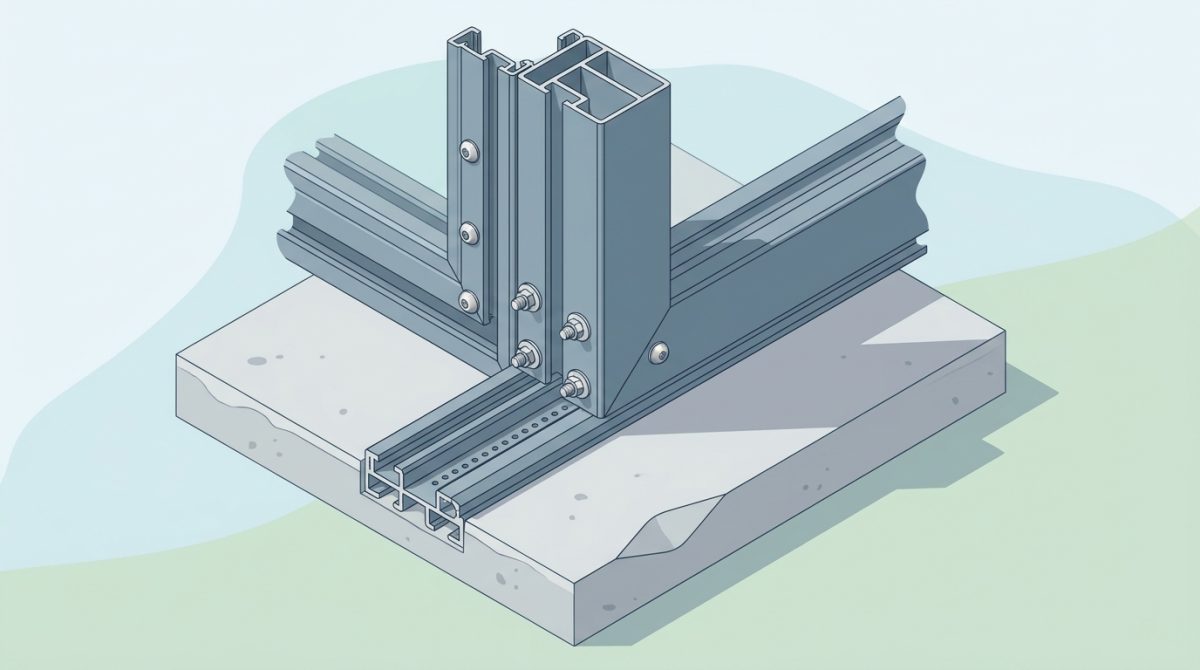
Real-World Longevity: What 20-Plus Years of Enclosure Performance Looks Like
There is a difference between a material's theoretical lifespan and what actually happens to structures in service. For quality aluminium pool enclosures, the gap between those two figures is encouraging: documented performance in demanding environments consistently confirms that the engineering ceiling is well beyond what most buyers expect when they first enquire.
Aluminium pool enclosures installed with quality coatings and sound structural engineering regularly reach 20 to 35 years of service life before any structural intervention is required. This is not a manufacturer claim; it reflects the observable behaviour of structures installed in the early period of market growth, which are now old enough to provide meaningful longevity data. The aluminium alloys used in enclosure extrusions do not weaken progressively with age under normal conditions. Fatigue and corrosion are the mechanisms that would limit service life, and both are controlled by good design and appropriate coating.
The global swimming pool enclosure market was valued at 2.8 billion USD in 2025 and is projected to grow at a compound annual rate of 6.9 percent through to 2034. Part of what is driving that growth is the shift in how buyers categorise this purchase. When enclosures had shorter track records, buyers treated them as semi-permanent. Now that 20-year-old structures are still in service and looking well, the market is increasingly treating an enclosure as a permanent home improvement in the same category as a conservatory or an extension. That reclassification matters because it changes the financial calculation entirely.
Evidence from coastal Florida, where UV intensity and salt exposure are both higher than anything typical UK conditions produce, is particularly useful as a stress test. Powder-coated aluminium outdoor structures in those environments regularly exceed 20 years with only cosmetic maintenance. If the material holds up under subtropical coastal conditions, the performance ceiling for a UK installation is substantially higher than most owners will ever approach.
The contrast with pool cage screen mesh, which typically lasts 7 to 15 years depending on quality, is instructive. In a screen-based enclosure, the mesh fails repeatedly while the aluminium frame itself may still be structurally sound after decades. This confirms that the aluminium frame is rarely the failure point in a well-built enclosure. The components that fail are the ones that were never engineered for long-term durability: screens, cheaper seals, zinc-plated fixings and under-specified glazing.
Arch Enclosures structures installed in the early 2000s remain in service at UK domestic and commercial sites. The original powder-coat finish is intact and no structural component replacements have been required. That is the kind of track record that turns a 10 or 15-year structural warranty from a marketing statement into a genuine risk transfer. A warranty only carries weight if the company offering it expects the structure to outlast it comfortably. Manufacturers who offer transferable warranties signal exactly that confidence, and a transferable guarantee also adds tangible value at resale since the coverage passes to the next owner alongside the structure.
The Low-Maintenance Reality: What Owners Actually Need to Do Each Year
The maintenance burden associated with a quality aluminium enclosure is one of the features that surprises owners most, usually in a positive direction. People who have owned timber pergolas or polycarbonate lean-tos approach the first year of ownership expecting a list of seasonal tasks. The list for a well-built aluminium enclosure is much shorter.
Annual maintenance consists of three tasks. Wash down the exterior surfaces with mild soapy water, inspect and lubricate any sliding or folding track mechanisms, and check glazing seals for shrinkage or cracking. If those three things are done once a year, the structure will perform as intended for decades without further intervention.
Cleaning Without Causing Damage
The cleaning task is simple, but there are products and tools that will cause damage if used. Avoid abrasive cleaners, bleach-based products, and pressure washers operating above 1,500 psi. All three can damage powder coating and, in most cases, will void the manufacturer's warranty. A soft brush, warm water and a small amount of washing-up liquid removes atmospheric grime, bird fouling and pollen deposits without affecting the coating surface.
Pressure washing below 1,500 psi at a wide angle is generally acceptable for rinsing, but direct jets at joints and seal interfaces should be avoided. The goal is to clean the visible surfaces, not to force water into areas where it does not belong.
Track Mechanisms and Seal Inspection
Sliding and folding mechanisms are the only moving parts in most enclosures, and keeping them moving smoothly is straightforward. Use a silicone-based spray lubricant rather than an oil-based product. Oil-based lubricants attract dust and debris, which then accumulates in the track and becomes the primary cause of track wear and mechanism failure over time. Silicone spray stays clean, repels water and keeps rollers moving freely without attracting fouling.
Glazing seal inspection takes under 30 minutes for a typical domestic enclosure and is worth doing methodically rather than at a glance. Run a finger along each seal line and look for sections that have pulled away from the glazing rebate, become brittle or show surface cracking. Catching a failing seal at this stage costs very little to fix. A seal that is left to fail completely allows water ingress that stains aluminium profiles, promotes algae growth on interior surfaces and, where the enclosure sits above timber decking, can accelerate subframe deterioration significantly.
Autumn Drainage Check
In UK gardens with deciduous trees nearby, checking that drainage outlets in base channels are clear of leaf debris each autumn is particularly important. Integrated drainage channels are an engineering feature, but they can only function if the outlets are not blocked. A few minutes with a small brush or a jet of water from a garden hose clears any accumulation and ensures that winter rainfall exits the system as designed rather than backing up at base rail joints.
It is worth noting what is not on this maintenance list. There is no repainting, retreating, sanding or application of wood preservative required at any point in the structure's service life. Timber alternatives need treatment every three to five years to maintain weather resistance and structural integrity. That cycle of treatment, which includes the cost of the product, the preparation time and the downtime while the treatment cures, represents a significant ongoing expense and time commitment that aluminium owners simply do not have. Over a 25-year service life, that difference in long-term ownership costs adds up to a meaningful figure.
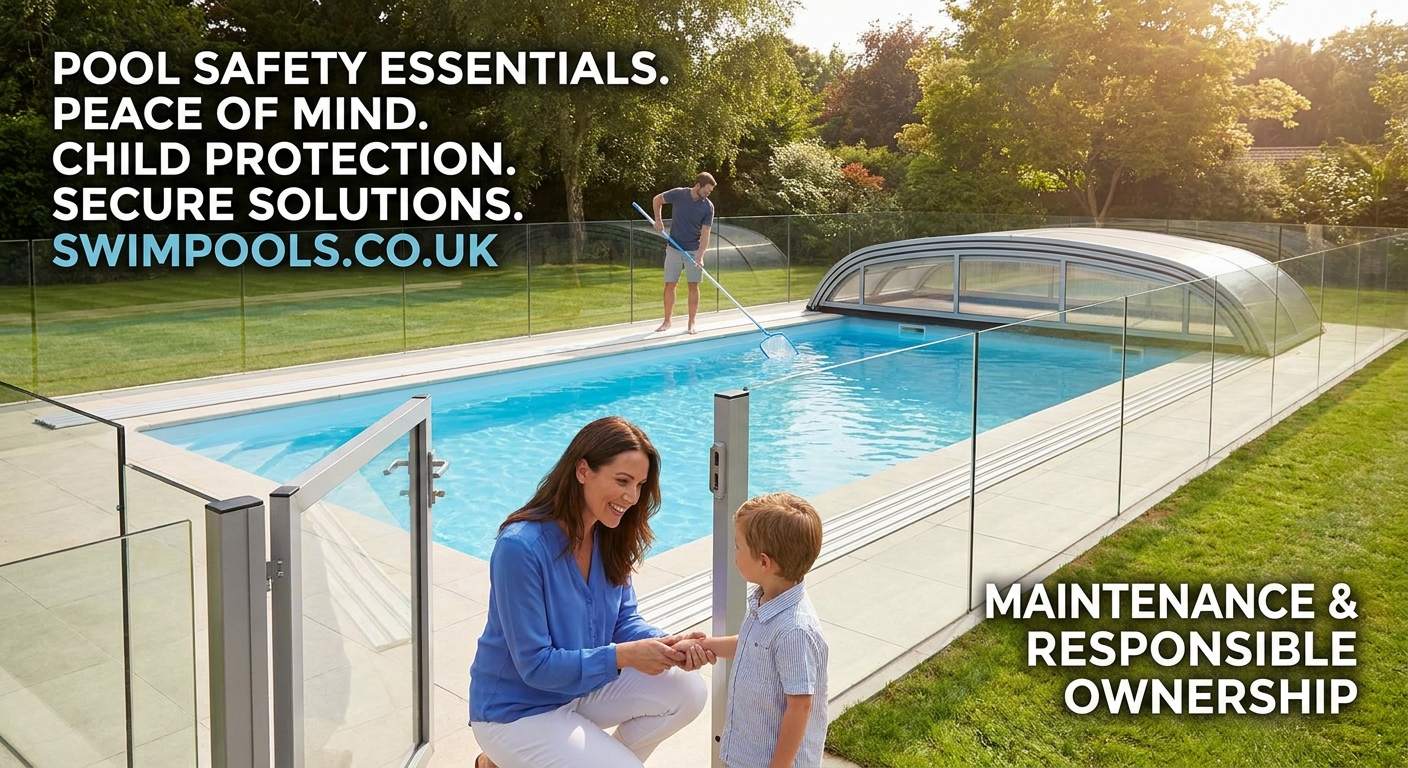
Pool Safety Essentials for UK Families: Child Protection, Enclosures and Peace of Mind
Drowning can happen in under two minutes, in water as shallow as a few inches, and without any sound that would alert an adult in the next room. For families with a residential pool, that fact is the starting point, not a worst-case scenario. Understanding precisely what stands between a young child and an unsupervised entry into the water is the work this article does, section by section, from physical barriers through to water chemistry.
The sections that follow build a complete picture rather than a list of reminders. Each layer of protection matters on its own, but the real security comes from stacking them. Start here, with the case for taking the whole subject more seriously than UK legislation currently requires you to.
Why Pool Safety in the UK Demands More Than Common Sense
Drowning is the third leading cause of unintentional injury death worldwide. Children under five are disproportionately represented in residential pool incidents, and the reason is straightforward: they move quickly, they have no reliable sense of danger around water, and they can enter difficulties silently. A residential pool does not need to be deep to be fatal for a toddler.
What makes the UK context particularly demanding is the absence of a single mandatory national standard for private residential pool fencing. Countries like Australia and several US states have prescriptive codes specifying exact fence heights, gate mechanisms and inspection requirements. UK homeowners have no equivalent rulebook handed to them at planning stage. The result is that safety provision varies enormously from one garden to the next, driven largely by what a homeowner happened to read or was told by an installer.
That legal vacuum does not mean there is no accountability. Under the Occupiers Liability Act 1957, homeowners owe a duty of care to any lawful visitor, including a neighbour's child invited round to swim. The 1984 Act extends a qualified duty even to trespassers, which in practice means a child who wanders in uninvited. If a child is injured on a pool that was inadequately secured, the absence of a national standard is unlikely to shield the property owner from a civil claim. The legal exposure is real, even if the regulatory trigger is not.
This combination of high risk and low regulatory compulsion means that homeowners must go looking for best practice rather than waiting for it to be imposed. That is where working with a specialist retailer makes a material difference. Swimpools brings together knowledge of pool construction, enclosure specifications and fencing integration that a general builder or landscape contractor is unlikely to hold in one place. The guidance available through a specialist is not a sales conversation; it is the substitute for the legislation that does not exist.
The sections in this article move from the outermost physical barrier inward to the water itself, covering fencing geometry, enclosure specifications, cover and alarm technology, supervision habits, and maintenance as a safety discipline. Each section addresses a distinct layer. Read them as a system, not a menu.
Fencing That Actually Works: Heights, Gates and Gap Rules
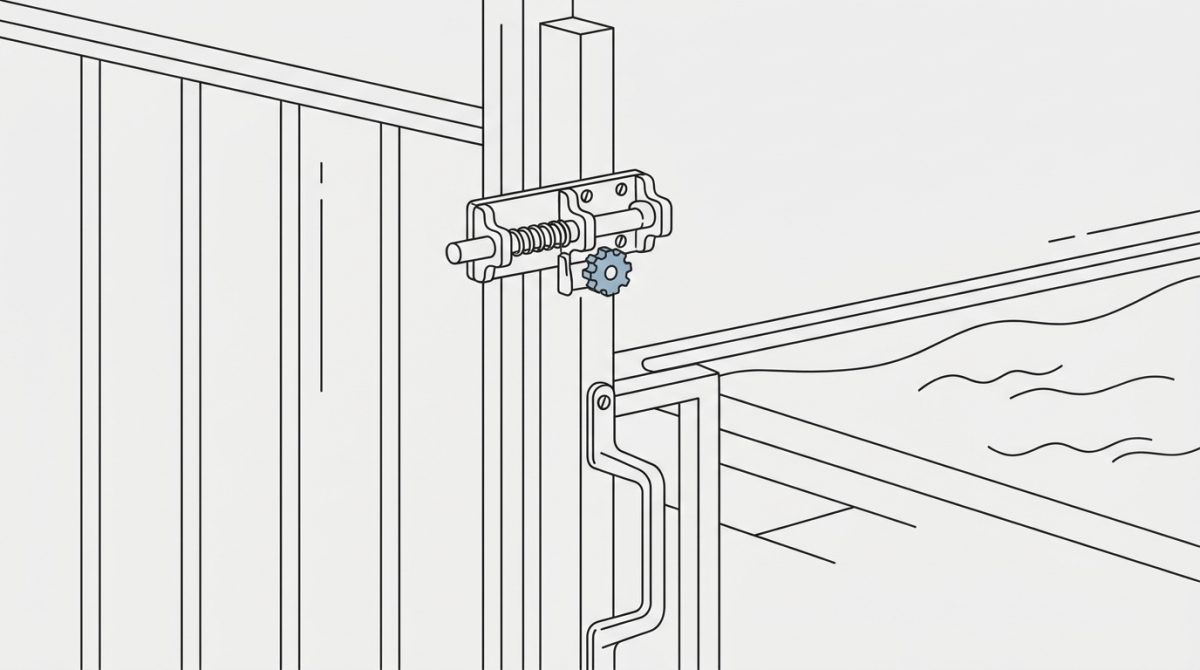
The single most important structural decision in residential pool fencing is whether the fence surrounds all four sides of the pool independently, or whether one side is formed by the house wall. The difference is not cosmetic. CPSC safety barrier guidelines are unambiguous: a fence completely surrounding the pool is substantially safer than one that relies on the house as the fourth side, because every door in that wall then becomes a potential access point. A four-sided independent fence keeps a child out of the pool zone regardless of whether a back door has been left open.
If the house wall genuinely must serve as one side of the barrier, the compensation requirements are strict. Every door that opens onto the pool area needs a door alarm fitted, and every door handle or lock that a child could reach needs a self-latching device positioned above their reach. This is a more complex system to maintain than a freestanding fence, and any failure in any door defeats the entire barrier.
Height and picket spacing
The CPSC recommends a minimum fence height of 4 feet for residential pools. In UK gardens where older children and teenagers are present, 5 feet or higher is strongly preferable. A motivated eight-year-old can scale a 4-foot fence with minimal effort; the extra foot introduces a meaningful deterrent even for children who understand the rules but choose to ignore them.
Picket spacing is equally important. Vertical pickets should have gaps no wider than 4 inches. That is the maximum that prevents a small child from squeezing a body through. Test your proposed design with a 4-inch sphere: if it passes through, so can a determined toddler's torso. The pickets themselves should be vertical, not horizontal. Horizontal rails on the pool-facing side of a fence act as a ladder. A child who cannot climb a smooth vertical face can often scale a fence with horizontal members in thirty seconds. Any horizontal structural element should be positioned on the outside of the fence, away from the pool.
Gate mechanics
Gates are the point of failure in most residential pool fence systems. A gate left propped open for convenience, a latch that does not fully engage, a hinge that lets the gate sag over time: each of these turns a good fence into a poor one. The requirements are not complicated, but they must be built into the gate from installation, not added as an afterthought.
- Self-closing hinges should return the gate to the closed position from any angle, including nearly-closed positions where a gentle push is not enough to engage the latch.
- Self-latching mechanisms must engage automatically every time without manual assistance.
- The latch should be positioned on the pool-facing (inside) surface of the gate, at least 54 inches from the ground, so that a young child standing on the outside cannot reach over and release it.
- If the latch is below 54 inches for any reason, it must be shielded by a cover requiring a specific action to remove, not just a simple lift or push.
Check the gate mechanism every few months. Springs weaken, latches corrode, and hinges shift under regular use. A gate that worked perfectly at installation may have a 2-inch gap at the base two years later if the ground has moved or a hinge has worn.
Material choices for UK conditions
The UK climate imposes specific demands on fencing materials that do not apply in drier climates. Consistent rain, temperature fluctuation and proximity to pool water create corrosion and rot conditions that will shorten the effective life of a poorly chosen material.
- Powder-coated aluminium is the practical first choice for most UK pool gardens. It resists corrosion, requires minimal maintenance, and holds its structural integrity without annual treatment. Specify marine-grade powder coating if the garden is exposed or particularly wet.
- Frameless glass panels offer unobstructed sightlines across the pool area, which is a genuine safety advantage as well as an aesthetic one. A parent inside the house can see the pool from a greater distance and angle than through a slatted fence. Toughened safety glass to BS EN 12150 is the minimum standard for structural glass in this application.
- Hardwood timber is visually warm and suits traditional garden aesthetics, but it requires annual treatment with a preservative or oil finish to prevent moisture ingress, rot and structural weakening. Untreated or under-treated hardwood can lose significant strength within three to four years in a wet UK garden, and a fence that looks intact may no longer hold under pressure.
Swimpools can advise on fencing and barrier solutions that integrate with the pool surround, decking materials and overall garden design, so the safety infrastructure works with the aesthetic rather than cutting across it. A fence that looks out of place tends to be the one that gets removed or modified over time; one that feels like a considered part of the garden design stays intact.
Pool Enclosures: the Difference Between a Barrier and a Sanctuary
A fence keeps an unsupervised child out of the pool area. A pool enclosure does something architecturally different: it converts the pool from an outdoor feature into a controlled indoor-outdoor environment that is only accessible when an adult makes a deliberate decision to open it. The distinction matters because an enclosure removes the possibility of accidental access entirely, rather than making access difficult.
Swimpools supplies pool enclosures across a range of configurations, from low-profile telescopic designs that retract along the pool length and sit almost flush with the surrounding garden to full standing-height structures that function as a glazed pool room. The right choice depends on garden dimensions, how the pool will be used through the year, and what aesthetic the homeowner wants to achieve. Both ends of the range deliver the core safety benefit: controlled, closable access.
Telescopic enclosures and their specific advantages
Telescopic enclosures are built from interlocking sections that slide along a track beside the pool. Individual sections can be locked independently, which introduces a useful level of operational flexibility. One end of the enclosure can be left open for ventilation while the remaining sections stay locked and secured against unsupervised entry. This means the enclosure does not have to be a binary open-or-closed choice during warm weather; it can be configured to allow airflow without opening the full pool area.
That same section-locking feature matters at the end of a swimming session. An adult closing the enclosure after use can lock each section individually as it is pushed back, so the pool is secured progressively rather than all at once. There is no single moment where the whole pool is unsecured while the cover is being fitted.
Running-cost savings that come with the safety investment
A quality pool enclosure reduces evaporation by up to 75 percent compared with an uncovered outdoor pool. That single figure drives significant reductions in both chemical consumption and heating costs, because the two largest variables in pool running costs are heat loss through the water surface and chemical loss through evaporation and UV degradation. The enclosure addresses both simultaneously. For a heated pool in a UK climate, the annual savings on gas or heat pump running costs alone can be substantial enough to offset part of the enclosure's capital cost over a five to ten year period.
This means the safety case and the financial case for an enclosure point in the same direction. Homeowners who might otherwise hesitate at the capital outlay are effectively paying for the safety benefit while recovering some of the cost through reduced running expenses.
Glazing standards and structural certification
The polycarbonate glazing panels used in premium enclosures carry UV protection ratings that prevent yellowing and embrittlement over time, as well as impact resistance ratings that matter in a family garden where balls, garden furniture and weather events are part of daily life. When specifying an enclosure, ask the supplier specifically for EN 1090 certification or equivalent on the structural aluminium frame. EN 1090 is the European standard for the structural assessment of steel and aluminium components; its presence on a pool enclosure frame confirms that the load-bearing elements have been designed and verified by a structural engineer rather than assembled from untested extrusions.
A two-layer detection system becomes practical once an enclosure is in place. If a pool alarm is installed on the water surface inside the enclosure, any breach of the structure that results in a child reaching the water triggers the alarm. The enclosure provides the first layer of physical containment; the alarm provides detection if that layer is somehow passed. Together they create a system with redundancy, so that no single point of failure leaves a child at undetected risk.
One installation detail is worth raising explicitly with your Swimpools consultant at the design stage. Enclosure footings are anchored into the pool surround or adjacent paving, and for luxury covers and enclosure systems fitted to Leisure Pools composite shells, the engineering of those footings must avoid any penetration that could compromise the pool shell's structural warranty. The solution is straightforward when it is designed in from the start; it becomes a much more complicated retrofit if it is overlooked during planning. Confirm the footing specification and its relationship to the shell warranty in writing before groundwork begins.
Pool Covers, Alarms and Wearable Tech: the Layers Between Your Child and the Water
A safety cover is not the same thing as the blue tarpaulin you drape over the water in October. A genuine safety cover is an engineered product rated to support the weight of a child or adult who falls onto it, with the European standard EN 13451 requiring a load tolerance of at least 485 kg per square metre. That is a meaningful number: it means the cover holds, buys time, and prevents a fall becoming a submersion. Solar covers and winter covers offer no such guarantee and should never be treated as a safety barrier.
Automatic safety covers powered by an electric roller close in under 60 seconds and are operated via a key switch mounted out of a child's reach. Models like the Tranquility with Auto Cover integrate the mechanism into the pool structure itself, so there is no visible housing for children to investigate. The key-switch requirement is worth emphasising: a cover that a child can operate is not a safety device.
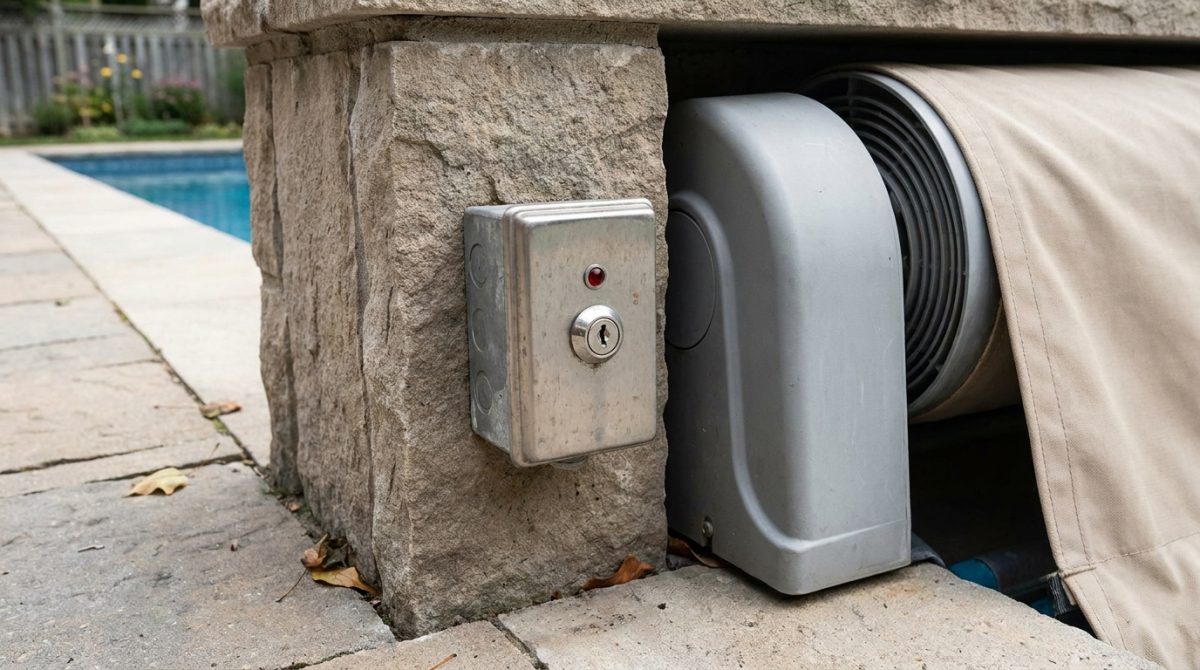
Pool surface alarms add the next layer. These devices detect wave disturbance the moment anything enters the water and can push alerts to a smartphone app within seconds. Brands such as Poolguard and Lifebuoy are available in the UK market and mount discreetly at the waterline. They are particularly useful for covering the gap between when a cover is retracted for use and when an adult's attention may momentarily drift.
Wearable wristband alarms provide a final, personal layer. Devices like the Aqua Alert are worn by children and trigger an audible alarm the instant the band is submerged, catching the moment of unexpected entry before it becomes a crisis. They are not a substitute for supervision, but they work precisely when supervision fails for a split second.
No single product does the whole job. The layered protection principle accepted across the pool safety industry holds that a fence combined with a safety cover and a water alarm together reduce risk far more than any one measure doubled or tripled. Think of each layer as catching what the previous one misses.
Finally, do not overlook the basics. A life ring with a minimum 30-metre throw line and a reaching pole should be mounted within two seconds of walking reach from the water's edge. Inspect them monthly: UV degradation, mildew, and fraying lines can render both useless exactly when they are needed.
Supervision Rules, Swimming Competence and the Family Safety Conversation
Physical barriers are only as reliable as the human behaviour around them. The hard truth is that drowning incidents consistently happen during brief lapses in adult attention, often in windows of under two minutes. A gate left unlatched, a door left open, a moment of distraction at a social gathering: these are the actual circumstances in which children reach water unsupervised. No fence compensates for an adult who has decided, just for a moment, that keeping watch is not necessary.
The most practical tool for any poolside gathering is the designated water watcher. This is a named adult whose sole responsibility during their rotation is watching the water. No phone, no conversation, no drink in hand. The role should rotate every 15 to 20 minutes to maintain genuine attention rather than habitual presence. At family barbecues and parties, where the sense of collective responsibility can paradoxically mean nobody is truly watching, formalising this role removes the ambiguity.
Swimming ability is not the same as water safety. A child who can complete a length at their local leisure centre has done so in a controlled environment, with a lane rope, predictable conditions, and a lifeguard on the poolside. Home pool conditions differ, unexpected falls produce panic responses, and clothing adds drag that even competent swimmers underestimate. Do not adjust your supervision level based on a child's school swimming certificate.
Before the pool is ever filled, establish non-negotiable family rules and rehearse them. Spoken rules are forgotten; rehearsed rules become habit. The core ones should include:
- No running on wet pool surrounds under any circumstances.
- No swimming alone, regardless of age or ability.
- No pool access unless the cover is fully retracted and a supervising adult is physically present.
- No breath-holding games or hyperventilation before swimming.
The Royal Life Saving Society UK (RLSS UK) runs Rookie Lifeguard programmes and Swim Safe outdoor sessions at venues across the country. These go beyond basic stroke work and teach children practical water survival skills: how to float, how to signal for help, how to manage unexpected cold water shock. Enrolling children in an RLSS UK programme is one of the most concrete steps a family can take, because it builds muscle memory for the moments when instruction cannot reach them.
Do not limit the safety conversation to your own household. Babysitters, grandparents, and visiting adults all need to understand the rules, and a verbal briefing is not enough. Write the rules down, post them somewhere visible near the pool access point, and make clear who holds supervisory responsibility at any given time during a visit. Ambiguity about responsibility is itself a hazard.
Maintenance as a Safety Practice: Water Quality, Equipment Checks and Seasonal Readiness
Pool maintenance is usually framed as a matter of aesthetics or equipment longevity. It is also a direct safety issue. Cloudy, poorly balanced water reduces underwater visibility to almost nothing at depth, meaning a submerged child can be invisible to an adult standing at the pool edge. pH should be maintained between 7.2 and 7.6, and free chlorine should stay between 1 and 3 ppm at all times. Test both at least twice a week during the swimming season and after any heavy use or rainfall.
Suction entrapment is a hazard that receives less attention than it deserves in residential settings. A faulty or displaced drain cover can create enough suction to trap hair, limbs, or swimwear, pinning a swimmer underwater. All drain covers should comply with ANSI/APSP-16 or an equivalent standard, and every cover should be physically inspected monthly for cracks, displacement, or signs of wear. Replace rather than repair any cover that shows damage.
Pool surrounds need seasonal inspection too. Lifting tiles, uneven decking boards, and algae growth are all slip hazards that develop gradually and are easy to overlook until someone falls. UK pool installation standards account for surround safety, but ongoing compliance is the owner's responsibility. Composite pool shells from Leisure Pools have a smooth, non-porous surface that resists algae attachment, simplifying this inspection considerably and reducing the frequency of chemical scrubbing required.
Heating and filtration equipment should be serviced annually by a qualified engineer. A pump running below specification does not just cost more to run; it can leave dead zones of undertreated water near steps, shallow ends, or return jets where children spend most of their time. An annual service catches this before it becomes a water quality problem.
At the point of installation, ask for a written commissioning and winterisation checklist specific to your pool model. Swimpools provides installation documentation with tailored maintenance schedules, which matters most for first-time pool owners who have no prior reference point for what a seasonal shutdown or spring recommissioning should actually involve.
Keep a poolside safety kit and inspect it quarterly. It should contain:
- A fully stocked first-aid kit, checked for expired items.
- A throwable rescue device with an intact throw line.
- Emergency contact numbers for the local NHS trust, printed and laminated.
- Basic CPR guidance laminated and waterproofed, positioned where any adult can find it in under five seconds.
Responsible pool ownership is not a list of things you do once at installation. It is a set of habits that run in parallel with the pleasure the pool brings. The families who get this right are not the ones who have the most equipment; they are the ones who check it, use it consistently, and treat the water in their garden with exactly the seriousness it deserves.
The True ROI of a Premium Swimming Pool: Resale Value, Lifestyle, and Long-Term Economics
Ask a UK homeowner whether a swimming pool adds value to their property and you will get a mixed response. Ask one who has lived with a premium composite pool for five years and the answer almost always shifts. The question is not simply whether a pool adds kerb appeal. It is whether the total investment, purchase price, running costs, maintenance, and eventual resale value, stacks up over time.
The short answer is: it depends entirely on what you buy and how it is built. A budget fibreglass shell or an ageing liner pool can drain money quietly for years. A properly specified composite pool from a manufacturer with a lifetime structural warranty is a different calculation altogether.
What UK Buyers Actually Pay and What They Get Back
Premium residential pools in the UK typically start around £30,000 for a straightforward installation and can reach well above £80,000 once you factor in enclosures, heating, automation, and landscaping. That sounds steep until you consider that a conservatory or a substantial kitchen renovation routinely costs a similar amount with a far shorter usable season.
In terms of resale uplift, the picture is nuanced. Research from Savills and various estate agents consistently suggests that a well-maintained, attractively presented pool can add between 5% and 15% to a property's sale price in the right market. On a £600,000 home, that is a potential uplift of £30,000 to £90,000. Location matters enormously here. In areas where affluent buyers expect outdoor entertaining space, a pool is a positive differentiator. In smaller suburban plots where outdoor space is limited, the equation is tighter.
The caveat is always condition. A pool that looks dated or carries obvious maintenance issues can actively deter buyers. This is where the choice of construction technology becomes a long-term financial decision, not just a lifestyle one.
The Maintenance Cost Problem (and How to Avoid It)
Traditional concrete pools, while durable, are porous. They require regular acid washing, resurfacing every 10 to 15 years, and ongoing remediation of cracks caused by ground movement. A full concrete pool refurbishment in the UK can cost anywhere from £8,000 to £25,000 depending on size and condition. Over a 25-year ownership period, those costs compound significantly.
Composite pools built on advanced fibreglass and resin technology sidestep most of these problems. The shell is non-porous, which means algae finds far less purchase and chemical consumption drops. The structure flexes slightly with ground movement rather than cracking. There are no internal surfaces to resurface. The ongoing cost profile is genuinely lower, and that matters when you are calculating true lifetime cost of ownership.
Leisure Pools, one of the world's largest composite pool manufacturers, backs their shells with a lifetime structural warranty. That is not a marketing phrase. It transfers the financial risk of structural failure from the homeowner to the manufacturer for the life of the pool. When you are making an investment of this scale, that guarantee is a meaningful part of the value proposition.
Lifestyle Value: The Return That Does Not Show on a Spreadsheet
Financial ROI is only half the story. The lifestyle return on a premium pool is substantial and largely invisible in any conventional cost analysis.
Consider the alternative spend. A UK family taking a week-long overseas holiday to access pool facilities might spend £4,000 to £8,000 per trip. Over ten years that is £40,000 to £80,000. A private pool at home replaces much of that spend while adding daily usability, fitness benefits, and a social anchor for family life that a holiday simply cannot replicate.
There is also the health dimension. Regular swimming is one of the most effective low-impact exercises available. Access to a private pool removes the friction of public leisure centres, timetable constraints, and travel. For families with children, early regular swimming builds confidence and water safety. For adults managing joint pain or recovering from injury, pool access has clear therapeutic value.
Why Build Quality Is the Central Variable
The home leisure sector broadly has seen strong demand since the early 2020s as UK homeowners invested heavily in outdoor living space. That demand has attracted a wide range of suppliers at different quality tiers. Not all pools are built equally, and the price difference between a budget option and a premium composite pool reflects genuine differences in longevity, performance, and long-term cost.
When evaluating any pool investment, the questions worth asking are:
- What is the structural warranty, and who backs it?
- What is the surface technology and how often will it need maintenance?
- How is the shell manufactured and what does it flex with ground movement?
- What is the expected chemical consumption compared with concrete alternatives?
- What enclosure and heating options are available to extend the usable season in the UK climate?
A pool that answers those questions well is one that protects its value across decades. A pool that cannot answer them clearly is a liability dressed as an asset.
Making the Numbers Work in the UK Context
The UK climate is an obvious objection to pool ownership. However, a composite pool paired with a good enclosure and an efficient heat pump extends the swimming season from the typical six summer weeks to something closer to nine or ten months. A solar-assisted heating system can reduce running costs further. The combination makes the lifestyle case much stronger and the cost-per-use figure more reasonable.
For a homeowner planning to stay in a property for ten years or more, the financial case for a premium pool is genuinely sound when you account for the full picture. Capital value uplift, avoided holiday costs, reduced ongoing maintenance versus cheaper alternatives, and the transferable lifetime structural warranty all contribute to a return profile that stands up to scrutiny.
The analogy with any major home investment holds here. A well-specified kitchen from a quality manufacturer retains its value better than a cheap flat-pack fit-out. A premium composite pool from a manufacturer with a lifetime warranty retains its value better than a budget liner or a porous concrete shell. The upfront cost is higher. The long-term economics are better. That is the real calculation worth making.
Five image styles to choose from
Every article gets a custom hero image generated to match. Pick the look that fits your brand, and change it any time. Click any thumbnail to see it full size.

Polished business imagery with strict no-text-artifacts rules.

Professional photography, no overlaid text. Editorial feel.

Photo plus a bold title overlay. Great for social shares.

Modern flat illustration. Friendlier, less corporate.

Looks like a real customer photo on a phone. Authentic, unpolished feel.
Everything you need, nothing you don't
A complete content pipeline you can fully automate, or take the wheel on any individual article whenever you want.
Auto-pilot mode
Set your cadence, connect WordPress, walk away. We check your queue daily and top it up when you have less than a week of posts scheduled. Fully automatic, no thinking needed.
Real research, not regurgitation
We crawl the sites already ranking for your keywords and your industry feeds. Every article is grounded in what people actually search for and read right now, not generic AI filler.
Original, in your voice
Every article is written from scratch in a voice that matches your brand, captured once during setup. No scraping, no spinning, no "as an AI language model".
Custom hero images
A unique on-brief image generated for every post in your chosen style. No more grabbing the same stock photos everyone else uses.
SEO baked in
Meta titles, descriptions, structured headings, internal linking suggestions, keyword targeting, all handled. Designed to rank, not just to fill space.
Direct WordPress publish
Posts go live automatically at the schedule you set, pushed straight to WP via the API. No copy-paste, no plugin install.
Rewrites + image regens
Don't love an article? Click Rewrite, we'll redo it on our credit, up to three times per article. Same for image regenerations.
Download every format
HTML, Markdown, Word, PDF. Articles are yours to keep, repost, repurpose, even if you cancel.
Done-for-you WP setup
Don't want to mess with API passwords? Drop in your WordPress login and we'll connect your site for you, free of charge. Same for the blog page itself if you don't have one yet.
Topic filtering
Block words or phrases you never want in articles. We filter at harvest time so the classifier never wastes credits on them.
Credits never expire
Buy credits when you want them, spend them when you want to. No "use it or lose it" pressure, no monthly resets that punish slow weeks.
No lock-in
Cancel any time from the Stripe billing portal. No setup fee, no minimum term, no awkward email exchange to leave.

Set your cadence, connect WordPress, walk away. We check your queue daily and top it up when you have less than a week of posts scheduled. Fully automatic, no thinking needed.

We crawl the sites already ranking for your keywords and your industry feeds. Every article is grounded in what people actually search for and read right now, not generic AI filler.

Every article is written from scratch in a voice that matches your brand, captured once during setup. No scraping, no spinning, no "as an AI language model".

A unique on-brief image generated for every post in your chosen style. No more grabbing the same stock photos everyone else uses.

Meta titles, descriptions, structured headings, internal linking suggestions, keyword targeting, all handled. Designed to rank, not just to fill space.

Posts go live automatically at the schedule you set, pushed straight to WP via the API. No copy-paste, no plugin install.

Don't love an article? Click Rewrite, we'll redo it on our credit, up to three times per article. Same for image regenerations.

HTML, Markdown, Word, PDF. Articles are yours to keep, repost, repurpose, even if you cancel.
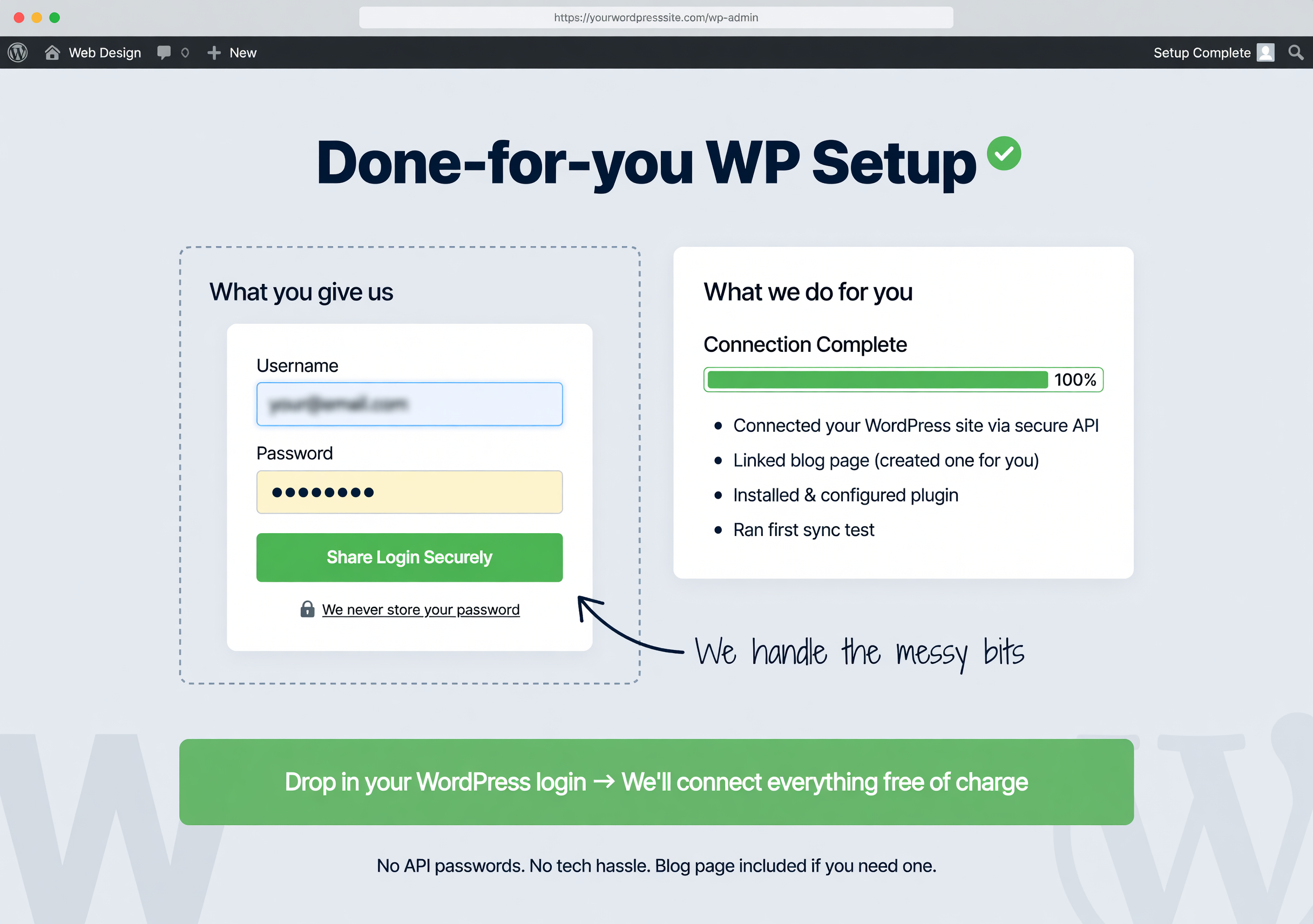
Don't want to mess with API passwords? Drop in your WordPress login and we'll connect your site for you, free of charge. Same for the blog page itself if you don't have one yet.
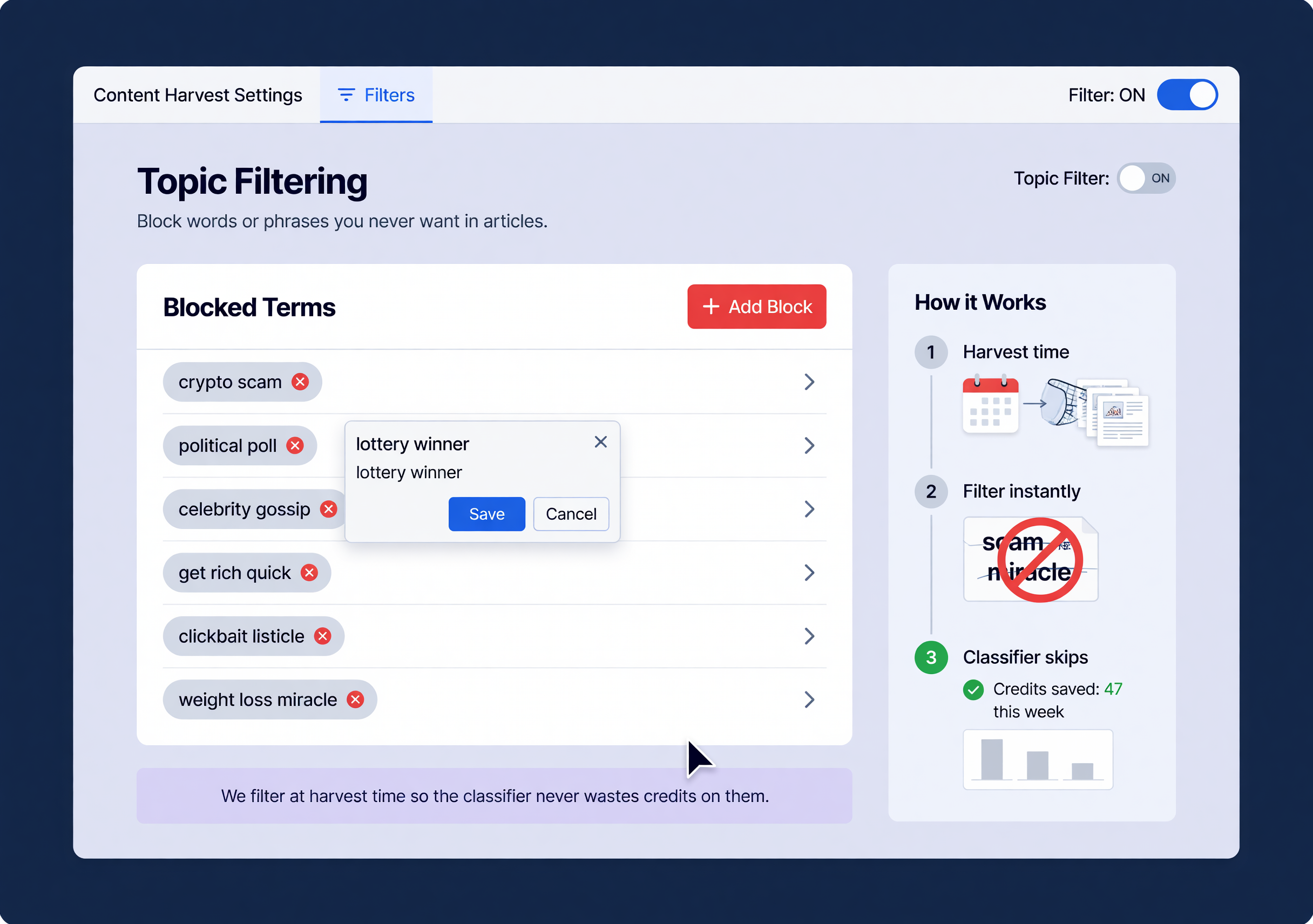
Block words or phrases you never want in articles. We filter at harvest time so the classifier never wastes credits on them.

Buy credits when you want them, spend them when you want to. No "use it or lose it" pressure, no monthly resets that punish slow weeks.

Cancel any time from the Stripe billing portal. No setup fee, no minimum term, no awkward email exchange to leave.
AI-curated article ideas, targeted at your business and customer base
Each article idea comes with a category, a type (Evergreen vs Timely), and is a high fit to your business niche and something your site visitors will be searching for.

Hero image, structured body, ready to publish
Every article gets a hero image generated in your chosen style, proper SEO structure, and download links for all major formats. Published automatically for you too!
Try it without paying a penny
3 fully-written articles, in your voice, on us. See if it's worth it before you spend anything. No card, no commitment, no obligation.
Up and running in under 2 minutes
From URL submitted to first article written, about as long as your morning coffee.
Drop in your URL
We analyse your site, find your real competitors, and surface a personalised content plan: categories, voice, image style.
Use your 3 free articles
We've handed you 3 free credits. Pick three ideas from the AI-curated queue and watch the first article appear in the portal.
Connect WordPress
Connect it yourself in 2 minutes, or drop us your admin login and we'll set it up for you. Both routes are free.
Flip on Auto (or stay manual)
Set your cadence, choose Auto and walk away, or keep Manual and pick ideas yourself. Either way, articles keep coming.
Try it without paying a penny
3 fully-written articles, in your voice, on us. See if it's worth it before you spend anything. No card, no commitment, no obligation.
Pay per article, the more you publish, the cheaper they become
All prices include VAT. Volume discount applies to credit packs AND monthly subscriptions, the more you commit to, the cheaper each article gets.
See your price live as you slide
In the portal you drag a slider, the tier you're in lights up, and the total updates in real time. Inc-VAT and ex-VAT toggle on demand.
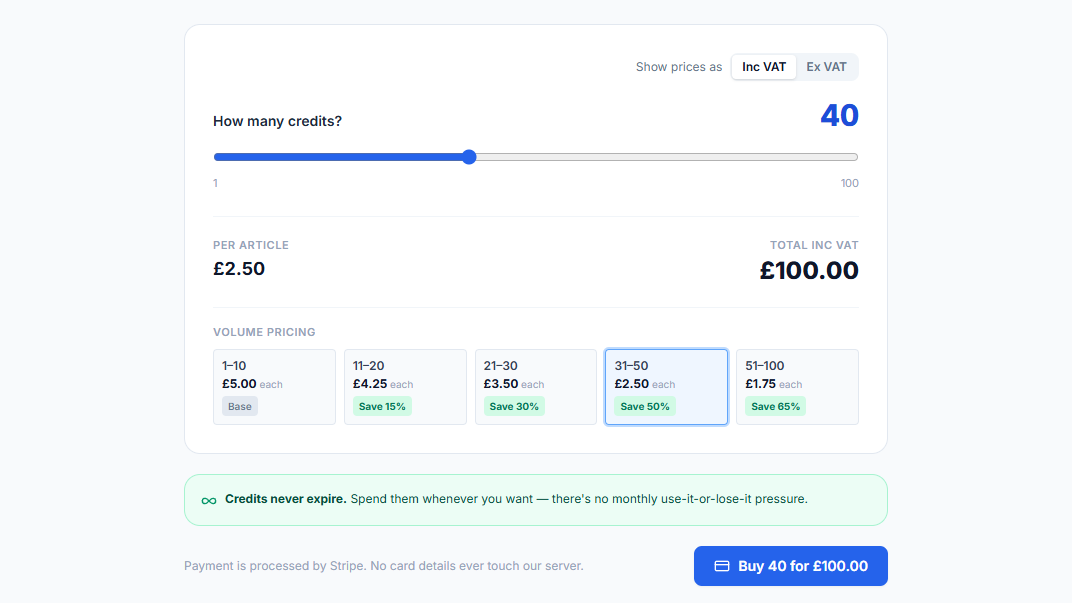
Credits never expire
Buy 100 today, spend them over a year. No monthly reset, no "use them or lose them".
Cancel any time
No minimum term, no setup fee. Manage everything from the Stripe billing portal yourself.
Rewrites on us
Don't love an article? Click Rewrite. Don't love the image? Click Regenerate. Up to 3 of each per article, at no extra cost.
Already convinced? Claim your 3 free articles and decide after you've seen the quality.
Truly autonomous, no monthly button-clicks
Most "AI content" tools dump articles on a schedule whether you need them or not. We only act when your runway runs low.
We watch your queue. You don't.
- Every day at 06:00 UTC we count how many posts are scheduled ahead on your WordPress.
- If you've got more than 1 week of runway, we leave you alone, no credits burned for the sake of it.
- If runway drops below 1 week, we harvest fresh ideas, write enough articles to top you back up to around 2 weeks, and schedule them at your cadence.
- Manual writes (yours) and Auto writes (ours) both extend the runway. Picking a few articles by hand just delays the next auto run. Nothing gets double-spent.

Questions worth answering up-front
Try it, judge it, decide
Drop your URL in. We'll write you 3 articles for FREE. We know you'll love them but there's no commitment to get more, you can just walk away.