
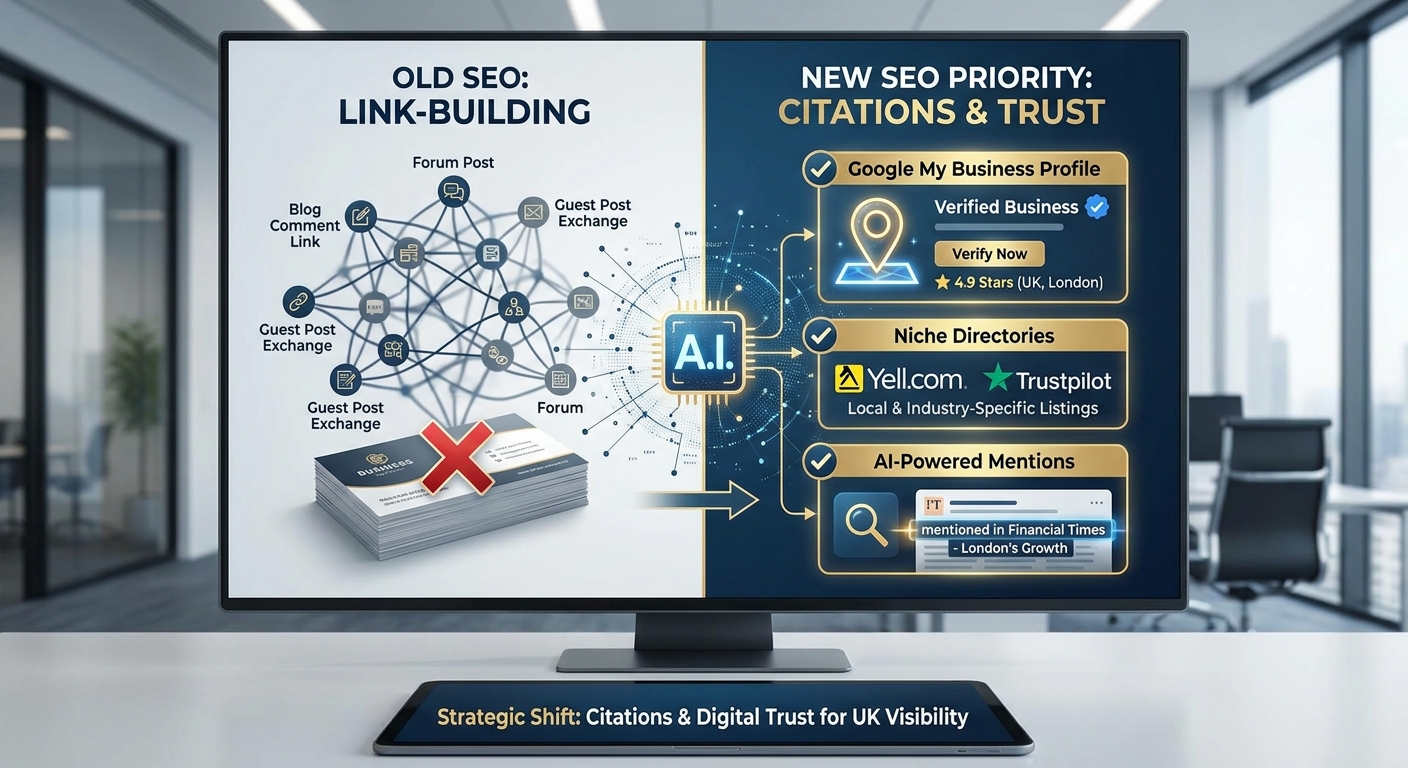
For years, getting other websites to link back to yours was the main way to climb Google's rankings. More backlinks from credible sites meant more authority, more visibility, more customers. Simple enough.
That logic still holds some water for traditional search. But something significant is shifting. AI-powered search tools like Google's AI Overviews, ChatGPT, and Perplexity are increasingly deciding what information people see before they ever scroll to a list of blue links. And the signal those tools rely on is not the backlink. It is the citation.
What is a citation, exactly?
In SEO terms, a citation is any place on the web where your business is mentioned, usually with your name, address, and phone number (often called NAP data). Think Google Business Profile, Yell, Checkatrade, Thomson Local, Yelp UK, Facebook business pages, and trade-specific directories.
A citation does not need to include a clickable link to count. Just being mentioned consistently and accurately across trusted sources tells search engines and AI tools that your business is real, established, and relevant to a specific location or industry.
How AI search changes the game
When someone asks Google's AI Overview or ChatGPT a question like "best plumber in Worthing" or "affordable web design for small businesses in Sussex", the AI is not crawling the web in real time looking for pages with the most backlinks. It is drawing on its training data and live index to identify sources it already trusts.
According to research cited by xseek.io, 58% of online searches now trigger an AI-generated answer. Separate analysis found that strong AI citation presence can boost a brand's visibility in those generative answers by around 40%. If your business is not mentioned in the places these AI systems consider credible, you may simply not appear in those answers at all, regardless of how many backlinks you have built up over the years.
Backlinks and citations are effectively solving two different problems. Backlinks still help your pages rank in the traditional "ten blue links" part of Google. Citations help determine whether AI tools mention you by name when someone is looking for exactly what you offer.
What this means for a small UK business
If you run a local or regional business, whether you are a tradesperson, a solicitor, a beauty salon, or a startup offering a service, this shift is actually good news. Building citations is far more accessible than chasing backlinks from high-authority publishers. You do not need a PR agency or a content team. You need consistency and the right listings.
Here is where to focus your effort:
- Google Business Profile: This is non-negotiable. Keep your name, address, phone number, website, opening hours, and categories accurate and up to date. Respond to reviews. Add photos regularly. Google's AI draws heavily on this data when surfacing local businesses.
- Core UK directories: Make sure your details are consistent on Yell, Bing Places, Apple Maps, and the Thomson Local directory. Inconsistencies between listings (a slightly different address format, an old phone number) actively undermine your credibility with AI systems.
- Industry-specific directories: A builder should be on Checkatrade and Rated People. A solicitor should appear on the Law Society's Find a Solicitor tool. A restaurant belongs on TripAdvisor and OpenTable. Niche directories carry real weight because they signal relevance, not just existence.
- Local press and community sites: A mention in your local newspaper online, a charity sponsorship listed on a community website, or a feature in a local business roundup all count as citations. These also have the bonus of reinforcing your local relevance.
- Social profiles: Facebook Business, LinkedIn company page, and even Instagram can function as citation sources. Keep your NAP data consistent here too.
The consistency rule matters more than you think
One of the most common mistakes small businesses make is having slightly different versions of their details scattered across the web. The business name might be "Samson Web Design" in one place and "Samson Web Design Ltd" in another. The phone number might be missing an area code somewhere. The address might use "Road" in one listing and "Rd" in another.
To a human this looks like a trivial variation. To an AI system deciding whether to trust a source, inconsistency is a red flag. Audit your existing listings using a free tool like BrightLocal or Whitespark, and clean up anything that does not match your primary details exactly.
Do backlinks still matter at all?
Yes. Do not abandon link-building entirely if it is working for you. Backlinks remain important for ranking in traditional Google search results, particularly for competitive keywords. If you are trying to rank a service page for "web design Worthing" or "boiler repair Brighton", quality backlinks from local business associations, suppliers, and industry bodies still help.
The smarter approach is to treat citations and backlinks as complementary. Citations build the foundation of trust that AI tools need to recognise and recommend your business. Backlinks help push your pages up the traditional rankings. Together, they cover both the old and new versions of how search visibility actually works.
A practical starting point
If you are not sure where to begin, start with a simple audit. Search your business name on Google and note every listing that appears. Check whether the details match. Then work through this short list:
- Claim and fully complete your Google Business Profile if you have not already.
- Check your Bing Places listing (many businesses forget this one).
- Search your business on Yell and update or claim it.
- Pick two or three industry-specific directories that are relevant to your sector and make sure you are listed.
- Set a reminder to review your listings every six months.
None of this requires a big budget or technical expertise. It requires attention to detail and a bit of time. Given that more than half of all searches now produce an AI-generated answer, getting your citations right is one of the most practical things you can do to stay visible in the months and years ahead.
If you want help auditing your current online presence or getting your listings in order, the team at Samson Web Design is happy to take a look. It is the kind of groundwork that makes everything else you do online work harder for you.


