
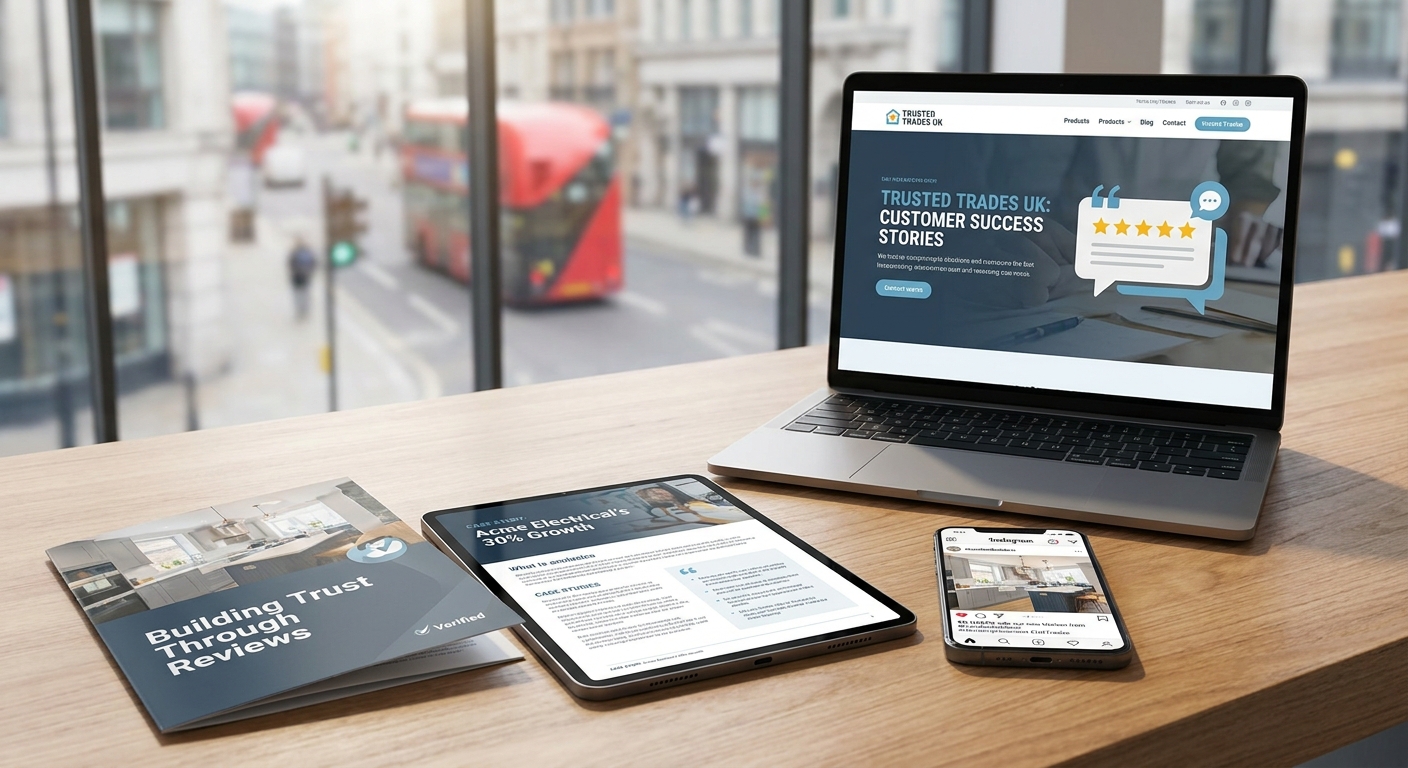
Picture three local plumbers listed on a Google search. One has 47 five-star reviews mentioning specific jobs, one has three reviews averaging two stars, and one has nothing at all. Even before clicking a single link, most people have already made a decision. That is social proof doing its job.
The psychology is straightforward: when we are unsure whether to trust something, we look at what other people have done or said. It is the same instinct that makes a busy restaurant feel safer than an empty one. For UK businesses, especially trades, service providers, and small retailers, understanding this principle and applying it deliberately on your website can make a measurable difference to your conversion rate.
Why Social Proof Works on a Psychological Level
Robert Cialdini identified social proof as one of the core principles of persuasion in his influential work on influence and decision-making. The short version: people default to the behaviour of others when they feel uncertain. Buying from a business they have never used before is inherently uncertain, so anything that shows others have done it successfully reduces that anxiety.
This is particularly relevant online, where customers cannot physically inspect a tradesperson's work, meet the team, or pick up a product before buying. Reviews and testimonials act as a substitute for that missing sensory information. According to research highlighted by Sprout Social, seeing a product or service with hundreds of positive reviews genuinely shifts purchasing decisions compared to seeing something with few or no reviews at all.
The Four Types of Social Proof Worth Using
Not all social proof carries equal weight. Here are the main forms, roughly in order of persuasive impact for most UK service businesses:
- Customer testimonials: Written quotes from real clients, ideally with a name, location, and photo. A testimonial that says "Trevor from Worthing" is more believable than one with no attribution.
- Star ratings and review platforms: Google Business Profile reviews, Checkatrade, Trustpilot, and Houzz are the platforms UK buyers recognise and trust. Embedding these on your site, or linking to them clearly, adds third-party credibility you simply cannot manufacture.
- Case studies and before-and-after examples: These go deeper than a quote. A short case study explaining the problem, what you did, and the outcome gives prospective clients something concrete to picture themselves in.
- User-generated content (UGC): Photos shared by real customers on social media, tagged reviews, or community posts. This is especially powerful for e-commerce or home improvement businesses where visual evidence matters.
Placement Matters as Much as Content
Having 50 glowing reviews buried on a separate testimonials page that nobody visits is a missed opportunity. Social proof works best when it appears close to the moment of doubt or decision, not filed away somewhere tidy.
On a trade business website, that typically means placing a couple of strong testimonials directly on the homepage, near your call-to-action buttons. A roofer's site, for example, benefits from showing a short quote like "They arrived on time, cleaned up after themselves, and the quote was exactly what we paid" right next to the "Get a Free Quote" button. That is the moment when a visitor is weighing up whether to commit, and reassurance from a real past customer helps push them forward.
On product or service pages, relevant testimonials work harder than generic ones. A quote specifically about your kitchen fitting service belongs on the kitchen fitting page, not just the homepage.
Making Your Testimonials Actually Believable
Vague, generic praise tends to backfire. Most visitors have developed a reasonable instinct for testimonials that feel fabricated or exaggerated. "Great service, would recommend!" sounds like every other testimonial ever written and adds almost no persuasive value.
Specific detail is what makes a testimonial credible. Encourage customers to mention:
- The actual job or product they used you for
- A particular problem you solved
- Something that surprised them positively, such as speed, tidiness, or communication
- Whether they would use you again or have already referred you to a friend
You do not need to put words in their mouths. Simply ask the right question when following up after a job. Something like "Was there anything specific about the experience that stood out for you?" tends to produce much richer responses than "Any feedback?"
Case Studies for Trades and Service Businesses
If you are a builder, electrician, landscaper, or any trade where the work is visual and project-based, a short case study can work harder than any testimonial. It does not need to be long. Three paragraphs covering the brief, the approach, and the result, accompanied by a before-and-after photo, is enough.
A bathroom fitter in Sussex, for instance, might write up a loft conversion enquiry from a family in a Victorian terrace who needed creative use of a small footprint. Showing the finished bathroom alongside a few sentences about the challenge and solution gives future customers something relatable and concrete. It also helps with local SEO as a bonus, particularly if you name the area.
Using Review Platforms to Build Off-Site Trust
Your own website testimonials will always carry a degree of scepticism because visitors know you curated them. Third-party platforms reduce that scepticism significantly because the reviews exist outside your control, and buyers know it.
For UK trade businesses, Checkatrade and Which? Trusted Traders carry strong recognition. For general businesses and retailers, Google Business Profile reviews and Trustpilot are the most widely trusted. The practical steps here are simple:
- Claim and fully complete your Google Business Profile if you have not already
- Ask satisfied customers directly (by text or email after a job) to leave a Google review
- Display your overall rating or a badge from these platforms on your website homepage
- Respond professionally to every review, including any negative ones
Responding to negative reviews publicly is itself a form of social proof. It signals that you take accountability seriously, which actually builds trust with prospective customers reading those responses.
A Simple Principle Worth Remembering
Social proof does not require a big budget or a marketing team. It requires consistency: asking for feedback after every job, sharing real customer stories on your website, and making sure the evidence of your good work is visible at exactly the moment a potential customer is deciding whether to get in touch.
Most small UK businesses are sitting on a goldmine of positive customer experiences that never make it onto their website. Getting those experiences into the right format and placing them in the right spots is one of the most cost-effective improvements you can make to your website's ability to convert visitors into paying customers.


