
A landscaping company in Surrey books out six weeks in advance every summer, then in October the phone goes quiet and the owner starts cold-calling old clients. A Worthing-based electrician finishes a big rewire job, looks at his diary, and realises there is nothing lined up for the next fortnight. Both businesses are profitable when they are busy. Neither has a lead pipeline. That is the problem this article is built to solve.
Why Most Service Businesses Live and Die by Feast and Famine
The feast-and-famine cycle is almost always caused by reactive marketing. When the diary fills up, marketing stops because there is no time for it. When the diary empties, panic sets in and business owners start posting on Facebook, emailing old clients, or asking around for referrals. The work that comes from that scramble keeps them busy for a few weeks, marketing stops again, and the cycle repeats. The effort is real but the results are erratic.
The answer is not a list of prospects to call each Monday morning. A pipeline is a set of systems that produce enquiries without you manually pushing them forward every week. When it is built properly, the website is capturing visitors and converting them while you are on a job. Google is surfacing your business to people searching right now. A follow-up sequence is warming up leads who filled in a form three weeks ago. None of that requires you to stop what you are doing.
Service businesses are particularly exposed to this problem because they trade time for money. A plumber cannot store a Tuesday afternoon and sell it on Friday. A consultant cannot bank unbilled hours. When capacity goes unsold, it is gone. That makes consistent enquiry flow more urgent for a service business than it is for, say, a product retailer who can hold stock.
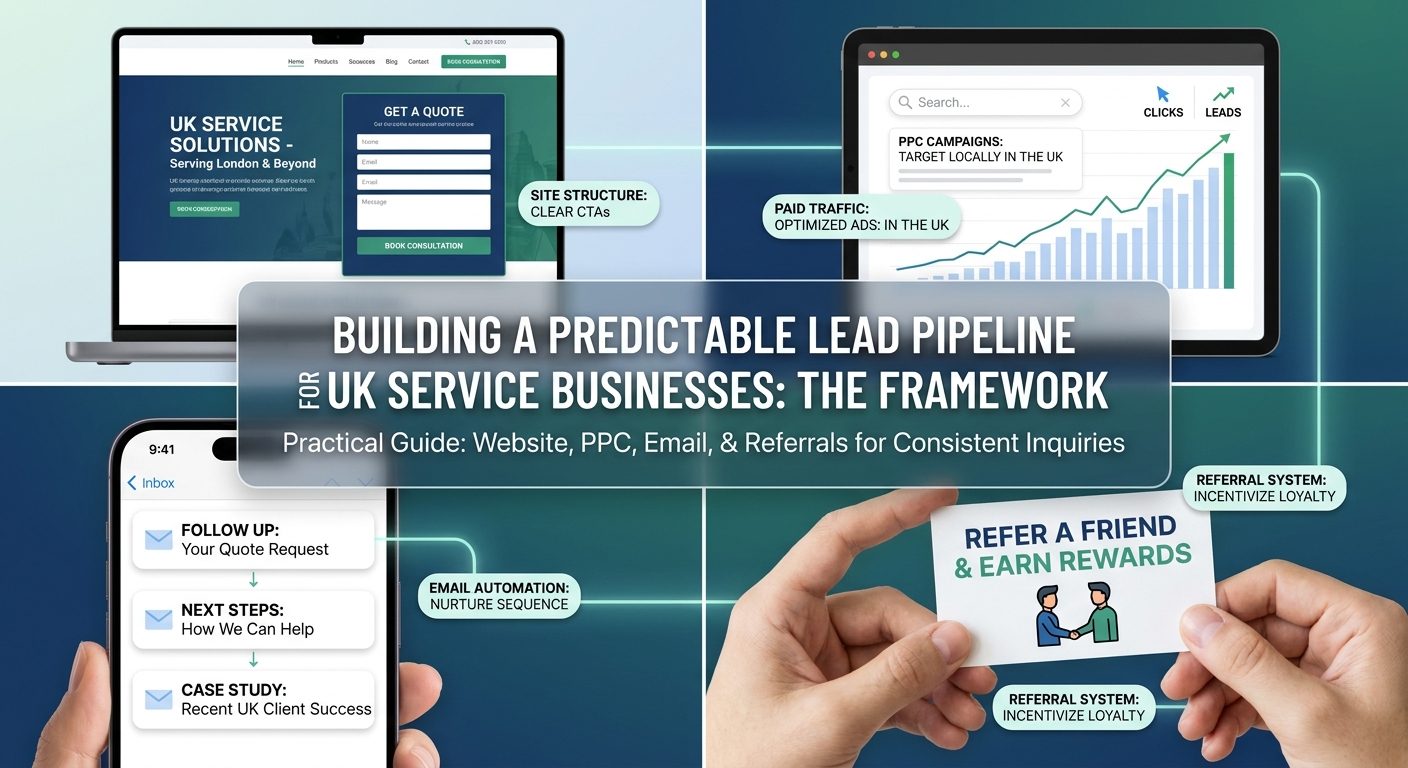
The fix is not simply spending more on advertising. Throwing money at Google Ads while the website leaks visitors, or chasing reviews while ignoring the contact form that barely works on mobile, produces disappointing returns. The real fix is building four interlocking layers that run simultaneously: a conversion-focused website, organic local search visibility, paid traffic that pays for itself, and a follow-up system that closes the loop on every enquiry. Each layer feeds the next. This article walks through each one in order so you can audit your own setup, spot where the gaps are, and know exactly what to fix first.
Your Website Is Either a Lead Machine or a Leaking Bucket
Most service business websites answer the wrong questions first. They open with a headline about the company's founding year, or a vague slogan about quality and commitment. The visitor, who arrived because they have a specific problem they want solved, scans the page for about eight seconds and leaves. The session is counted in Google Analytics. The enquiry never arrives.

A conversion-focused service page answers three questions before the visitor has to scroll: what you do, who it is for, and how to get started. "Boiler installations and servicing for homeowners in West Sussex" answers all three in one line. "Welcome to our website" answers none of them. Get those three answers into the headline and the opening sentence, and you immediately hold more visitors long enough to do something useful.
Layout: why two columns beat a wall of text
Walls of text push people away. A two-column layout, often called a 50/50 block, pairs every key claim with a proof point. Put a photo of a completed project next to the paragraph about your workmanship. Put a short testimonial next to the paragraph about your response times. 50/50 page blocks break up the visual monotony and give the reader's eye somewhere to land, which keeps them on the page longer and builds credibility as they read.
Every service page should have one primary call to action, and it should appear at least three times: in the top banner, roughly halfway down the page, and again at the bottom. Repeat it without apology. The visitor's attention drifts; they skim rather than read from top to bottom. If the only button is at the bottom, everyone who skims the top half and leaves without scrolling is a missed enquiry.
The wording of that call to action matters more than most business owners realise. "Get a free quote" performs consistently better than "Submit" or "Contact us" because it tells the visitor what they will receive, not what they are being asked to do. "Book a free survey" or "Request a callback" work for the same reason. Low-friction language removes the sense of commitment that stops people clicking.
Speed and mobile performance
Page speed is not a technical detail to hand off to a developer and forget. Google's own data shows that a one-second delay in mobile load time can cut conversions by up to 20 percent. Most small business websites in the UK are loaded primarily on mobile, which makes this directly relevant to how many enquiries actually arrive each week. Run your site through Google PageSpeed Insights, and if your mobile score is below 70, treat fixing it as urgent, not optional.
Trust signals that actually work
Generic trust badges do almost nothing. The signals that move the needle are specific ones. A testimonial that reads "Fantastic job replacing our flat roof in Lancing, finished on time and cleaned up perfectly" is more convincing than "Great service, highly recommend" because it contains verifiable detail. Named clients with a town or county are significantly more credible than anonymous quotes.
Recognised accreditation logos placed near the top of the page tell the visitor immediately that you meet an industry standard they probably care about. Gas Safe registration for heating engineers, NAPIT or NICEIC for electricians, FCA authorisation for financial services firms. These logos communicate something a paragraph of text cannot: that a third party has verified your credentials.
A visible local phone number in the header, not buried in the footer, signals that there is a real person available. Many visitors will not fill in a form but will call if the number is obvious. Keep both options open.
The contact form and what comes after it
Three fields is the right number for an initial contact form: name, email address, and a short description of what the visitor needs. HubSpot research has found that each additional field on a form reduces completion rates by roughly 11 percent. A form asking for name, email, phone, address, type of work, budget, and preferred start date will be abandoned by a significant proportion of the people who were ready to enquire.
Once someone submits the form, most websites show a bland confirmation message and leave the visitor wondering what happens next. Add a short "What happens next" section directly below every contact form. Something as simple as: "We'll reply within two working hours. If your job is urgent, call us directly on [number]. We'll ask a few quick questions and can usually give you a ballpark figure on the first call." This sets clear expectations, reduces the anxiety that makes people second-guess their submission, and increases the proportion of people who go through with it.
How Local SEO Puts You in Front of People Already Looking to Buy
Someone typing "emergency plumber Worthing" into Google at 8am on a Monday morning is not browsing. They have a burst pipe and they need someone today. That is the difference between local search traffic and most other forms of online visibility. The intent is commercial and the geography is specific, which means the people arriving at your website through local SEO are far closer to booking than someone who found you through a general interest article or a social media post.
Local SEO is the process of making sure your business appears prominently when people in your service area search for what you offer. It is not a single tactic but a combination of interconnected signals that Google uses to decide which businesses to show in the map pack and the organic results below it.
Google Business Profile: the highest-leverage free tool available
If there is one thing to fix before anything else, it is your Google Business Profile. This is the listing that appears in the map results and in the panel on the right side of the search results page. Complete every single field: business name exactly as it appears on your website, primary category, additional service categories, service areas, opening hours, a description using your key service terms, and a link to your website.
Photos make a measurable difference. Businesses with photos on their Google Business Profile receive 42 percent more requests for directions than those without. Upload photos of your completed work, your team, your van or premises, and anything that helps a potential client understand what you do and trust that you do it well. Aim for at least 10 photos to start with and add more over time.
NAP consistency across directories
NAP stands for Name, Address, and Phone number. Google cross-references the details on your website with the details in every directory listing it can find. If your business is listed as "Smith Plumbing Services" on your website but "Smith's Plumbing" on Yell, and your old address appears on Bing Places, those inconsistencies are a negative ranking signal. Check your listings on Yell, Bing Places, and any niche directories relevant to your trade, such as Checkatrade, FreeIndex, or Rated People, and make sure every entry uses identical details.
Location pages for every area you serve
One generic page titled "Areas We Cover" does not rank for location-specific searches. A Worthing-based plumber should have individual pages targeting "plumber Worthing", "plumber Lancing", and "plumber Shoreham", each written with enough unique content about that specific area to be genuinely useful to a local visitor. These pages take time to build but each one adds another entry point to your website from buyers in a specific location.
Review velocity and how to maintain it
The total number of Google reviews matters, but so does how recently they arrived. A business with 40 reviews, the most recent from 18 months ago, looks less active than one with 22 reviews where three arrived last month. Google uses review recency as a signal that the business is currently trading and currently satisfying customers. Aim for at least two new reviews per month by asking every satisfied client within 24 hours of completing the job, either by text with a direct link to your review page or by a short follow-up email. The 24-hour window matters because that is when the experience is freshest and the willingness to help is highest.
Content that captures long-tail commercial searches
Publishing one locally relevant piece of content per month compounds over time. A page answering "How much does a new boiler cost in West Sussex?" captures people who are actively considering a purchase and want to understand what they will pay before they call anyone. A page titled "What to do if your drains are blocked in Worthing" captures emergency searches. These pages do not need to be long or complex; they need to directly answer a question that someone in your service area is typing into Google.
Local SEO produces compounding returns over a 6 to 12 month period. The location pages you build now, the reviews that accumulate over the coming months, and the blog posts that answer buyer questions all stack on top of each other. That is exactly why local SEO must run in parallel with faster-acting paid channels rather than being treated as an alternative to them. The organic layer builds authority slowly; paid traffic provides immediate enquiries while that authority grows.
Running Google Ads That Pay for Themselves Instead of Draining Your Budget
Google Search Ads are the fastest route to enquiries for a service business that is new, relaunching, or simply not yet ranking organically. Within hours of a campaign going live, your business can sit at the top of search results for terms like "emergency boiler repair Worthing" or "kitchen fitter Brighton". The people typing those searches are already in buying mode, which is exactly the traffic you want.
The most common reason campaigns fail is starting too broad. Keep your first campaign tight: pick one service, one location, and no more than 10 to 20 keywords using exact-match and phrase-match settings. Set a daily budget of 10 to 20 pounds. That is enough to gather real data on what converts without burning through cash while you learn what works.
Negative keywords are just as important as the ones you bid on. Without them, your ads show up for searches that will never produce a paying customer. For service businesses, add these as negatives from day one:
- jobs (attracts people looking for employment)
- course and training (people looking to learn, not hire)
- DIY and how to (browsers doing research)
- free (people who will not pay for your service)
Checking your Search Terms report weekly and adding new negatives is a simple habit that can cut wasted spend by 20 to 30 percent within the first month.
Quality Score is Google's rating of how relevant your ad is, scored from 1 to 10. A score of 7 or above reduces your cost per click meaningfully because Google rewards relevance with cheaper placement. Achieving it is straightforward: match the ad headline to the keyword a person searched, then match the landing page headline to the ad. If someone searches "roof repair Chichester", the ad headline should say "Roof Repair in Chichester" and so should the first heading on the page they land on. Consistency through that chain is what lifts the score.
If you are a verified trade business, Google Local Services Ads are worth setting up alongside standard Search Ads. LSAs show above regular paid results, carry a Google Guarantee badge, and charge per lead rather than per click. That means you only pay when someone contacts you directly, which makes the risk much lower for businesses working with a tight budget.
Always track phone calls as conversions. Set up call extensions in your campaign and use a call tracking number so you can tie actual enquiries back to specific keywords. A click that never becomes a call is data, not a conversion, and you need to know the difference.
Finally, set a cost per lead target before you spend a penny. If your average job is worth 800 pounds and you convert one in four enquiries into booked work, you can afford up to 200 pounds per lead and still make money. If your campaign is producing leads at 60 pounds each, you have room to scale. If it is producing them at 250 pounds, you need to fix the landing page or the keyword list before increasing the budget.

The Email Follow-Up Sequence That Turns Enquiries into Booked Jobs
Most service businesses do not lose leads because the prospect chose a competitor. They lose them because nobody followed up. Research into lead nurturing consistently shows that 44 percent of salespeople give up after just one follow-up attempt, yet the majority of enquiries require multiple touchpoints before a decision is made.
The fix is an automated email sequence that triggers the moment someone submits an enquiry form. The 24 to 72 hour window after a form submission is when a prospect is most actively weighing their options. If your business goes quiet during that window, a competitor who does follow up will book the job instead.
A five-email sequence that works
You do not need anything complicated. A five-email structure covers the journey from first contact to booking decision:
- Email 1, sent immediately: Confirm the enquiry has been received, set a clear expectation for when they will hear from you, and give them one action they can take right now (such as viewing your portfolio or checking your availability calendar).
- Email 2, sent at 24 hours: Share a short case study or a specific customer testimonial relevant to what they enquired about. Social proof at this stage does more than any sales pitch.
- Email 3, sent at 72 hours: Address the most common objection head-on, which for most service businesses is price. Explain what is included, why your pricing reflects the quality of the outcome, and what a cheap alternative actually costs people in the long run.
- Email 4, sent on day 7: Offer a time-limited incentive, such as a free site survey, a small discount for jobs booked within the week, or priority scheduling. The urgency needs to be real, not manufactured.
- Email 5, sent on day 14: A short, low-pressure check-in. Something like: "Just wanted to make sure you got everything you needed. Happy to answer any questions if it would help." This tone converts a surprising number of prospects who had simply gone quiet.
Contextual sequencing makes the whole thing more effective. If a prospect clicks the pricing link in email 2, the next email they receive should address value and return on investment, not remind them of your company name. Good automation tools let you branch the sequence based on what a contact clicks or opens. That level of responsiveness feels personal even when it is entirely automated.
You do not need an expensive platform to do this. Mailchimp handles it free up to 500 contacts. MailerLite is similarly accessible for small lists. ActiveCampaign, which has stronger automation rules for behaviour-based branching, starts at around 9 pounds per month. Any of these can run a five-email sequence without technical expertise.
Keep every email under 150 words. Use one link and one call to action per email. Longer emails get skimmed and the call to action gets buried. Short, clear, and purposeful outperforms detailed and comprehensive every time in a follow-up context.
Building a Referral System That Generates Warm Leads on Autopilot
Referrals convert at a higher rate than any other lead source for service businesses. The reason is simple: trust is transferred from the person making the recommendation. A referred prospect arrives already half-convinced. They are not comparing you against four other quotes in the same way a cold lead does. Yet most businesses leave referrals entirely to chance, hoping satisfied customers will mention them without ever being asked.
A referral system has three parts: a clear ask, a simple mechanism to act on it, and a reliable reward or recognition. Without all three, the system does not hold together.
When and how to ask
The ask should happen at the peak of satisfaction, which for most service businesses is within a week of completing a job. That is when the new garden looks immaculate, the boiler is running silently, or the website just went live. A personal text or email at that moment, referencing the specific job, lands very differently from a generic newsletter sent three months later asking customers to "recommend us to friends".
The mechanism needs to remove friction. Options that work well include:
- A unique referral link the client can share, tracked so you know where new enquiries came from
- A small physical card with a QR code posted with the job completion paperwork
- A named discount code (for example "SARAH10") that the client can share with their contacts
Rewards do not have to involve cash. A handwritten thank-you card, a charitable donation made in the client's name, or a guaranteed priority booking slot the next time they need you can be more memorable than a voucher and cost considerably less. The gesture matters more than the monetary value.
Trade and complementary business partnerships
Some of the most consistent referral pipelines come not from individual clients but from other businesses serving the same customers. A web designer working with a local accountant, a landscaper partnering with an estate agent, or a plumber with a regular arrangement with a letting agency: these relationships create a steady stream of pre-qualified introductions. The referred prospect already needs what you do, and the person sending them has professional credibility.
These partnerships cost nothing to set up and nothing to maintain beyond the occasional coffee and a commitment to reciprocate. They also tend to produce higher-value jobs because the referring business has usually already filtered out the prospects who are not serious buyers.
Connecting the Four Layers So the Pipeline Runs Without You Chasing It
Each of the four layers covered in this guide, your website, local SEO, paid ads, and your follow-up and referral system, only works properly when it feeds into the same place. That means one dedicated enquiry page, not a phone number buried on your About page, a contact form on the homepage, and a WhatsApp link in your Google Business Profile all pulling people in different directions. Fragmented contact routes mean fragmented data, and fragmented data means you have no idea what is working.
Point everything at a single enquiry page with one clear form. Every Google Ads campaign, every local SEO landing page, every referral email, every follow-up sequence should link there. That way, every submission is counted in the same place and you can actually measure your pipeline.
The Five-Metric Monthly Dashboard
You do not need a complex analytics setup to know whether your system is healthy. Five numbers tell you almost everything:
- Website sessions (from Google Analytics 4, free to set up)
- Enquiry form completions (set up a goal or conversion event on the thank-you page)
- Cost per lead from Google Ads (divide total ad spend by confirmed form submissions in that period)
- Email open rate (visible in whatever tool you use, whether that is Mailchimp, ActiveCampaign, or similar)
- Number of referrals received (just keep a running tally in a spreadsheet)
Review these on the first Monday of every month, not on a Friday afternoon when you are tired. Crucially, make only one change after each review. If you adjust your ad targeting and rewrite two email subject lines at the same time, you will never know which change moved the numbers. One change per cycle is the discipline that turns guesswork into a system.
Match Your Starting Point to the Right Layer
Not every business should start in the same place. If you are a newer business or have a limited budget, Google Ads and referrals give you the fastest return. Ads can produce enquiries within 48 hours of going live, and a simple referral ask costs nothing. Established businesses with an existing client base should put their energy into local SEO and email sequences first, because compounding organic visibility and an automated follow-up system will reduce your reliance on paid spend over time.
The end goal is a pipeline where at least three of the four layers are producing enquiries at the same time. A business that only relies on Google Ads is one budget pause away from an empty diary. A business where referrals, local search, and a follow-up sequence are all ticking along can absorb a slow month in one channel without it becoming a crisis.
Set the dashboard up this week, even if the numbers look rough at first. Knowing you have a cost per lead of £85 and a form completion rate of 2.3% is infinitely more useful than having no idea at all. From that starting point, every monthly review makes the system a little tighter, a little cheaper, and a little more consistent. That is how you stop chasing work and start choosing it.


