
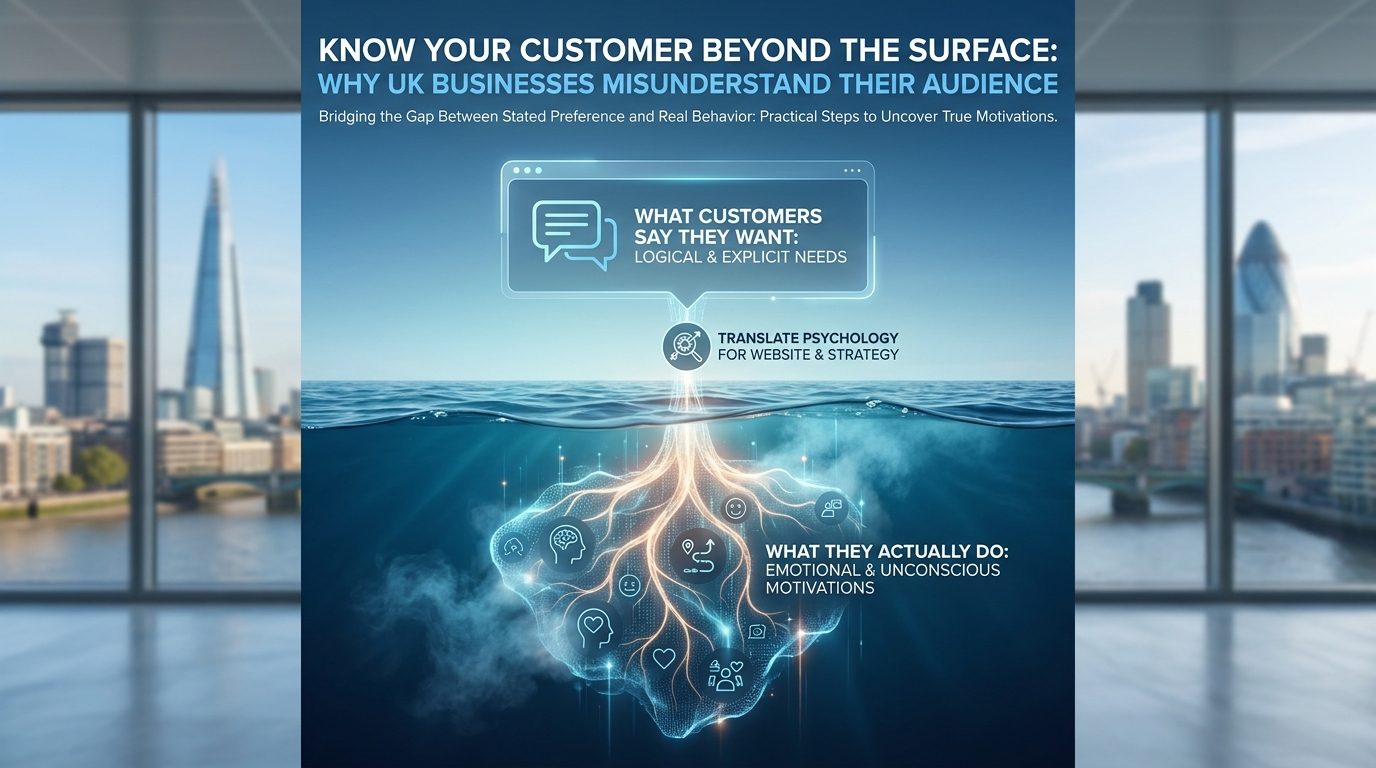
Ask most business owners why a customer chose them and you'll hear the same answers: good price, quality work, word of mouth. Ask those same customers and you'll hear almost identical things. The problem is that neither answer is usually the whole truth, and building your website or marketing around it means you're solving the wrong problem from the start.
This gap between stated reasons and actual behaviour is one of the most consistent patterns in consumer psychology, and it costs small businesses real money every year. Understanding it properly changes how you write your website copy, which photos you choose, and where you focus your time.
The Gap Between What Customers Say and What They Actually Do
When customers give you feedback, they're telling you a story. That story is coherent, polite, and almost always incomplete. Research consistently shows that purchase decisions are driven far more heavily by trust signals and convenience than by price or quality, yet when customers are asked why they chose a business, price and quality dominate the answers. The real drivers are harder to articulate, so they go unmentioned.
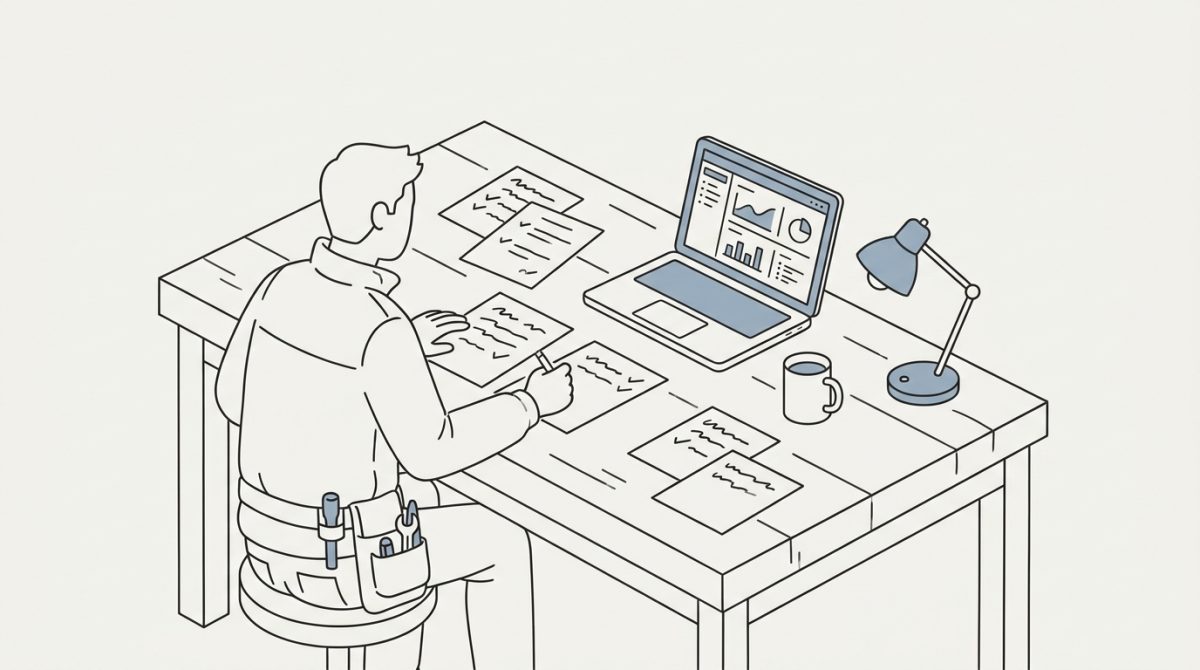
A classic illustration of this comes from a study by psychologists Sheena Iyengar and Mark Lepper, widely cited in behavioural economics research. When shoppers at a food market encountered a display of 24 jam varieties, more people stopped to browse than at a table offering just six. But the purchase rate from the larger display was dramatically lower. Shoppers said they loved having more choice. Their behaviour said something entirely different. Stated preference and real behaviour pulled in opposite directions.
For a UK small business, this plays out in a very specific way. A customer who tells you "your quote was a bit too expensive" may well have left for a different reason entirely. If your website looked dated, lacked testimonials, or had no photos of real work, the decision to walk away was probably made before price ever entered the picture. The price objection is the polite explanation, not the true one.
This matters because most businesses respond to feedback by adjusting the thing the customer mentioned. They lower their prices, tweak their service packages, or add more detail to their quotes. When those changes don't improve conversion, the business is confused. The reason is simple: they accepted the customer's stated reason at face value and fixed something that was never the real barrier.
Accepting customer feedback at face value is the core mistake, and it creates a cycle where businesses keep fixing the wrong things. The only way out is to look past what customers say and start examining what they actually do.
Four Layers of Customer Reality You Are Probably Only Seeing One Of
Customers don't experience your business on one level. They experience it on four, often simultaneously, and each layer tells a different part of the story. Most business marketing only ever addresses the first one.
The Four Layers
- What they say out loud: the stated reason, the review they leave, the answer they give when asked how they found you
- What they consciously think: the rational considerations they're weighing up, such as location, reliability, or whether you specialise in what they need
- What they feel emotionally: the anxieties, hopes, and instincts running underneath the rational layer
- What they actually do in practice: the specific sequence of actions they take before picking up the phone or filling in your contact form
Take a tradesperson as a practical example. A homeowner might say "I found you on Google" (the surface layer). At the cognitive level, they were actively thinking "I want someone local who won't let me down." Emotionally, they felt genuine anxiety about letting an unfamiliar person into their home. And behaviourally, they read five Google reviews, checked the profile photos, looked at the before-and-after pictures, then called. Four entirely different things happening at once, and only one of them was mentioned.
Most marketing only responds to that first layer. The tradesperson hears "I found you on Google" and concludes that SEO is doing its job. That may be true, but the question of whether that customer converted, or hesitated, or went to a competitor, was decided at layers two, three, and four. If the Google Business Profile had no photos, or the reviews were from three years ago, the emotional and behavioural layers killed the enquiry before it started.
This is not a theoretical concern. QuickBooks discovered that their customers were using their accounting software in ways the company had never intended, because the development process had focused entirely on what customers said they wanted during research phases rather than observing real usage behaviour. The result was features nobody used and missing functionality that customers had quietly built workarounds for.
The same dynamic plays out on small business websites every day. A business owner adds more information to the homepage because a customer said they wanted to know more, without realising that the behavioural data from their website shows visitors are leaving the homepage in under fifteen seconds. The problem was never information depth; it was probably visual trust signals or a slow loading time. But because no one looked past the stated layer, the wrong fix was applied.
Identifying which layer is actually driving or blocking a purchase for your specific customers is the foundation of everything else. It determines what your homepage needs to say, where you put your reviews, whether you should show pricing, and what your contact form asks for. Getting this right is not about being clever with marketing; it's about understanding the actual decision your customer is making and meeting them where they are when they make it.
Practical Ways to Uncover What Your Customers Really Want
The good news is that the data you need is mostly already out there. You don't need expensive research agencies or complex surveys. You need to look in the right places and ask the right questions.
Read the Emotional Language in Reviews
Start with your own Google reviews and then spend thirty minutes reading your competitors' reviews. You're not looking for ratings. You're looking for emotional language. Words like "stressed", "relieved", "finally", "panicked", "trusted", and "wouldn't hesitate" tell you the actual job customers hired the business to do. A plumber whose reviews mention "relieved" and "sorted it quickly" is not being hired for cheap prices; they're being hired to end anxiety. That's the message their website should lead with.
This takes under an hour and gives you more usable insight than most formal market research projects. The language customers use in reviews is unfiltered and specific, and it maps almost directly onto what your homepage copy should say.
Ask Better Post-Purchase Questions
Send a five-question email after a job is completed or a purchase is made, but ask behavioural questions rather than rating-scale questions. The most valuable ones are: "Can you describe the moment you decided to get in touch with us?" and "Was there anything that nearly stopped you from contacting us?" These questions surface the emotional and behavioural layers that standard satisfaction surveys never reach.
You'll often find that customers mention something on your website, a specific photo, a testimonial from someone in a similar situation, or a line of copy that addressed their hesitation directly. That's exactly the kind of insight you can act on immediately.
Watch Real Behaviour With Session Recordings
Microsoft Clarity is a free tool that records how real visitors move through your website: where they scroll, where they hesitate, where they click, and where they abandon a form halfway through. This is behaviour data, and it tells the truth in a way surveys cannot. If visitors consistently scroll back up to your reviews section before clicking your contact button, that tells you reviews are doing the persuasion work on your site. If they're abandoning your contact form on question three, that question is the problem.
Install it, let it run for two or three weeks, and then watch ten session recordings. Patterns will emerge that no customer would ever think to tell you about.
Talk to People Who Didn't Buy
This is the most underused source of insight available to small businesses. Identify three or four people who made an enquiry but didn't proceed, and ask if they'd be willing to have a brief conversation about it. Most people will agree if you're genuine and low-pressure about it. What you learn from these conversations is more valuable than feedback from happy clients, because it shows you the precise gap between what you're offering and the actual threshold of trust your market requires.
Happy clients already crossed that threshold; non-buyers reveal exactly where it sits.
Cross-Reference What Customers Say Against What They Do
If customers tell you in calls that your pricing feels clear and transparent, but your pricing page has a consistently high exit rate in your analytics, the behaviour is telling the truth and the stated feedback is not. These contradictions are where the most useful insights live. When what someone says and what they do diverge, always trust the behaviour. It has no reason to be polite.
How Real Customer Motivations Should Shape Your Website
If your customer research reveals that anxiety is the dominant emotion before someone picks up the phone or fills in a form, your homepage needs to lead with reassurance, not a clever tagline. That means accreditations, years in business, the local area you serve, and a named person with a real photo. A visitor who is worried is not looking for wit. They are looking for evidence that the risk of contacting you is low.
Trades and service businesses often undersell themselves by describing what they do rather than what they fix. Show before-and-after photos on landing pages. Customers are not buying a boiler service in the abstract. They are buying the end of the cold shower they took this morning, or the relief of not worrying about a damp patch spreading through the living room wall. The problem they are living with right now is far more motivating than any feature list you can write.

The same logic applies to how many options you put in front of people. Paradox of choice research consistently shows that more options reduce the likelihood of a decision being made at all. If your services page lists ten packages or tiers, cut them to three. You will reduce decision fatigue at the emotional layer, and enquiry rates will rise as a result. Giving people fewer, clearer choices feels counterintuitive but it works.
Consider a local Worthing plumber who restructures their homepage around one central promise: emergency call-out within the hour. That speaks directly to the real motivation, which is urgency and peace of mind, not the stated motivation, which is competitive rates. Price is what people say they care about. Speed and reliability in a crisis is what they actually care about when the kitchen is flooding on a Sunday afternoon.
Every call-to-action button on your site is also a small moment of psychology. 'Get a Free Quote' is so generic it means almost nothing. 'See How Much Your Project Costs' speaks to the cognitive layer, the part of the customer that wants information and certainty. 'Stop Worrying About It, Get in Touch Today' speaks to the emotional layer directly. Not every business will want that tone, but every business should at least be asking which layer their current button copy is addressing, and whether it matches where their customers actually are when they read it.
Local Search Is a Window Into Actual Customer Intent
The words someone types into Google are behavioural data. Unlike survey responses or feedback forms, they are not filtered through politeness or self-image. When someone types a search query at 10pm, they are telling you exactly what they need and roughly how they feel about it. That is more honest than almost any other data source a small business can access for free.
A customer searching 'emergency boiler repair Worthing tonight' is showing anxiety-driven urgency. They are not comparing options calmly. They are cold, possibly panicking, and want someone trustworthy immediately. A customer searching 'best boiler service Worthing' is in an entirely different mindset, one of comparison and deliberation. The same business needs two different landing page tones to convert both. A single generic homepage will do a mediocre job with each. A page built around one specific intent will convert far better for that group.
Your Google Business Profile does work on a customer before they ever click through to your website. Posts showing recent jobs, photos of real work in progress, and considered responses to reviews all feed the emotional and cognitive layers for local customers. A business that responds thoughtfully to a negative review signals something important: that it is run by a real person who takes their reputation seriously. That signal is processed emotionally, not logically, and it matters more than most businesses realise.
Hyper-local keywords are consistently underused by small businesses. Phrases like 'web designer Shoreham' or 'accountant Lancing' often convert at a higher rate than broader terms because they match the specific, trust-seeking behaviour of someone who wants a nearby, known quantity. The search volume is lower, but the intent is sharper. A visitor who searched for something that precise is already telling you they want local, and local means trustworthy to them.
One of the fastest free methods for understanding what customers actually want to know is to look at the 'People also ask' boxes that appear in Google search results for your service category. These questions are almost always more emotionally loaded than the keywords people start with. A search for 'electrician Worthing' might surface 'how do I know if my electrics are dangerous?' in the People also ask box. That question reveals a layer of fear and uncertainty that a smart electrician's website could speak to directly, and almost none of their competitors will be doing it. You can find practical guidance on using these local SEO signals to build content that matches real customer intent rather than assumptions about it.
Turning Customer Psychology Into a Marketing Strategy You Can Actually Use
The mistake most businesses make when they decide to 'understand their customers better' is trying to understand all of their customers at once. Start with one specific group. Pick the customer type that either buys most frequently or that you most want to attract, and map out all four layers for that group before you change a single word on your website or write a single ad. Broad customer insight is usually shallow. Narrow, specific insight is the kind you can actually build something with.
Once you have that clarity, make two immediate changes. Update your homepage headline to reflect the emotional layer you uncovered, not the features list you have always led with. Then update your Google Business Profile description to match. These two things are visible, free to change, and between them they influence a large proportion of the first impressions your business makes online. Most businesses have not revisited either in years.
Set a quarterly reminder to do three things: re-read the most recent reviews you have received, check session recordings in a tool like Microsoft Clarity (which is free), and have a short conversation with one person who enquired but did not buy. That last one is the most valuable and the most neglected. Non-buyers will tell you things that your customers never will, because they felt whatever you did not address well enough to overcome their hesitation.
A website built around real customer psychology does not need to shout louder than its competitors. It simply needs to feel, from the first few seconds, like it already understands the person reading it. That feeling is not magic. It is the result of knowing what your customer is anxious about, what question they have not yet asked aloud, and what outcome they are picturing when they look for someone like you. When your site speaks to that, browsers become enquiries, and enquiries become the kind of customers who trust you before you have even spoken to them.


