
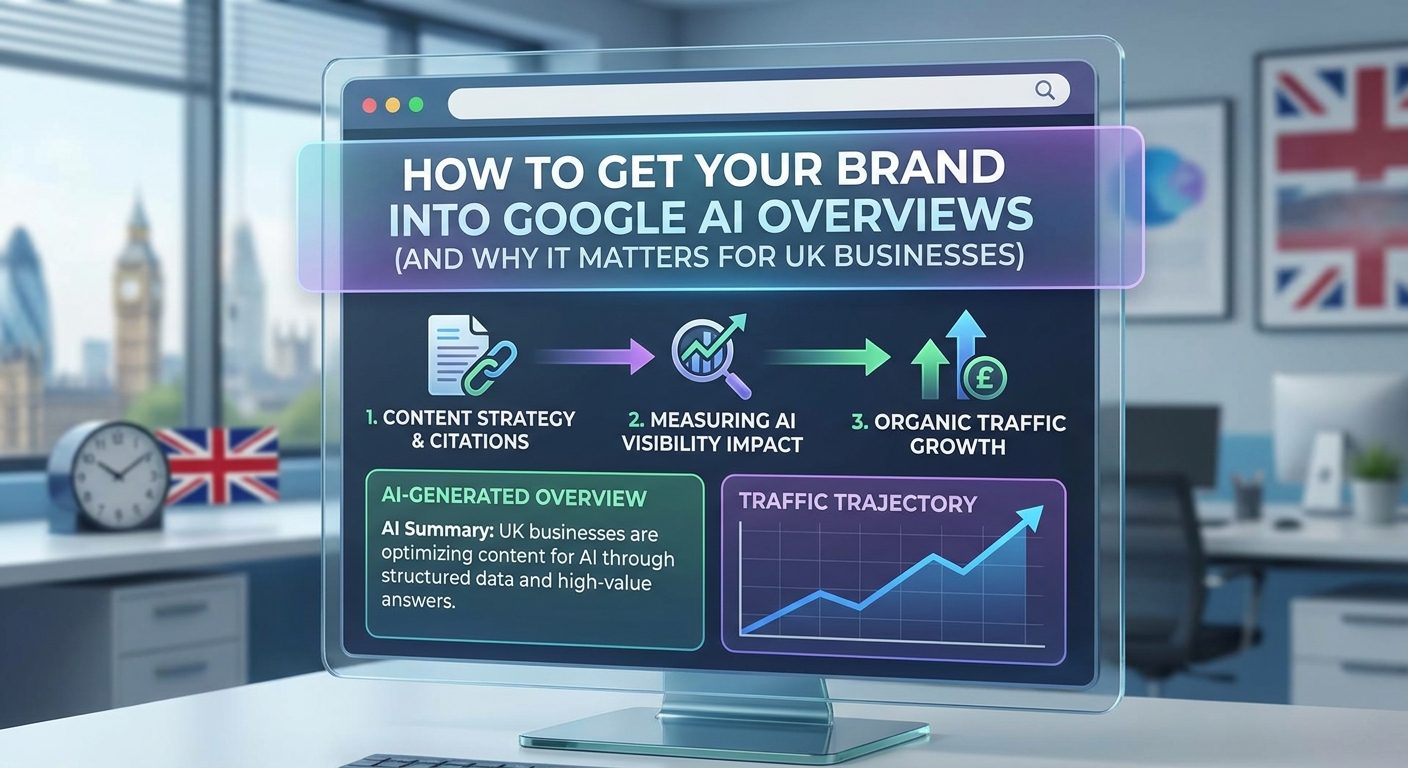
Most small business owners think about SEO in terms of page one rankings. That framing is already a step behind. In 2024 and into 2025, Google began answering a growing proportion of search queries before the user ever sees the traditional blue links, using AI-generated summary boxes that pull from several sources at once. If your business is not one of those sources, you are invisible at the very moment a potential customer is forming their opinion.
The encouraging news is that the format is still relatively new in the UK, and the competition for AI Overview citations is nowhere near as fierce as it is for standard page-one rankings. That gap will close. The businesses that act now have a genuine first-mover advantage.
What Google AI Overviews Actually Are and Why Small Businesses Should Pay Attention
Google AI Overviews are AI-generated summary boxes that appear above the organic search results. When a user types a question into Google, the system draws on multiple web pages and condenses the most relevant information into a single, structured answer at the top of the page. The user gets their answer immediately, without necessarily clicking anywhere.
Think of it as a research assistant who has read a dozen articles on your behalf and summarised the key points. It works in a similar way to the old featured snippet, where Google would pull a paragraph from a single page and display it prominently. But AI Overviews are more expansive. They synthesise content from several sources, attribute those sources with small citation links, and often break answers into steps or sections. Your brand name and a link to your site can appear right there, at the very top of the results page.

These summaries trigger most often on informational and question-format queries, the kinds of searches people make when they are researching a problem before they spend any money. A homeowner wondering why their radiators are cold, a business owner asking how to register for VAT, a parent searching for the best type of loft insulation: all of these are exactly the queries that produce AI Overviews. They are also exactly the kinds of searches your prospective customers make in the days or weeks before contacting a local business.
Even when a user does not click through to your website, being cited in the summary builds something valuable: recognition and trust. The searcher sees your business name associated with a credible answer. When they are ready to buy, that association influences who they contact. AI Overview citations can increase brand visibility even while reducing direct click-through rates, which means measuring success purely by traffic misses the point.
UK businesses that ignore AI Overviews are already ceding ground. If your competitor's content is cited as the answer to a question your potential customer just typed, your competitor's brand is the one being associated with expertise. The format is new enough that most small and medium-sized UK businesses have not started optimising for it yet. That window will not stay open indefinitely.
The Technical Groundwork You Cannot Skip Before Optimising
No amount of well-written content will earn you an AI Overview citation if Google cannot actually access and read your pages. The technical foundations come first, and skipping this step means every subsequent effort is built on sand.
Confirm your pages are indexed
Open Google Search Console and use the URL Inspection tool on each of your priority pages. Type the full URL into the inspection bar and look for the green confirmation that the page is indexed. If a page returns a result saying it is not indexed, Google cannot cite it regardless of how good the content is. Fix indexing issues before you change a single word on the page.
Pay particular attention to pages you updated recently. Google does not re-crawl pages instantly, and a page you rewrote last month may still be indexed in its old form. You can request re-indexing directly from the URL Inspection tool, which nudges Google's crawlers to return sooner.
Audit for technical blockers
Three common issues block AI Overview inclusion before content quality even becomes a factor. First, crawl errors: check the Coverage report in Search Console for pages returning 4xx or 5xx status codes. Second, accidental noindex tags: these are sometimes applied by developers during a site build and left in place after launch, silently hiding pages from Google. Third, slow page load times: Google's crawl budget is finite, and sluggish pages get crawled less frequently and less deeply. Use PageSpeed Insights to identify any pages loading above three seconds on mobile.
Implement structured data
Structured data is the markup language that tells Google what type of content a page contains. For AI Overview optimisation, two schema types matter most.
- FAQPage schema (schema.org/FAQPage): Add this to any page that contains questions and answers. It signals to Google that the page is structured as a Q&A resource, which is precisely the format AI Overviews prefer to draw from.
- HowTo schema (schema.org/HowTo): Use this on any page that walks through a process step by step. A guide on how to bleed a radiator, how to apply for a business licence, or how to prepare a room for repainting all qualify.
You do not need to be a developer to add these. Plugins like Yoast SEO Premium or Rank Math (both for WordPress) have built-in schema generators. If your site is not on WordPress, your web developer can add the JSON-LD markup directly to the page head. Test any structured data you add using Google's Rich Results Test tool to confirm it is reading correctly.
Clean up internal linking
A clear internal linking structure helps Google understand which pages on your site carry the most authority on a given topic. If you have written ten blog posts touching on boiler maintenance, make sure they all link back to your main boiler servicing page, and that page links out to the most detailed supporting articles. This cluster structure signals topical depth and increases the probability that Google selects your authoritative pages as citation sources rather than thinner, more peripheral ones.
Use Search Console's Coverage report as your final pre-flight check. Filter by the "Excluded" tab and look for patterns: are particular sections of your site being excluded? Are important pages listed as "Crawled but not indexed"? Resolve these issues before moving on to keyword research and content changes, because they will undermine everything else you do.
Choosing the Right Keywords: Where AI Overviews Actually Appear
Not every search query produces an AI Overview. Understanding which query types trigger them is the difference between optimising pages that have a realistic chance of being cited and wasting effort on terms Google handles differently.
Target low-competition, question-format queries
AI Overviews trigger most reliably on long-tail, question-format queries with a keyword difficulty (KD) score below 40 in tools like Ahrefs or Semrush. High-competition, transactional terms such as "boiler installation London" or "accountant near me" rarely produce AI Overviews because Google treats them as commercial queries, not informational ones. The summary box format is designed for research, not for pointing someone at a local business directory.
The strongest AI Overview triggers are queries beginning with specific words.
- How ("how does underfloor heating work")
- What ("what is a party wall agreement")
- Why ("why is my boiler losing pressure")
- Can I ("can I extend my lease myself")
- Best way to ("best way to insulate a loft conversion")
Each of these phrasing patterns signals to Google that the user wants an explanation, not a product page. That makes them priority targets for service businesses, tradespeople, and anyone selling something that requires a degree of customer education before the sale.
Think like your customer before they are ready to buy
Consider the difference between two queries a plumber's potential customer might type. "Plumber Worthing" is a transactional query. The person already knows they need a plumber and is looking to hire one. "What causes a boiler to lose pressure" is an informational query. The person has a problem and is trying to understand it. The second query is far more likely to generate an AI Overview, and a plumbing business whose content answers it clearly gets their brand name in front of that person at the exact moment the problem is front of mind.
This is the top-of-funnel opportunity that AI Overviews create. The user may not call that day, but when the boiler problem worsens and they decide they need professional help, they already associate that local plumber's name with helpful, knowledgeable advice. That association is worth more than a generic listing in a directory.
Use People Also Ask as free keyword research
Google's "People Also Ask" boxes are one of the most useful free tools available for AI Overview keyword research. Every question displayed in that box represents a query that Google considers closely related to your original search, and each one is a strong candidate for triggering an AI Overview. When you search for a broad term relevant to your business and look at the PAA questions that expand below the first few results, you are essentially looking at a list of informational queries your audience is already asking.
Click each PAA question to expand it. The source Google cites inside the PAA box is often the same content type that appears in AI Overviews for that query. Note which sites are being cited. If none of them are your competitors, that is an open opportunity. If one competitor consistently appears, examine how their content is structured and what they are doing differently.
Build a baseline audit spreadsheet
Before you change any content, conduct a manual baseline audit of 30 to 50 priority queries. Search each one in Google using an incognito or private browsing window (this removes your personalisation history from the results) and record the following for each query.
- Does an AI Overview appear at all?
- Which websites are cited as sources in the overview?
- Does your site appear anywhere in the AI Overview citations?
- Does your site appear in the standard organic results below the overview?
- What format does the cited content appear in (steps, paragraphs, bullet points)?
This spreadsheet becomes your baseline. Auditing target queries systematically is the only reliable way to understand where you currently stand and to measure whether your optimisation efforts are producing results. Without it, you are guessing. With it, you have a concrete record of where competitors are being cited in your place, which tells you exactly which pages to prioritise when you move into content restructuring.
Run the audit on desktop and on mobile separately if you can. AI Overview behaviour can differ between devices, and a query that triggers a summary on mobile may not do so on desktop, or vice versa. Even a rough split gives you more accurate data to work from.
Structuring Your Content So Google Picks It as a Source
The single most effective structural change you can make is putting your direct answer first. Within the opening two or three sentences of any section, give a complete, standalone response to the question that section addresses. Everything that follows is elaboration. This mirrors exactly how AI Overviews are themselves written, which makes it far easier for Google to extract your content as a source.
Keep that opening answer tight. Aim for 40 to 60 words before you expand. That is roughly the length Google tends to pull into an AI Overview snippet, so if your answer runs to four paragraphs before it reaches the point, Google will either skip it or paraphrase it badly. A crisp, self-contained answer at the top of each section is your best chance of being quoted accurately.
Write Headings That Mirror Real Search Queries
Vague headings like 'Our Services' or 'Certificates' tell Google almost nothing. Descriptive headings phrased as questions or clear statements do far more work. Compare 'Certificates' with 'How Long Does a Gas Safety Certificate Last in the UK'. The second version matches the exact language someone types into Google and signals to the AI exactly what your content covers.
This matters because AI Overviews are disproportionately triggered by question-format queries. If your headings already contain those questions, your page is structurally aligned with the queries most likely to produce an AI Overview in the first place. A heating engineer's page titled with a reference to the Gas Safety (Installation and Use) Regulations 1998, for instance, immediately signals citable, authoritative content rather than generic marketing copy.
Specific, Verifiable Facts Outperform Vague Claims
AI systems consistently favour content that contains named regulations, real statistics, and UK-specific figures over content that speaks in generalities. 'We are highly experienced' earns nothing. 'Under Part P of the Building Regulations, any new electrical circuit in a home in England must be either inspected by a qualified electrician or self-certified by a registered competent person' is precisely the kind of citable, authoritative detail that gets pulled into an AI Overview.
If you run a trades business, go through your service pages and replace vague claims with actual standards, current costs, or official timeframes. A roofing company can cite Building Regulation Approved Document C. A financial adviser can reference FCA registration requirements. These specifics are what separate content that gets cited from content that gets ignored.
Add a Dedicated FAQ Section to Key Pages
A FAQ section at the bottom of your main service and blog pages works extremely well for AI Overview inclusion, provided the questions are written exactly as a user would type them. Do not write 'Questions About Our Boiler Service'. Write 'How much does a boiler service cost in the UK?' and 'How often should a combi boiler be serviced?'. Keep each answer under 60 words and make every answer self-contained.
Plain English is not optional here. AI Overviews consistently favour clear, jargon-free explanations written at roughly a Year 9 reading level. If you are unsure whether your content is accessible enough, paste a paragraph into a readability checker like the Hemingway App and aim for a score of 9 or below.
Keep High-Performing Content Fresh
Google weights recency when selecting AI Overview sources for time-sensitive topics. A 2021 guide to permitted development rights, for example, is less likely to be cited than a version updated to reflect current rules. Set a quarterly calendar reminder to review your top 10 pages by impressions in Search Console, check whether any statistics, dates, regulations, or costs have changed, and update the content accordingly. Change the published date only when you have made meaningful updates, not cosmetic edits.

Building the Off-Page Signals That Reinforce Your Authority
Content structure alone will not get you cited if Google does not already regard your site as a credible source. AI Overviews draw heavily from pages that have earned authority over time, and that authority is built largely off the page. Backlinks, brand mentions, and reviews are not separate concerns from your AI Overview strategy. They are central to it.
Earn Links From UK-Relevant Sources
A link from your local Chamber of Commerce directory, a mention in a regional news outlet like the Worthing Herald, or a case study published on a trade association website does two things at once: it builds topical authority by associating your site with credible industry sources, and it builds geographic authority by confirming where you operate. Both signals feed AI Overview selection for local and industry-specific queries.
Practically, this means reaching out to local business groups, offering expert comment to local journalists, and making sure your business is listed on any trade association directories relevant to your sector. A plumber listed on the Chartered Institute of Plumbing and Heating Engineering's member directory carries more weight than a plumber who is not. These are low-volume but high-quality citation sources.
Your Google Business Profile Is Not Optional
For local AI Overview results, your Google Business Profile is one of the most direct inputs Google has. Keep it completely up to date: correct opening hours, a full list of services, recent photos, and a steady flow of genuine customer reviews. An incomplete or outdated profile is a missed signal, particularly for queries with local intent like 'boiler repair Worthing' or 'web designer near me'.
Reviews deserve specific attention. Encourage customers to leave detailed responses that mention the actual service they received and the location. 'Fitted a new boiler in Worthing, very tidy job' is more useful to Google than 'great service, would recommend'. The specificity reinforces the connection between your business, the service, and the location. You can make this easy by sending a follow-up message with a direct link to your review page and a short prompt about what to mention.
Branded Search Volume Feeds AI Visibility
There is a strong correlation between how often people search for your business by name and how likely Google is to treat your site as a credible entity worth citing. brand search volume rises when you run offline campaigns, email newsletters, social media activity, or even local sponsorships that prompt people to search specifically for you. That branded traffic sends a trust signal back into Google's systems and contributes to AI Overview inclusion over time.
This means your AI visibility strategy is not purely a content or SEO exercise. A local radio ad, a sponsored post that names your business clearly, or a well-run email sequence that gets recipients to visit your site by searching your name all feed back into your authority profile. It is worth tracking your branded search impressions in Search Console separately so you can see whether these offline and social activities are producing measurable spikes.
Measuring Whether Your Efforts Are Actually Working
Measuring AI Overview performance requires a slightly different mindset from traditional rank tracking. You are not just monitoring where you appear in a list of ten blue links. You are tracking whether your content is being selected as a source for a generated answer, how prominently it is cited, and what effect that citation has on branded awareness even when it does not produce a direct click.
Start With an AI Overview Inclusion Rate
Pick your 30 to 50 most important target queries and test each one manually in Google. Record which queries trigger an AI Overview at all, then record which of those AI Overviews cite your content. That gives you two percentages: the proportion of your target queries that trigger AI Overviews, and your citation rate within those. According to guidance from AI Overview content strategy best practice, this baseline audit is the essential starting point before you can measure improvement.
Log everything in a simple spreadsheet: the query, whether an AI Overview appeared, whether you were cited, your position among the cited sources, and the date. This is not glamorous work, but it is the only way to see whether changes you make to content structure or off-page signals are producing results over subsequent months.
Read Google Search Console Differently
Search Console does not have a dedicated AI Overview filter, but there are indirect signals worth watching closely. If impressions for a specific query are rising while clicks and click-through rate are falling, that is a strong indicator your content is appearing in an AI Overview. Users are getting their answer from the summary without needing to visit your page.
This is not automatically bad news. A rising impression count means more people are seeing your brand name, even if they are not clicking. What you want to avoid is a situation where impressions and clicks are both flat, which suggests you are being excluded from AI Overviews and losing ground to competitors who are being cited. Monitor at the query level, not just the aggregate, so you can identify which specific topics are generating this pattern.
Watch Branded Versus Non-Branded Trends Separately
A common pattern that emerges as AI Overviews take hold is that non-branded clicks dip while branded searches rise. Non-branded queries get answered in the AI Overview, so users do not click through. But those same users, having seen your business name cited as a credible source, then search for you directly. If you are only watching total organic traffic, you will miss this shift entirely.
Segment your Search Console data so you can see branded and non-branded impressions and clicks on separate trend lines. A divergence between the two, where branded searches climb while non-branded clicks soften, is a sign that AI Overviews are building awareness even without producing direct traffic. That is a measurable return worth reporting.
Use Specialist Tools to Scale Your Monitoring
Manual spot-checking works for 30 to 50 queries, but if your keyword set is larger, tools like SE Ranking's AI Overview tracker or Semrush's AI snapshot feature automate citation monitoring across hundreds of keywords. They can tell you which queries trigger AI Overviews, whether your domain is cited, and how citation rates are trending over time, without you running every search by hand.
Beyond inclusion, track citation position. A source listed first in an AI Overview receives significantly more user attention and generates more click-through than sources listed further down. If you are consistently appearing as a secondary or tertiary source, that suggests your content is credible enough to be included but not quite the most authoritative answer available. That gap is worth closing with more specific facts, fresher data, or a more direct opening answer.
Set a fixed monthly review date. Pull your Search Console data, run manual checks on your priority queries, update your tracking spreadsheet, and compare against the previous 90 days. Weekly data is too noisy to act on. A 90-day view gives you a clear enough picture to decide whether your content updates and off-page activity are shifting the numbers in the right direction.
What a Realistic AI Overview Strategy Looks Like Over Six Months
Most businesses want results immediately. With AI Overviews, that is not how it works. What you are actually building is authority in Google's eyes, and that accumulates gradually. Here is a practical month-by-month shape for a small UK business starting from scratch.
Month One: Fix the Foundations
Before you publish a single new page, complete a full technical audit. Confirm every key page is indexed, fix any crawl errors in Search Console, and check your Core Web Vitals scores. Then go back through your existing content and add FAQ and HowTo schema markup to any page that answers a specific question. These are the pages most likely to get picked up quickly.
At the same time, build your baseline query spreadsheet. Pick 30 to 50 queries you want to appear for, test each one in Google, and record whether an AI Overview appears, whether you are cited, and which competitors are. This spreadsheet is the thing you will return to in month six, so the more thorough it is now, the more clearly you will see what has changed.
Months Two and Three: Publish Content Built for AI Overview Selection
Now you write. Aim to publish or substantially rewrite four to six content pieces during these two months. Each one should target a question-format keyword with a keyword difficulty score under 40. Think queries like "how much does a new boiler cost in the UK" or "what should a trades website include" rather than broad terms like "plumber" or "web design".
Every piece follows the same structure: a direct, concise answer in the first paragraph, supporting detail in the body, and a dedicated FAQ section at the bottom. Append FAQ schema to each one. Do not bury the answer. Google's systems are looking for content that satisfies the query fast, so give it exactly that before going deeper.
Months Four and Five: Build Off-Page Authority
With your content published and indexed, the focus shifts outward. Aim to earn two or three quality UK backlinks during these months. Local business directories, industry association websites, and guest posts on relevant UK trade or business publications are all realistic targets. A link from a respected source tells Google that others in your space consider you worth citing.
Alongside this, refresh your Google Business Profile completely. Update your hours, services, and photos, and run a short review-gathering campaign by emailing recent customers with a direct link to your review page. Reviews contribute to the trust signals Google uses when deciding which businesses to surface in location-relevant AI Overviews, and many small businesses simply neglect this step.
Month Six: Measure, Learn, and Decide What to Do More Of
Pull up Search Console and compare your branded search volume against the baseline you recorded in month one. A rise in branded queries is one of the clearest signals that AI Overview appearances are building awareness, even when direct clicks are flat or down. Research from multiple SEO sources confirms this pattern: non-branded clicks may dip while branded searches climb, which reflects the way AI Overviews work by giving users the answer upfront but leaving them curious about the source.
Go back to your query spreadsheet and retest every query. Record your citation rate now versus month one. Then look specifically at which content formats earned citations. Was it the FAQ-heavy pieces? The step-by-step how-to articles? The pages with HowTo schema? Whatever pattern you see is the pattern to repeat.
The realistic expectation here is not a sudden leap to the top of search. It is a compounding effect. Each page that earns a citation builds a small amount of additional authority, which makes the next page slightly more likely to be cited. Over time, Google's overall assessment of your site shifts. A trades business in Worthing that answers ten specific local questions well will gradually become the default cited source for those questions, and that reputation does not disappear when an algorithm updates.
Six months is enough to see meaningful movement in citation rate and branded search volume. It is also enough to know which content investments are worth scaling. Start the second six months with that knowledge, double down on what worked, and the compounding effect accelerates.


