
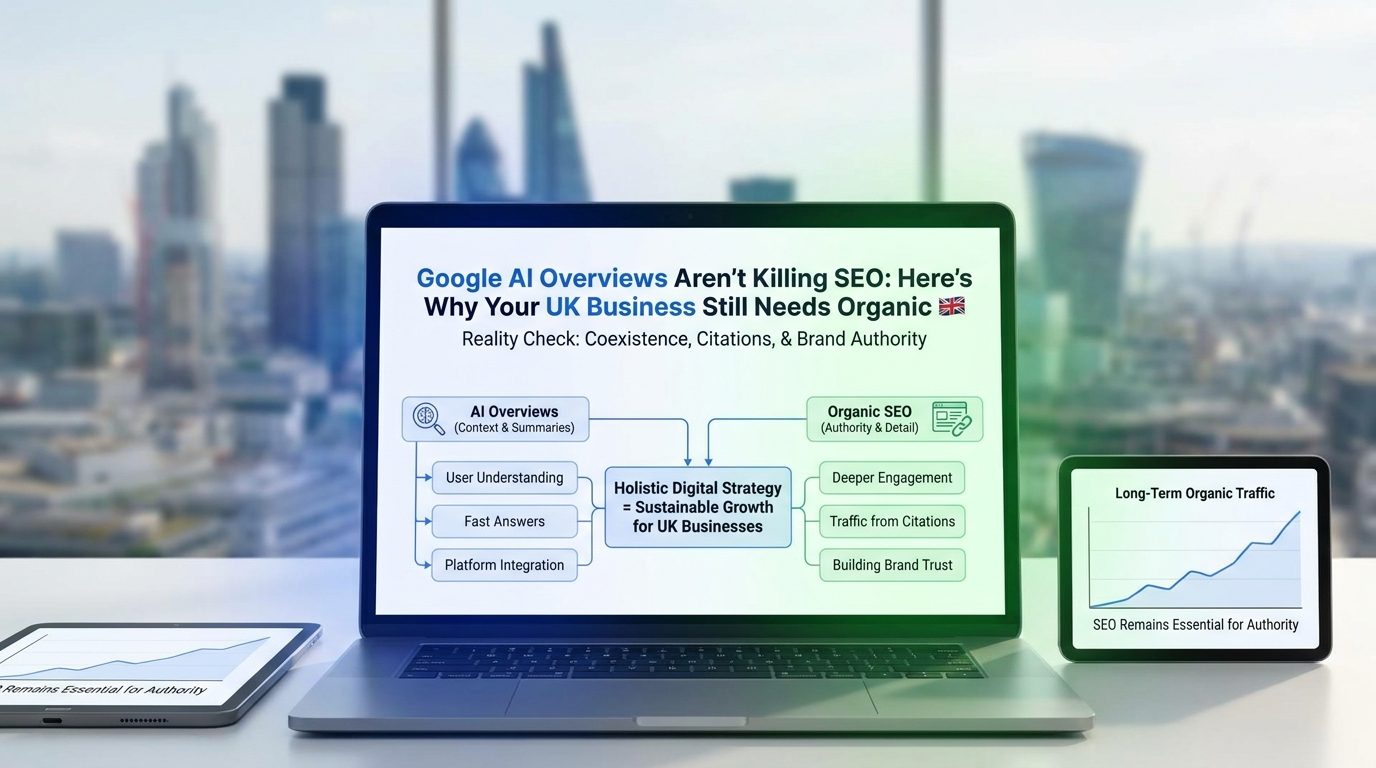
In 2017, a wave of SEO professionals watched featured snippets roll out across Google and reached for the panic button. The zero-click apocalypse was coming, they said. Why would anyone click a result when Google had already answered the question at the top of the page? Newsletters were written, Twitter threads were posted, and more than a few small business owners quietly started wondering whether bothering with SEO was still worth the money.
They were wrong, as it turned out. Well-optimised pages kept getting traffic. The businesses that adapted early and structured their content to earn those snippet positions actually grew their visibility. And now, in 2025 and into 2026, we are watching almost exactly the same film again, just with a bigger budget and a new title.
We Have Been Here Before: The Featured Snippet Panic of 2017
The featured snippet story is worth revisiting properly, because the emotional arc mirrors what is happening with AI Overviews almost beat for beat. When Google started surfacing direct answers in a box above the organic results, the instinctive reaction across the SEO industry was that clicks would dry up. And for a narrow slice of purely informational queries, that did happen to some degree. If someone searches "how many centimetres in a foot" and Google shows the answer directly, yes, they are probably not clicking through to a conversion chart website.
But that represented a tiny fraction of commercial reality. For trades, local services, e-commerce stores, and professional services firms, the queries that mattered most were never going to be answered by a box. Nobody reads a featured snippet about a kitchen extension and decides they no longer need a builder. The snippet might tell them roughly what a kitchen extension costs, but the next step is still clicking through to find an actual business to hire.
What actually happened was instructive. The businesses and agencies that stopped panicking and started optimising for featured snippets found they could claim significant SERP real estate. Being in the snippet meant more visibility, more brand recognition, and in many cases more qualified traffic, because the user already had some context about the topic before they arrived. The pattern was clear: new SERP feature appears, panic spreads among people who extrapolate worst-case scenarios, and the businesses that adapt early end up winning more than they lose.
AI Overviews are the 2024-2025 version of that same panic. The technology is more sophisticated, the summaries are longer, and the visual presence on the page is more dominant than a featured snippet ever was. Those differences are real and worth taking seriously. But the underlying dynamic is identical: Google has introduced a new way of displaying information, some clicks will shift, and the businesses that understand what is actually happening will adapt and come out ahead.
The purpose of this article is to give UK small business owners a grounded, evidence-based view of what AI Overviews actually mean for organic search, rather than amplifying the hype in either direction. Neither "SEO is dead" nor "nothing has changed" is an honest position. The reality sits somewhere more nuanced and, for most local and service businesses, considerably more reassuring than the headlines suggest.
That matters especially for businesses in Worthing, Brighton, and across the wider UK who are running on tight budgets and cannot afford to be bounced between contradictory advice. Abandoning a working SEO strategy because of fear, based on incomplete data and worst-case framing, is one of the more expensive mistakes a small business can make. Before you redirect that monthly SEO budget into something else, it is worth understanding what the numbers actually say.

What Google AI Overviews Actually Are (and Are Not)
Google AI Overviews are Gemini-powered summaries that appear above the standard organic results for certain types of search queries. When you type a question like "what causes damp in older houses" or "how does VAT work for sole traders," Google may now respond with a generated paragraph or two that synthesises information from multiple sources, with small citation links embedded in the text. It looks different from anything Google has shown before, and that visual difference is part of why the reaction has been so strong.
What they are not, and this is the part that tends to get lost in the coverage, is a replacement for the full search results page. Scroll past an AI Overview and you will still find paid ads, the local map pack, People Also Ask boxes, and the standard blue-link organic listings. The rest of the page has not been removed. It has just been pushed down slightly. The full ecosystem of search results is still there and still functioning.
The other thing AI Overviews are not is a universal presence across all query types. This is probably the single most important fact for UK small business owners to understand, and it comes directly from trigger rate data. According to research from Semrush's AI search study, the appearance of AI Overviews is highly selective depending on what the person is actually searching for.
Trigger rates vary enormously by query type
For purely informational queries, the kind that start with "what," "how," or "why" and are looking for an explanation rather than a product or service, AI Overviews appear at a rate of around 60 to 70 percent. These are the queries where the impact on traditional organic clicks is most significant, and they are also, crucially, the queries least likely to drive direct revenue for most small businesses.
Commercial research queries sit in the middle ground, triggering AI Overviews at roughly 30 to 40 percent. These are the comparison and consideration-phase searches, things like "best accountant for freelancers" or "which boiler brand is most reliable." Even here, the comparison intent means users are still clicking through to websites to read more, check reviews, and make contact. A generated summary cannot replace the experience of visiting an actual business's website and deciding whether to trust them.
Transactional queries, which are the ones with the most direct commercial value, trigger AI Overviews at only 10 to 15 percent. Someone searching "emergency plumber Worthing" or "buy oak flooring online" is not going to be stopped by a paragraph of generated text. They need to act, and acting means clicking through to a website, making a call, or completing a purchase.
What this means for trades, services, and local businesses
Think about the searches that actually matter to a typical UK trade or service business. "Boiler repair West Sussex." "Web designer Worthing." "Accountant for small business near me." "Buy handmade candles UK." Every single one of those falls into the commercial or transactional categories where AI Overview trigger rates are low to moderate and where user intent drives the click regardless.
The businesses most exposed to AI Overview disruption are those whose traffic model depended heavily on high-volume informational content: "how to fix a leaking tap" type articles written to attract passive readers. That kind of content was always one step removed from a sale. For the overwhelming majority of UK small businesses with straightforward local or transactional SEO goals, the threat is considerably smaller than the headlines imply.
Understanding which category your target queries fall into is the first practical step. If your SEO is built around informational content that has nothing to do with your actual services, that is worth reviewing. If it is built around location-based, service-based, or product-specific queries, you are operating in territory where AI Overviews are much less disruptive.
The Real Traffic Data: Alarming Headlines vs. What the Numbers Actually Show
The scariest number doing the rounds is a roughly 61 percent decline in organic click-through rates for queries where AI Overviews appear. That figure comes from an industry study cited by enfuse-solutions.com, and it is real data, not invented for effect. On top of that, AI Overview prevalence grew by somewhere between 400 and 500 percent year-on-year across desktop and mobile by early 2026. Those two facts, taken together, do paint a genuinely challenging picture for certain kinds of web content.
But context is what turns a scary statistic into a useful one. A 61 percent CTR decline on informational queries that were never going to convert is a very different problem from a 61 percent decline on queries that bring in paying customers. The studies measuring CTR impact are mostly measuring the informational query segment, precisely because that is where AI Overviews are most prevalent. The transactional and local segments that small UK businesses depend on are largely absent from those headline numbers.
Zero-click does not equal zero value
This is a point that gets underplayed in the traffic-loss narrative. When an AI Overview appears and a user reads it without clicking, they are still encountering information. If your content is cited inside that overview, your brand name, or your website's URL in a small citation chip, is visible to that user. Brand impressions build familiarity. Familiarity builds trust. Trust drives eventual action, whether that is a direct search for your business name, a return visit later, or a word-of-mouth recommendation.
Zero-click search is not a new concept invented by AI Overviews. Featured snippets created zero-click situations. Knowledge panels created them. Local packs created them. The SEO industry adapted to each of those by recognising that visibility and clicks are related but not the same thing. A business that appears in an AI Overview for a relevant query has earned a form of visibility that simply did not exist two years ago.
Rankings still drive citations
Here is where the data becomes actively encouraging for businesses already investing in SEO. Semrush research found that ranking in strong organic positions correlates directly with being cited inside AI Overviews. In other words, the work you do to rank well in traditional search does not become worthless when AI Overviews appear. It increases your chances of appearing inside them.
There is an additional nuance here that most of the panic-driven coverage misses entirely. Research from BrightEdge and a separate Moz analysis of 40,000 queries found that only around 12 to 17 percent of AI Overview citations come from pages that also rank in the organic top 10. That sounds counterintuitive at first, but it is actually good news for businesses outside the top positions. It means that strong, well-structured, authoritative content can earn citations inside AI Overviews even when it is not ranking in the top handful of standard results. You do not have to be number one to appear. You need to be credible, relevant, and clearly structured.
Who is actually losing traffic
When you look past the aggregate numbers, a pattern emerges in the businesses reporting the most significant traffic losses. They tend to share a common characteristic: their organic traffic was built primarily on passive, informational content rather than on pages tied to clear commercial intent. Think "how to write a business plan" blogs written by accountancy firms that were pulling thousands of visitors who never converted. That kind of traffic was always thin in commercial terms, and AI Overviews have accelerated the erosion of it.
Commercial and local pages, the kind that say "accountancy services for small businesses in Worthing" and include contact details, service descriptions, pricing signals, and genuine expertise, are largely protected. A user searching with intent to hire, buy, or contact is not satisfied by a generated paragraph. They need a website to land on, a form to fill in, a phone number to call. That is the kind of content and those are the kinds of queries that organic SEO for UK small businesses is built around. The data, looked at clearly rather than through the lens of alarming headlines, supports the case for staying the course.
Why Being Cited Inside an AI Overview Is the New First-Page Ranking
When Google cites your page inside an AI Overview, something interesting happens. Your brand name and a link appear at the very top of the results page, often before the first traditional organic listing. That is not second place. That is arguably the most prominent piece of real estate Google has ever offered to a website that did not pay for an ad.
Traditional rank-one results sit below the AI Overview panel. A cited source sits inside it, with a direct link attached to the summary that searchers are already reading. The credibility signal is immediate. A user sees your brand name paired with a helpful, authoritative answer before they have even considered scrolling down to the blue links.
As thegrowthterminal.com puts it plainly: winning now means optimising for citations in AI-generated answers, not just traditional rankings. That is a meaningful shift in how to think about what good SEO actually produces. The goal was never "be on page one" as an end in itself. The goal was always to get in front of people at the moment they need what you offer. Citation inside an AI Overview does that, often more effectively than a rank-one listing ever did.
Here is the part that should genuinely excite smaller UK businesses. Citation does not require being in the organic top ten. Research from BrightEdge found that only 17% of AI Overview citations come from pages that also rank in Google's organic top ten. A separate Moz analysis of 40,000 queries found roughly 12% of cited URLs matched the organic top ten. That means the vast majority of citations come from pages that would never have appeared on page one through traditional ranking alone.
What earns a citation is clarity, structure, and relevance to a specific question. Google's AI systems are looking for the clearest, most direct, most authoritative answer to what the user asked. A well-organised FAQ page, a detailed service explainer, or a practical how-to guide can outperform a huge domain if it simply answers the question better.

Consider a concrete example. A Worthing-based electrician publishes a single, well-structured page answering the question "how much does a consumer unit replacement cost in the UK?" The page uses clear headings, breaks the answer into logical sections covering labour, parts, regional variation, and what affects the final price. That page is a genuine candidate for an AI Overview citation, even if the electrician's domain authority is nowhere near the level of a national trade directory. The AI does not care about domain authority as a primary signal. It cares about whether the page actually answers the question in a way a person would find useful.
For UK small and medium businesses, this is an opportunity that did not exist in the old ranking system. The barrier to entry for citation is high-quality content, not high domain authority or a large link-building budget. That levels the field in a way that should feel genuinely encouraging.
How Search Intent Protects Most UK Small Business Queries
Not every search triggers an AI Overview. Google is careful about where it deploys the feature because its primary job is still to give users what they actually want. For the queries most UK small businesses depend on, AI Overviews appear far less often than the alarming headlines suggest.
The queries that local trades, services, and e-commerce businesses live on tend to be local and transactional in nature. Searches like "plumber Worthing", "accountant near me", or "buy handmade candles UK" do not reliably trigger AI Overviews. Google knows that users typing those searches want a business to contact or a product page to visit. A generated text summary does not satisfy that intent. A map listing, a business profile, or a product page does.
Google's local pack, the map with the three business listings that appears for location-based searches, sits entirely separately from AI Overviews and is unaffected by them. The signals that determine whether you appear in that pack, your Google Business Profile, your reviews, your consistent name and address data, your local citation count, remain exactly as important as they were before AI Overviews existed. Local SEO has not been disrupted by this change at all.
The data on transactional queries is reassuring. According to research from digitalapplied.com, transactional searches trigger AI Overviews only 10 to 15% of the time. That is because Google understands that a shopper searching for a product wants to land on a product page and make a decision, not read a paragraph summarising what the product is. The commercial journey requires a click. AI Overviews do not replace that.
Service-industry and trades businesses are in a particularly safe position. A customer searching for a boiler repair, a kitchen fitter, a solicitor, or a driving instructor in their area is carrying clear buying intent. That kind of search is exactly the type that Google routes toward local results and business websites rather than AI-generated summaries. These businesses are sitting in the safest segment of the current search landscape.
It is worth being precise about who is actually exposed. The businesses that have seen the sharpest traffic falls from AI Overviews are informational publishers. Blogs that rank for "what is" and "how does" questions, content farms built around high-volume informational keywords, and websites whose entire model depends on users reading articles rather than contacting a business. Those are the operations that are genuinely struggling. A local service provider trying to win customers in a specific area is not competing in the same environment.
This distinction matters because a lot of the fear about AI Overviews is borrowed from publisher and media industry data and applied incorrectly to small business SEO. The two situations are not comparable. If your revenue comes from people calling you, booking you, or buying from your shop, the search behaviour that drives that revenue is largely protected from the AI Overview effect right now.
Brand Authority: The SEO Outcome AI Cannot Take Away From You
There is a version of SEO that is dying, and there is a version that is thriving. The version that is dying is the approach built on publishing large volumes of keyword-targeted content with no genuine depth or expertise behind it. The version that is thriving is the one built on becoming a genuinely trusted, recognisable source in your field.
Searchengineland.com draws this distinction clearly: topical authority built by publishing endless keyword-targeted sludge is fading, but brand authority built by becoming a genuine trusted source is growing in importance. The difference is not subtle. One is a volume game. The other is a reputation game. And reputation is something that compounds over time in ways that no algorithm update can simply erase.
Brand authority, in practical terms, means your business name gets searched directly. It means people who have heard of you type your name into Google rather than a generic search term. It means you earn mentions in articles and directories without having to ask for them. It means people associate your business with the specific problem you solve. None of that is easy to build, but all of it is durable.
What makes brand authority particularly valuable right now is that it feeds directly into how AI systems decide who to cite. Google Gemini, ChatGPT, and Perplexity do not operate in isolation. They pull from the broader web. They favour sources they have seen mentioned repeatedly, linked to from credible places, and associated with reliable answers. A business that has built consistent brand signals across the web is a business that AI systems have reason to trust and cite.
Seosherpa.com makes the point directly: AI search citations now come from broader web presence, not just Google rankings. That means the full picture of your online footprint matters. Your Google Business Profile, your Trustpilot reviews, your listing in trade directories, a mention in a local newspaper, a quote in an industry newsletter, a consistent set of social profiles. All of these contribute to the web-wide signal that tells AI systems you are a real, credible, active business.
For a UK small business, the practical checklist looks like this:
- Consistent NAP data (name, address, phone number) across every directory and listing where your business appears
- Active review collection on Google and Trustpilot, with genuine responses to those reviews
- Mentions in local press, trade publications, or industry blogs, even small ones carry weight
- A website that confidently signals expertise through clear service descriptions, case studies, and relevant content
- Social profiles that are maintained and linked back to your main site
None of that list is new. It is the same advice serious digital marketers have given for years. What has changed is the stakes. Previously, these signals influenced your ranking in Google's organic results. Now they also influence whether AI systems consider you a credible source worth citing in front of potentially thousands of searchers a month.
There is a further point worth sitting with. A business that invests consistently in SEO is, almost as a side effect, building exactly the brand signals that AI systems use to decide who to trust. Every piece of content published to answer a genuine question adds to your authority. Every backlink earned from a relevant local or industry source adds to your citation profile. Every review collected adds to the evidence that real customers have found value in what you do. SEO and brand-building are not separate activities happening in parallel. They are the same activity described from two different angles.
Which is why cutting SEO spend in reaction to AI Overviews would be one of the more counterproductive decisions a UK business could make right now. The activity that earns you visibility in traditional search results is the same activity that earns you a seat at the AI citation table. Stopping it does not protect you from disruption. It removes you from the competition entirely, both in the old system and in the new one.
Businesses that treat this moment as an opportunity to build something more durable than a keyword ranking will find themselves better positioned not just for today's search landscape, but for whatever comes after it.
Practical Steps to Make Your Content AI-Overview-Ready
Knowing that AI Overviews exist is one thing. Doing something concrete about it is another. The good news is that the changes required to make your content citation-worthy are exactly the same changes that make your content clearer and more useful for human readers too. None of this requires expensive tools or a complete rebuild.
The single most effective change you can make is to lead with the answer. Start each page or section with one or two sentences that directly address the target question, then expand on the detail below. AI Overviews are built to extract concise, confident answers, and if your answer is buried under three paragraphs of introduction, the crawler moves on to a page that gets to the point faster. This is not about dumbing down your content. It is about respecting the reader's time and signalling clearly what the page is about.
Make Your Headings Do Real Work
Vague section labels like "Our Process" or "What We Do" tell crawlers almost nothing. Headings that read as actual questions, such as "How long does a website redesign take?" or "What does SEO cost for a small UK business?", match the conversational queries that trigger AI Overviews in the first place. Every H2 and H3 on your site is an opportunity to claim a question your customers are genuinely typing into Google.
Structured data markup is the next layer. Adding FAQ schema, HowTo schema, and LocalBusiness schema to your pages helps Google's crawlers understand exactly what type of content they are reading and how to extract it reliably. A local trades business adding LocalBusiness schema with accurate address, phone number, and service area data is not just helping AI Overviews, it is reinforcing every local search signal across the board. Plugins like Yoast SEO or Rank Math make implementing basic schema straightforward without touching code directly.
Keep Content Fresh and Intent-Matched
Research from Tripledart emphasises that AI favours recently updated, relevant content. Updating pages with new pricing, fresh examples, or current statistics at least every six months is not optional hygiene, it is a competitive signal. A page last edited in 2021 is not competing on equal terms with one refreshed this quarter, even if the original writing was excellent.
Intent matching matters just as much. A page targeting "best web design Worthing" should state its core claim clearly and early, not bury it inside a company history section. Ask yourself: if someone landed on this page with that exact query, would they find the answer in the first screen-length of content? If the honest answer is no, the page needs restructuring.

Technical fundamentals remain prerequisites, not optional extras. Fast load speed, mobile usability, and clean internal linking are confirmed by SeoProfy as essential for AI crawlers just as much as for traditional Googlebot. A beautifully written page that loads in six seconds on mobile is still a page that gets skipped.
Finally, build standalone answer pages for the most common questions your sales team or front desk hears every week. Questions like "How much does a new website cost?" or "Do I need SEO if I already have a website?" are precisely the informational queries that trigger AI Overviews most often. A dedicated, well-structured page answering each of these questions is a direct route to citation eligibility, and it also reduces the time your team spends answering the same questions by phone or email.
Why Organic Search Still Beats Paid Ads for Long-Term UK Business Growth
The discussion around AI Overviews sometimes leads business owners to question whether SEO is worth investing in at all, especially when paid ads still appear reliably at the top of search results. It is a reasonable question, but it confuses two channels that work on fundamentally different timescales and economics.
The most important structural difference is this: paid search stops the moment you stop paying. The day you pause your Google Ads campaign, your visibility disappears completely. An organic ranking you have earned through consistent SEO continues working around the clock, generating clicks and enquiries without a per-click cost attached to each one. Over months and years, that difference compounds into something substantial.
As Shopify's 2026 SEO guide puts it, paid search is well suited to generating traffic quickly for launches and promotions, but organic search becomes a reliable growth channel over time. For UK small businesses working with limited marketing budgets, the compounding return on SEO investment over a 12 to 24 month horizon typically outperforms spending the same amount on PPC for ongoing visibility. PPC has a role, but that role is not the same as building a durable traffic asset.
It is also worth noting that AI Overviews have no effect whatsoever on paid ads. Google Ads still appear above AI Overviews in the search results layout. The concern that AI Overviews are reducing organic visibility is real for some query types, but it does not touch the paid channel at all. This means the two channels are genuinely complementary rather than competing, and the choice between them is not either-or.
A sensible blended strategy looks like this:
- Use paid ads for immediate lead generation around specific campaigns, seasonal promotions, or new service launches where you need results within days rather than months.
- Use organic SEO for building compounding authority, earning AI Overview citations, and generating ongoing traffic that does not disappear when a budget runs dry.
- Let each channel strengthen the other: strong organic rankings increase the credibility of your paid ads, and paid ad data reveals which keywords convert well enough to prioritise in your SEO work.
For a trades business or local service provider in the UK, the long-term case for organic search is particularly strong. Your customers are searching for painters, plumbers, web designers, and accountants in their area every single day, year-round, without any advertising prompt. Showing up consistently for those queries, and now being cited inside the AI Overviews that answer them, is a compounding asset that paid ads simply cannot replicate at the same cost over time.
The Mistake of Chasing AI Traffic Without a Website Worth Landing On
There is a version of the AI Overview conversation that focuses entirely on getting cited and almost entirely ignores what happens after the click. That is a significant oversight, and for UK small businesses it can mean that all the effort spent optimising content translates into nothing useful at all.
When an AI Overview cites your page, it creates a micro-moment of trust. The person reading the Overview sees your business named as a source, and they click through with some expectation already formed. If the page they land on is slow to load, cluttered, confusing about what you do, or missing any obvious next step, that trust evaporates within seconds. At that point, the click has not just been wasted, it has actively created a negative first impression that is harder to recover from than never being found at all.
A bespoke, conversion-focused website that clearly communicates what you do, who you serve, and what to do next is the non-negotiable foundation beneath any SEO or AI strategy. This is not a new principle, but the stakes are higher now. AI Overviews bring higher-intent visitors who have already read a summary answer and chosen to click through for more. Wasting that traffic with a poor website experience is an avoidable failure.
This matters most for UK trades and service businesses, where trust signals are what actually convert browsers into enquiries. A visitor who clicks through from an AI Overview about "bathroom fitters in Worthing" wants to see accreditations, genuine customer reviews, a clear local address, and an obvious way to get in touch. If those elements are missing or hard to find, the enquiry goes to a competitor whose website makes the decision feel safe and easy.
Investing heavily in AI citation optimisation while neglecting the website itself is like perfecting a shop window display for a store that is difficult to enter and impossible to navigate once inside. The window might stop people on the pavement, but if the interior does not deliver on the promise, the footfall is worthless. Getting your website right is not a separate project from your SEO strategy. It is the same project.
What to Track Now That AI Overviews Have Changed the Metrics
One of the most disorienting things about AI Overviews for business owners and marketers alike is that the usual scoreboard no longer tells the whole story. Click-through rate, long the headline metric of organic search performance, has become genuinely misleading when viewed in isolation. A page can appear as a cited source inside an AI Overview and generate dozens or hundreds of brand impressions without producing a single click. That is not a failure. It is a form of visibility that simply did not exist in 2022, and it has real value for brand recognition even when the click never comes.
This means your reporting needs to evolve alongside the search landscape. If you are only looking at organic CTR and seeing it fall, you may be drawing the wrong conclusion entirely. The drop could reflect the fact that your content is being consumed inside the Overview rather than bypassed by it.
Where to Look for the Real Picture
Google Search Console is still your starting point. Use the Search type filter alongside the Performance report to identify which queries are generating impressions versus clicks, and start building a baseline for pages you suspect are earning AI Overview citations. The impression data tells you whether Google considers your content relevant to a query even when users do not proceed to your site.
For businesses with a bigger budget, tools like SEMrush and BrightEdge offer more granular AI Overview tracking, including whether specific URLs are being pulled into generated answers. BrightEdge's Generative Parser, for instance, has been tracking AI Overview citation patterns across industry keyword sets throughout 2025 and into 2026. If those tools are out of reach right now, the free tier of Search Console combined with consistent manual spot-checks of your target queries in Google will get you a long way.
Seoprofy.com makes a practical recommendation worth following: identify which of your target queries actually trigger AI Overviews, then audit whether your pages are structured well enough to earn a citation on those specific queries. This is not a one-time task. It is an ongoing part of content maintenance, because the queries that trigger Overviews shift as Google refines its systems.
The Metrics That Still Signal Whether Your Strategy Is Working
Branded search volume is one of the most underrated indicators of SEO health right now. If people are typing your business name directly into Google rather than a generic phrase, your brand authority work is doing its job, regardless of what generic keyword CTR is doing. Monitor branded search volume monthly inside Search Console. A steady upward trend tells you that your content, your citations, and your overall presence are creating genuine recognition.
Conversion rate and enquiry volume matter more than raw traffic totals in the current environment. A smaller, more intent-driven stream of visitors arriving from AI-cited pages may convert at a noticeably better rate than the high volumes of low-intent informational traffic that older SEO strategies chased. If your enquiry form submissions, phone call tracking, and quote requests are holding steady or growing while overall sessions dip, that is a healthy sign, not a warning one.
The Bottom Line for UK Business Owners: Adapt, Don't Abandon
AI Overviews are a genuine and permanent shift in the way Google presents search results. They are not, however, the end of organic search. They are a new layer sitting on top of it, one that rewards the same fundamentals that good SEO has always rewarded: clear content, real expertise, and a site that earns trust.
The businesses that will lose ground over the next few years are not those who face AI Overviews head-on. They are the ones who either panic and slash their SEO budgets at exactly the wrong moment, or those who do nothing and keep churning out thin, unstructured content that neither Google nor a prospective customer finds useful. Both responses lead to the same outcome: disappearing from search results at the point when competitors who adapted are becoming the default citation source in their category.
The businesses that will win are those who double down on clear, structured, authoritative content that earns citations and builds brand trust at the same time. Those two things are not separate strategies. When your content is good enough to appear inside an AI Overview, it is also good enough to make someone searching your business name feel confident they are in the right place.
For UK small businesses, trades, startups, and service providers, the core job has not changed: be findable, be credible, and be worth clicking on when someone does decide they want more than a summary. A plumber in Brighton, an accountant in Leeds, a solicitor in Cardiff, a web design agency in Worthing. The person looking for your specific service in your specific location is still going to click through. Transactional and local queries trigger AI Overviews at a much lower rate than informational ones, and even where they do appear, the user who is ready to spend money wants to see a real business behind the answer.
Working with an experienced UK web design and SEO agency means you have someone in your corner who has seen this kind of shift before. Featured snippets arrived and people panicked. Mobile-first indexing rolled out and people panicked. Core Web Vitals became a ranking factor and people panicked. Each time, the businesses that stayed consistent with quality, adapted their structure, and kept their sites technically sound came out ahead. AI Overviews are the next chapter in that same story, not a full rewrite of it.
The fundamentals are still the fundamentals. The only thing that has changed is how important it is to get them right.


