
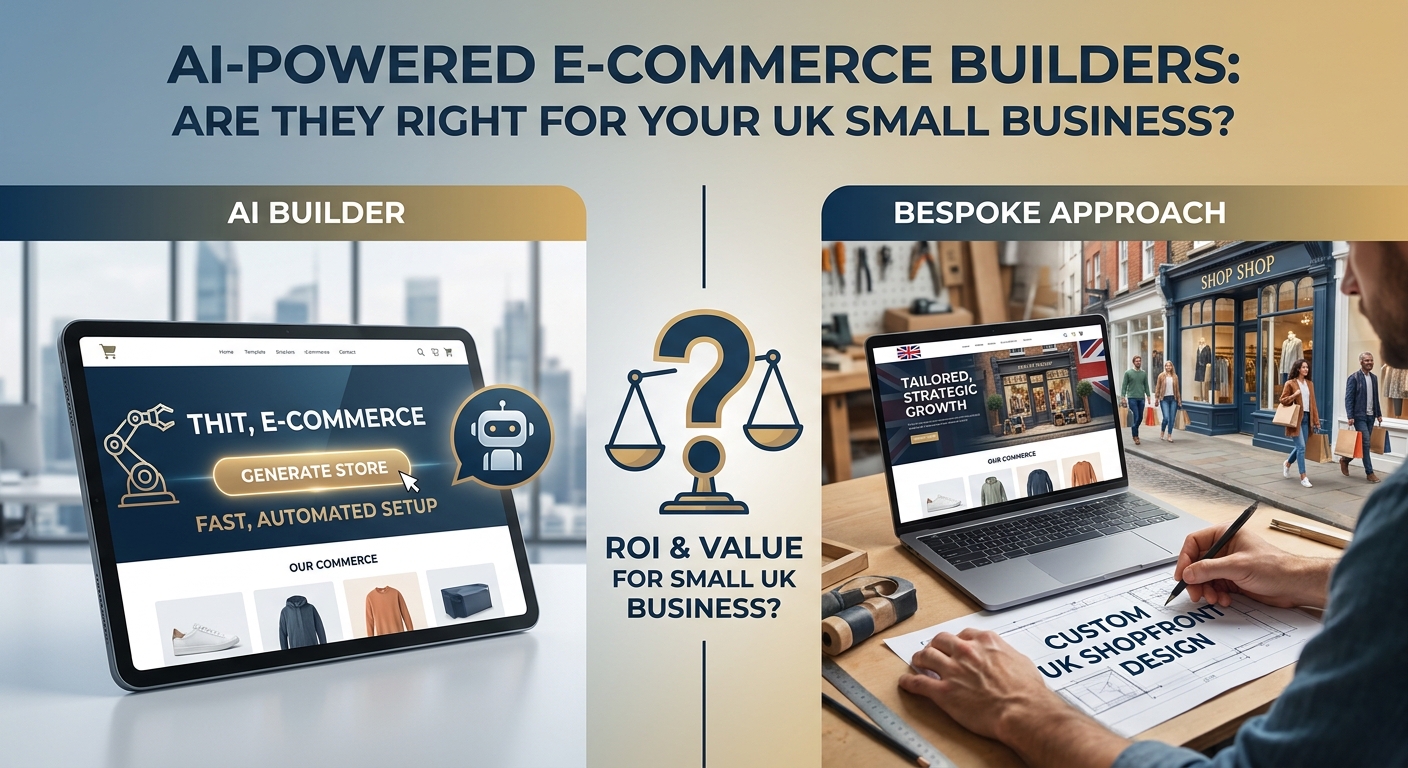
It is hard to ignore the noise around AI website builders right now. Tools like Shopify, Wix, and Hostinger all claim you can describe your business in plain English and have a working online shop up and running within the hour. For a busy plumber in Brighton or a gift shop owner in Worthing, that sounds genuinely appealing.
But there is a difference between a site that exists and a site that actually earns money. Before you type your first prompt, it is worth asking what you are really getting, and what you might be giving up.
What AI Builders Actually Do
Modern AI ecommerce builders use a short questionnaire or a text prompt to generate a store layout, suggest a colour scheme, write placeholder copy, and sometimes even recommend a product catalogue structure. Hostinger, for instance, has been widely noted for offering this at a genuinely low price point, making it attractive for businesses with tight budgets.
The output is faster than it used to be. You are not staring at a blank template any more. The AI fills in the gaps, which removes the initial paralysis a lot of small business owners feel when they first try to build a site themselves.
What the AI is really doing, though, is making educated guesses based on your industry category. It has no idea that your customers are mostly local, that you operate Tuesday to Saturday only, or that your most profitable line is a niche product your competitors do not stock. That context still has to come from a human.
The Real Costs of a DIY AI Store
The monthly subscription looks affordable on the surface. Hostinger plans sit at the lower end of the market, and even Shopify's entry tier is manageable for most small businesses. But the full picture includes more than the licence fee.
- Transaction fees on some platforms add up quickly once you move real volume.
- Premium templates, additional app integrations, and advanced analytics often sit behind paywalls.
- Time spent tweaking an AI-generated layout that is almost right, but not quite, is still time you are not spending on your actual business.
- SEO defaults on AI builders are usually generic. Ranking for local searches in the UK takes deliberate work that a prompt cannot do automatically.
A small retailer who spends three months wrestling with a Wix AI store that converts at 0.8% would likely have been better served by a properly built site from the start, even if the upfront cost felt higher.
Where AI Builders Genuinely Shine
It is only fair to say there are real use cases where these tools make sense. They are not universally wrong for small businesses, just often oversold.
- Testing a new product idea: If you want to validate whether there is demand before committing fully, a quickly spun-up Shopify or Wix store can answer that question cheaply.
- Very limited catalogues: A sole trader selling one or two digital products or a small range of handmade goods does not need a complex bespoke build.
- Short-term event or pop-up trading: A temporary online presence for a seasonal campaign is a reasonable fit for a low-cost AI builder.
- Budget genuinely not available yet: Something is usually better than nothing while you save for a proper build, provided you go in with realistic expectations.
The key word in all of those cases is temporary or simple. For a business with serious growth ambitions, these are starting points, not destinations.
The Bespoke Argument: What You Actually Get
A bespoke ecommerce site built by a professional agency is not just about aesthetics. It is about the decisions made before a single page goes live: the site structure, the conversion flow, the hosting environment, the local SEO groundwork, and the way your checkout is set up to reduce abandoned baskets.
AI builders make the same structural decisions for every business in your category. A bespoke build starts from your customers, your margins, and your specific goals. That difference shows up in conversion rates, search rankings, and ultimately in revenue.
Speed of launch matters, but speed of earning matters more. A site that takes six weeks to build properly and converts at 3% will outperform one that went live in an afternoon at 0.9% for every single month it is running.
Questions to Ask Before You Decide
There is no single right answer for every UK small business, but these questions will help you work out which route actually fits your situation.
- How many products or services will you be selling, and will that number grow significantly in the next two years?
- Is most of your customer base local, and do you need to rank for location-specific searches?
- Do you have a recognisable brand, or does your design need to do some heavy lifting to build trust?
- Are you planning to run paid advertising through Google or Meta? If so, your landing pages need to be built with conversion in mind, not just speed.
- Will you need custom integrations with booking systems, trade pricing, or stock management tools?
If you answered yes to most of those, a DIY AI builder is likely to create friction rather than remove it.
The Bottom Line for UK Traders
AI ecommerce builders are genuinely useful tools in the right circumstances. They have lowered the barrier to entry, and for simple use cases, they do what they promise. Hostinger in particular offers solid value at its price point for someone who needs a basic online presence quickly.
But for a small UK business that wants its website to be a serious sales channel rather than a digital business card, the template-and-prompt approach has real limits. The AI does not know your customers, your local market, or your margins. A good web designer does, because they ask.
If you are not sure which approach fits where your business is right now, it is worth having an honest conversation with a web design team that works with small UK businesses day to day. Sometimes the answer really is to start simple and grow into something better. Sometimes bespoke from the start saves you a year of frustration. The right advice depends entirely on your specific situation.


